Low-Cost Housing Alternatives: How Options, Costs and Trade-Offs Differ
Low-cost housing alternatives include shared rooms, extended hostel stays, vehicle-based living, house sitting, live-in jobs and subsidised housing. They reduce or restructure accommodation payments in different ways; compare total costs over the same period alongside lawful access, privacy, stability and eligibility, because no single option is always the cheapest or most suitable.
At-a-glance comparison
Compare two housing options
Select any two arrangements to compare how costs change, where expenses can reappear and which living conditions to verify. This is a qualitative guide, not a price quote or a universal ranking.
These are the same option. Choose a different second option to compare two arrangements.
Shared housing and room rentals
How the payment changes
A room or shared household payment replaces the cost of an entire dwelling.
Other costs to check
Utilities, internet, transport or storage where not included.
Access and living conditions
Household rules, lease conditions, shared amenities and privacy.
House sitting
How the payment changes
Accommodation may be exchanged for agreed property or pet-care duties.
Other costs to check
Travel, fees where applicable, and paid accommodation during gaps between sits.
Access and living conditions
Screening, duties, confirmed dates and continuity between placements.
Compare on equal terms: add the actual accommodation charge and other costs for your intended stay, then assess privacy, continuity, duties and access separately. A lower rent payment does not necessarily mean a lower total burden.
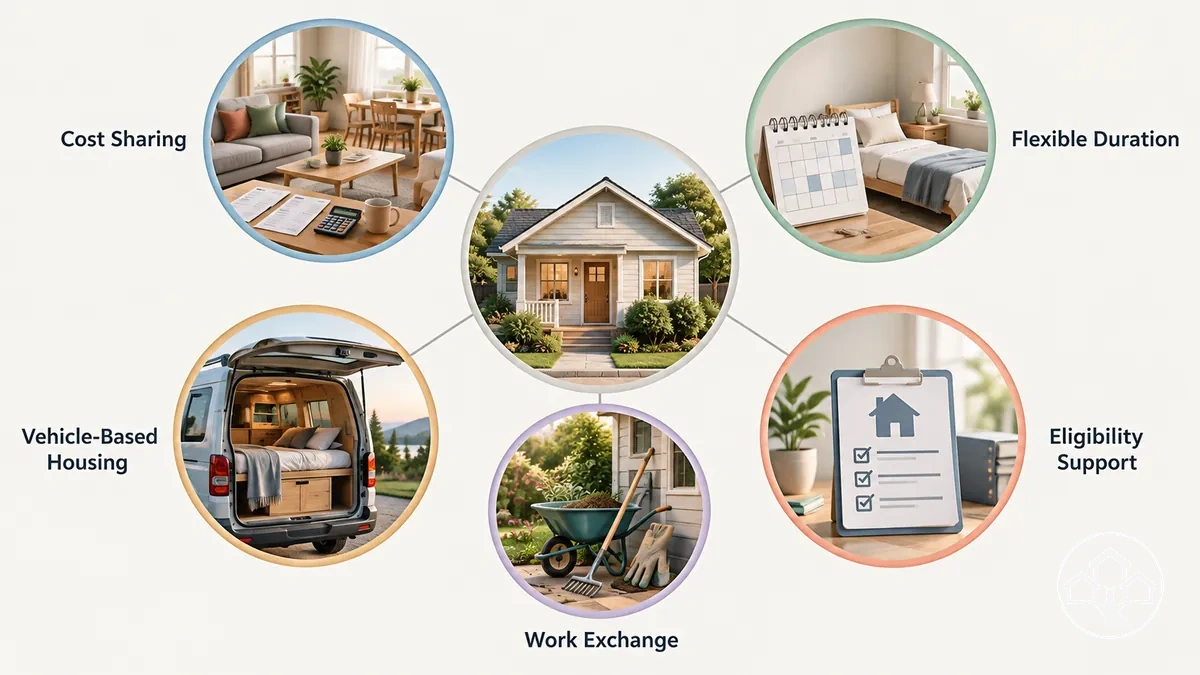
Lower accommodation payments can come from cost sharing, a different stay length, work or care duties, vehicle-based living, or eligibility-based support. Each mechanism changes which expenses you pay directly and which obligations remain.
Before deciding, check included bills and services, transport needs, local rules, responsibilities, availability and the likely continuity of your stay. These conditions determine whether an option works for your location and intended duration.
Table of Contents⌄
What Makes a Housing Alternative Low-Cost
A low-cost housing alternative is an arrangement that can reduce the total housing burden compared with a conventional rental or ownership situation by changing the payment structure, space, sharing, duration, responsibilities, eligibility, or the way accommodation is provided.
The defining condition is the overall burden of the arrangement rather than its headline accommodation cost alone.
A lower headline rent or accommodation cost does not necessarily mean lower total housing cost.
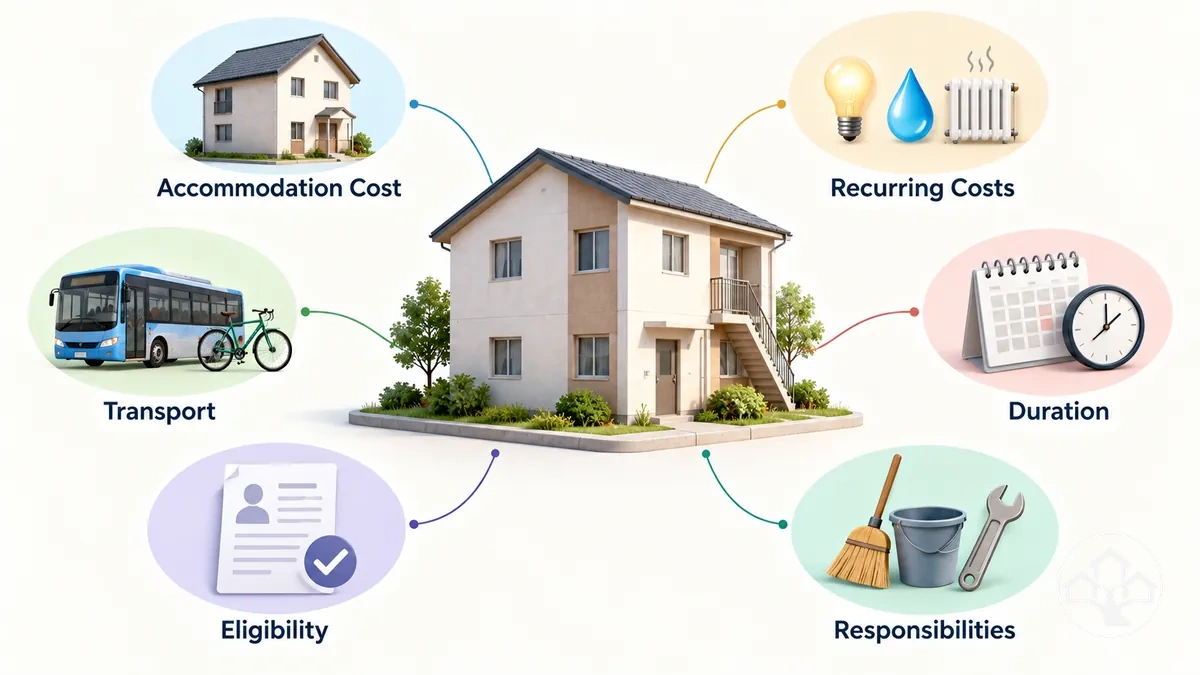
Recurring costs such as utilities, transport and fees can remain separate, while some arrangements shift costs into longer travel, shared facilities, eligibility conditions or responsibilities attached to the accommodation.
The practical cost therefore includes direct payments, recurring charges and shifted expenses over the same period. Time commitments, reduced privacy and uncertain continuity should also be assessed as suitability conditions rather than treated as zero-cost benefits.
The illustration below separates direct accommodation cost from other recurring or shifted obligations and the practical conditions that can affect the total housing burden.
A housing option can qualify as low-cost in one situation but not another when location, duration, access, eligibility, availability or required responsibilities change its total burden.
When the underlying problem is unaffordable rent, the relevant housing alternatives need to be assessed under the person's actual circumstances rather than by headline accommodation cost alone.
How the Main Low-Cost Housing Alternatives Work
Low-cost housing alternatives work through different cost-reduction or cost-shifting mechanisms rather than one common model.
Some reduce direct accommodation payments through cost-sharing or support, while others substitute money with different constraints, responsibilities, mobility costs or reduced stability.
Cost-sharing divides rent, utilities or common-space costs; shorter or different tenure changes the duration and commitment attached to accommodation; and vehicle-based housing substitutes a vehicle and its operating requirements for a conventional dwelling.
Work exchange can trade labour or responsibilities for some or all accommodation, while eligibility-based assistance can reduce direct housing costs when access requirements are met.
The diagram below groups these mechanisms by how they change housing costs or obligations rather than by individual housing type.
The practical effect of each mechanism depends on how accommodation is obtained, which costs are reduced or shifted, and what changes in privacy, stability and flexibility.
Availability may also be limited by location, duration, eligibility, parking or mobility requirements, or the responsibilities attached to the arrangement.
Shared Housing and Room Rentals
Shared housing and room rentals can lower an individual's housing burden by dividing rent, utilities or common-space costs among occupants, or by renting a private room instead of an entire dwelling.
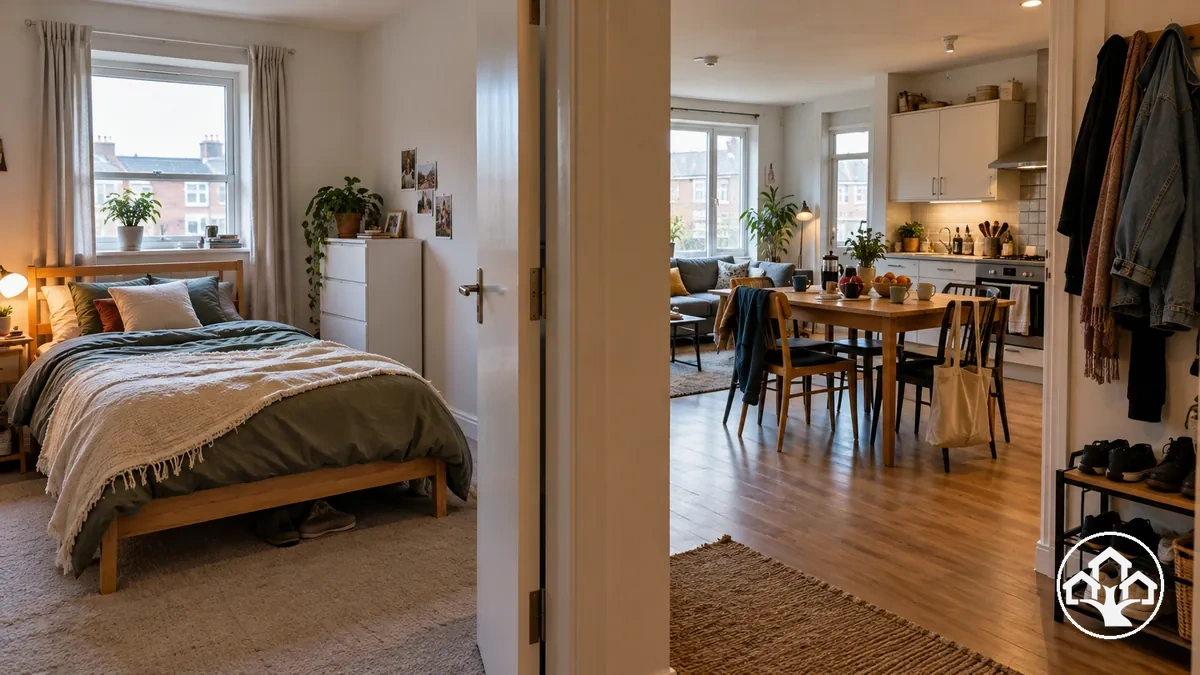
A private room provides personal sleeping space while kitchens, living areas or other facilities may remain shared.
The image below shows the typical relationship between private space and shared space that shapes both cost sharing and privacy.
Renting a private room in a shared dwelling can reduce the amount one person pays toward rent and utilities compared with renting an entire apartment, while also providing less exclusive space and creating more shared household responsibilities.
Bill sharing may cover utilities or other household costs, although what is included depends on the tenancy conditions and the specific arrangement.
Privacy and stability can depend on household rules, lease terms, the number of occupants and location.
These conditions determine whether the lower individual payment is accompanied by acceptable shared-space obligations and tenancy stability.
Long-Term Hostel Stays
Long-term hostel stays are bed- or room-based shared accommodation used beyond a short tourist stay, without a universal duration threshold for what counts as long-term.
The accommodation may involve a dormitory bed or private room alongside shared facilities, and the balance between sleeping space and communal areas affects privacy and day-to-day practicality.
The image below shows how sleeping space and shared facilities can coexist in an extended hostel stay without implying a fixed cost or stay limit.
Check the hostel’s rate for the entire intended stay, the included facilities, any stay limit and likely availability rather than assuming a long booking will remain inexpensive.
Vehicle-Based Housing
Vehicle-based housing uses a car, van or motorhome (RV) to provide part or all of the housing function. It may reduce conventional rent while shifting some of the housing burden to vehicle access, running costs, mobility and location-related constraints.
Lower rent alone does not establish lower total cost because operating costs, maintenance, insurance, parking, and access to lawful places to stay still affect the arrangement.
The illustration below shows how vehicle size can change sleeping space and mobility while each option retains operating and location constraints.
A smaller car may involve less usable sleeping space but can be easier to manoeuvre and park, while a larger van or RV may provide more interior space or facilities and can add operating, maintenance, or parking constraints.
Vehicle-based housing also depends on access to lawful places to stay, because parking or camping rules and availability differ by location.
Sanitation, water, power, and other daily facilities may be available inside some vehicles or may need to be accessed elsewhere, depending on the vehicle and setting.
Insurance and other vehicle expenses can further shift costs away from conventional housing payments rather than eliminate them.
These conditions define the practical housing implications without determining which vehicle to use or how to prepare it for living.
House Sitting
House sitting is temporary accommodation obtained in exchange for agreed responsibilities such as property care, pet care, or both during the property owner's absence.
The arrangement may reduce direct accommodation payments, but the exchange depends on fulfilling the agreed responsibilities rather than receiving accommodation without conditions.
Before accepting a placement, confirm the care duties, exact dates, fees and plan for any gap before the next stay.
Live-In Jobs With Accommodation
Live-in jobs with accommodation are employment arrangements in which housing is included, subsidised, or provided under work-related terms that may involve a pay deduction.
The arrangement can reduce a separate rent payment while increasing dependence on job continuity because accommodation is tied to employment and its specific occupancy conditions.
Compare the total pay and accommodation deductions as well as the written conditions for remaining in the housing if the job changes or ends.
Subsidised Housing
Subsidised housing is an eligibility-based affordability pathway in which government, community, or program support reduces a household's housing contribution.
The mechanism changes housing cost through assistance rather than by requiring an unconventional dwelling or living arrangement.
Check the specific program’s current entry requirements, household contribution, availability and ongoing conditions before treating assistance as an accessible housing option.
How Monthly Costs Differ Across Low-Cost Housing Options
Monthly housing costs differ because each arrangement reduces, includes, shares, or shifts different recurring expenses rather than following one universal cheapest pattern.
A useful comparison separates the base accommodation cost from recurring services and arrangement-specific costs shifted elsewhere, while actual totals vary with location, duration, included services, eligibility, transport needs, and personal use.
The base accommodation cost is the direct payment for the room, bed, dwelling, site, or work-linked accommodation where applicable.
For a like-for-like comparison, put charges on the same time basis. A continuously charged weekly rate has an average monthly equivalent of weekly rate × 52 ÷ 12 if the rate applies for all 52 weeks; a nightly rate should be multiplied by the nights actually booked in the comparison month. Add separately billed services and travel, including expenses created by gaps between stays.
Other recurring expenses can include utilities, separately charged services, laundry, storage, transport, insurance, maintenance, parking, and fees, but each category applies only where the arrangement creates that expense.
Vehicle-based housing can shift part of the monthly housing outlay into fuel, maintenance, insurance, and parking, while house sitting can shift costs toward travel, gaps between placements, or applicable fees.
The table distinguishes recurring costs from expenses shifted elsewhere rather than giving fixed prices. Compare actual quotes for the same location, stay duration and included services before drawing a cost conclusion.
Option
Base accommodation cost
Other recurring costs
Costs shifted elsewhere
Conditions that change the total
Shared housing and room rentals
Shared rent or a private-room payment rather than the cost of an entire dwelling.
Utilities, internet, laundry, or household fees when not included.
Transport or storage may increase where location or personal space is more limited.
Number of occupants, included services, tenancy terms, room type, and location.
Long-term hostel stays
Nightly, weekly, or monthly accommodation charge.
Laundry, food, storage, or services that are not included in the charge.
Repeated short-period charges or separate storage and transport costs can add to the total.
Stay length, room type, included services, stay limits, availability, and location.
Vehicle-based housing
Conventional rent may be reduced or replaced, while parking, camping, or site charges may apply.
Fuel, insurance, maintenance, parking, sanitation access, and utility-related expenses.
Housing expenditure shifts toward vehicle access or ownership, mobility, upkeep, and lawful places to stay.
Vehicle type, distance driven, location, parking or camping conditions, and personal use.
House sitting
A separate rent payment may not apply during an individual placement because accommodation is exchanged for agreed responsibilities.
Travel, applicable platform or service fees, and other expenses not covered by the arrangement.
Gaps between placements can create temporary accommodation and additional travel costs.
Availability, duration, duties, screening, location, and continuity between placements.
Live-in jobs with accommodation
Accommodation may be included, subsidised, or reflected through a pay deduction under employment terms.
Utilities, services, transport, or other charges where they are not included.
Housing cost can become more dependent on employment continuity and workplace location.
Job duration, occupancy conditions, site rules, location, accommodation terms, and what happens when employment ends.
Subsidised housing
Household housing contribution is reduced according to the applicable support and eligibility rules.
Utilities, service charges, or other recurring costs not covered by the program.
Costs are reduced through assistance rather than shifted into another housing mechanism.
Eligibility, contribution rules, availability, waiting period, location, and occupancy conditions.
Keep one-off setup costs—such as deposits, vehicle purchase costs, equipment or initial moving expenses—separate from recurring monthly expenses. If you choose to spread an upfront cost across a budget, divide it by the number of months you expect to use the arrangement and make that assumption explicit; a refundable deposit is not automatically a permanent expense.
Location, duration, eligibility, included services, transport needs, and personal use can change the total monthly cost within the same housing category.
Comparing these categories on the same basis shows whether a lower base accommodation cost is accompanied by other recurring expenses or costs shifted elsewhere.
The Main Trade-Offs Behind Lower Housing Costs
Lower housing costs often change non-price attributes such as privacy, space, stability, flexibility, location access, responsibilities, eligibility, or availability.
These housing trade-offs affect practical fit differently depending on the person's duration, daily needs, and living requirements, so a lower payment does not by itself determine suitability.
Living-condition differences include how much private space is available, whether amenities are shared, and how easily essential daily needs can be met.
Continuity and flexibility depend on factors such as stay duration, placement or job continuity, occupancy conditions, and availability.
Location access can change transport requirements, while responsibilities or eligibility can determine whether an arrangement remains accessible.
The comparison below organizes these non-price consequences consistently without ranking the options.
Option
Privacy and space
Stability and flexibility
Responsibilities or eligibility
Practical implication
Shared housing and room rentals
Private sleeping space may be combined with shared kitchens, bathrooms, or living areas.
Stability depends on tenancy terms and household continuity, while commitment length can vary by arrangement.
Household rules and shared responsibilities may apply.
Practical fit depends on tolerance for shared space, household conditions, location access, and available amenities.
Long-term hostel stays
Sleeping and communal space may be shared, although some properties may offer private rooms.
Shorter commitments may provide flexibility, while stay limits or changing availability can reduce continuity.
Property rules and occupancy conditions apply rather than an eligibility-based access model.
Practical fit depends on required privacy, duration, facility access, and whether availability remains suitable over the intended stay.
Vehicle-based housing
Usable living and sleeping space depends on vehicle type, with larger vehicles potentially providing more interior space.
Mobility can provide location flexibility, while lawful places to stay, parking conditions, and vehicle reliability can affect continuity.
Access depends on vehicle-related requirements and applicable parking or camping conditions rather than housing-program eligibility.
Practical fit depends on space needs, mobility requirements, sanitation and utility access, location, and lawful use.
House sitting
Private use of a property may be available during an individual placement, subject to the agreed arrangement.
Individual stays are temporary, and gaps between placements can reduce continuity even when scheduling flexibility is useful.
Property care, pet care, screening, or other agreed responsibilities may apply.
Practical fit depends on availability, duration, required duties, travel between placements, and tolerance for gaps.
Live-in jobs with accommodation
Space and amenities depend on the accommodation attached to the employment arrangement.
Housing continuity may depend on job duration and what the accommodation terms provide when employment ends.
Occupancy conditions, site rules, and continued employment may determine access.
Practical fit depends on whether work dependency, location, accommodation conditions, and reduced housing flexibility match the person's needs.
Subsidised housing
Privacy, space, and amenities depend on the housing available through the applicable program.
Stability depends on program and occupancy conditions, while initial access can be limited by availability or a waiting period.
Eligibility and continued compliance with applicable conditions determine access.
Practical fit depends on eligibility, availability, location, occupancy conditions, and whether the available housing meets daily needs.
The importance of each trade-off changes with personal requirements and duration: for example, reduced privacy may be manageable for a short stay but less suitable when private space is needed consistently over a longer period.
Affordability should therefore be considered alongside stability, flexibility, location access, responsibilities, amenities, eligibility, availability, legality, safety, and essential daily needs without turning these attributes into a universal ranking.
How Temporary and Longer-Term Housing Alternatives Differ
Temporary and longer-term housing alternatives differ mainly in duration-related commitment, flexibility, continuity, recurring cost structure, and stability rather than by one fixed universal time cutoff.
The practical distinction depends on the stay rules, contract terms, availability, and expected length of use attached to the arrangement.
Temporary arrangements may involve shorter commitments and greater flexibility to change location, but more frequent moves can reduce continuity and address stability.
Longer-term arrangements may reduce move frequency and provide more predictable continuity when tenure or occupancy conditions remain available, although they can require greater commitment.
Recurring cost patterns can also change with duration because included services, repeated short-stay charges, transport needs, or longer-term obligations differ between arrangements.
The comparison below applies the same criteria to both duration categories without treating either as inherently superior.
Dimension
Temporary arrangements
Longer-term arrangements
Why it matters
Commitment
May use shorter stay periods, flexible booking terms, or temporary occupancy conditions.
May involve longer tenancy, employment, program, or occupancy commitments.
The required commitment affects how easily the arrangement can be changed when circumstances shift.
Flexibility
Can allow easier changes of location or accommodation when short stays are available.
Can provide less frequent change but may involve more restrictions on ending or altering the arrangement.
Flexibility matters when work, travel, care responsibilities, or other circumstances may change during the expected stay.
Recurring cost pattern
May include repeated short-stay charges, transport, laundry, storage, or services that would otherwise be bundled into a longer arrangement.
May spread some recurring costs across a longer stay, but utilities, fees, transport, or other obligations can still remain separate.
Duration changes how recurring expenses accumulate even when the base accommodation arrangement appears similar.
Move frequency or continuity
May involve more frequent moves or gaps between placements when availability changes.
May reduce move frequency when the arrangement remains available for the intended duration.
Continuity affects disruption, planning effort, transport between stays, and the ability to maintain a consistent living arrangement.
Privacy and address stability
Privacy and address stability may change more often when rooms, hosts, properties, or locations change between stays.
Privacy and address stability may be more consistent when occupancy terms and location remain unchanged.
A stable address or consistent private space can matter for work, services, administration, and daily routines.
Availability
Access may depend on short-notice vacancies, placement timing, seasonal demand, or temporary stay rules.
Access may depend on longer-term vacancies, contract conditions, eligibility, or continued occupancy rights.
Availability determines whether the preferred duration can be maintained in the required location and under the applicable conditions.
The same housing type can function as temporary accommodation in one situation and as a longer-term arrangement in another because contract terms, local rules, availability, and expected duration can change how it operates.
Practical fit therefore depends on whether the arrangement's commitment, recurring cost, continuity, flexibility, address stability, and availability remain suitable for the intended stay rather than on a universal duration label.