
Scenario: seasonal utility increase
In a plausible higher-usage season, a utility bill can exceed the expected case. A contingency may help cover the difference only if the higher amount is not already in the variable-cost range.
Budget the full monthly cost of an alternative housing arrangement by adding the base payment, separate fixed charges, realistic variable costs, monthly allowances for annual and foreseeable irregular expenses, and contingency for uncertainty not already covered. Keep upfront cash separate; spread applicable non-refundable one-off costs over the expected stay only when comparing options, and do not treat a refundable bond as a monthly expense.
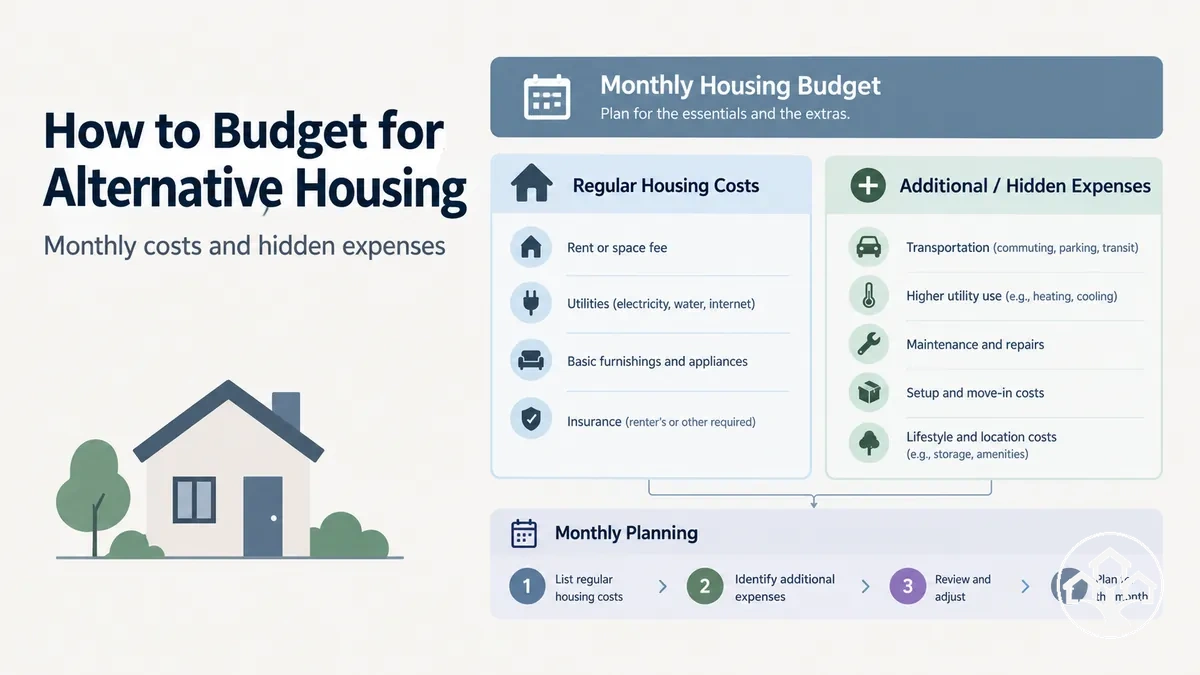
Monthly housing budget
Calculate the full cost, not just the advertised payment
Enter costs that actually apply to the housing arrangement. The estimate separates the ongoing monthly requirement, a like-for-like comparison amount, and cash needed for listed entry costs. Enter all monetary values in one currency; results show a $ sign without converting currencies. No prices are assumed.
How the estimate works: Ongoing monthly requirement = base payment + other fixed costs + expected variable costs + monthly reserves + contingency + annual bills ÷ 12. For comparison only, add non-refundable one-off costs ÷ expected stay in months. Listed entry cash is the entered setup costs plus refundable deposits; it excludes advance recurring payments or other entry charges not entered here. The result is a planning estimate, not a guaranteed bill or a complete affordability assessment.
Location, usage, provider terms and expected length of stay change which costs apply. A more remote location can add transport expense; limited space can require storage; utilities, service fees and maintenance depend on the arrangement and who pays for them.
The same one-off non-refundable amount has a larger monthly equivalent over a shorter stay and a smaller equivalent over a longer stay. A refundable bond still requires cash at entry, but its eventual recovery depends on the agreement and any applicable deductions.
Before comparing options, use the same housing-cost boundary and monthly time basis for every arrangement so ordinary personal spending is not counted against one option but excluded from another.
An expense belongs in the housing budget when the housing arrangement directly requires it or materially creates or changes it.
A direct housing charge is included because occupancy depends on paying it, while ordinary personal spending that would remain substantially unchanged is excluded.
For a borderline expense, the inclusion test is whether the housing arrangement creates a meaningful additional cost rather than whether the expense is part of everyday life.
This keeps housing cost separate from general living cost.
Apply the same housing-budget boundary to every expense by checking its connection to the housing arrangement before deciding on inclusion.
The diagram makes that boundary visible by separating housing-linked costs from unrelated personal spending.
 Direct housing charges and required services have the strongest connection, while arrangement-created transport, storage, compulsory fees, and reserves require a specific condition linking them to the housing arrangement.
The criteria below apply that test from the strongest direct connection to the weakest borderline connection.
For example, ordinary commuting remains a general living cost when the housing arrangement does not materially change it, but extra transport caused by a more remote location can qualify as housing cost to the extent of that added expense.
Likewise, existing personal storage spending remains outside the housing budget if it is unchanged, while storage newly required because the arrangement lacks sufficient space can be included.
Within low-cost housing alternatives, use the same boundary for every later calculation so each inclusion decision remains consistent.
Housing-cost timing determines whether an expense is treated as an upfront cost or an ongoing cost.
Upfront costs are paid before or at entry, while ongoing costs recur during occupancy; the timeline organizes these costs by when they occur.
 This timing distinction separates the cash required at entry from costs that continue after occupancy begins.
Ongoing expenses can then be classified by their stability or billing frequency.
An ongoing cost is classified by how its amount and billing frequency behave during the budgeting period, not by the expense name alone.
A recurring cost may be fixed when its amount is stable for the relevant period, variable when usage changes the amount, or irregular when it recurs without a consistent monthly schedule.
Contract terms or billing methods can therefore place similarly named expenses in different timing categories.
For example, a connection fee charged once when a service starts is an upfront one-time cost, while a service charge billed repeatedly during occupancy is an ongoing cost.
Keeping that timing distinction explicit prevents entry cash requirements from being mixed with recurring monthly costs in later budgeting.
An upfront setup cost or transition cost is a one-time or front-loaded amount that must be funded before an alternative housing arrangement can operate as planned.
These costs create an initial cash requirement separate from the later recurring budget, even when the advertised monthly payment is relatively low.
Whether a particular deposit, bond, setup cost, or item applies depends on the arrangement and its contract or provider terms.
The main upfront costs can be grouped by the event that triggers the initial outlay, such as entering the arrangement, activating a service, relocating, or obtaining required initial equipment.
A refundable bond is cash required at entry, but it is not automatically a housing expense: record it separately from any non-refundable fee. For a monthly comparison, allocate relevant non-refundable setup costs over the expected stay, while treating any possible bond deduction according to the applicable terms.
For example, an arrangement with a low monthly payment can still require a larger initial outlay when a deposit, service connection, relocation, and required setup items are due at the start.
Those cash-at-entry needs should be budgeted separately from the recurring costs that begin after occupancy or use starts.
A fixed recurring housing cost is a recurring charge that follows a known billing schedule and remains a relatively stable amount during the relevant budget period.
A calendar view can show how these predictable payments repeat over time while allowing for a later renewal or rate review.
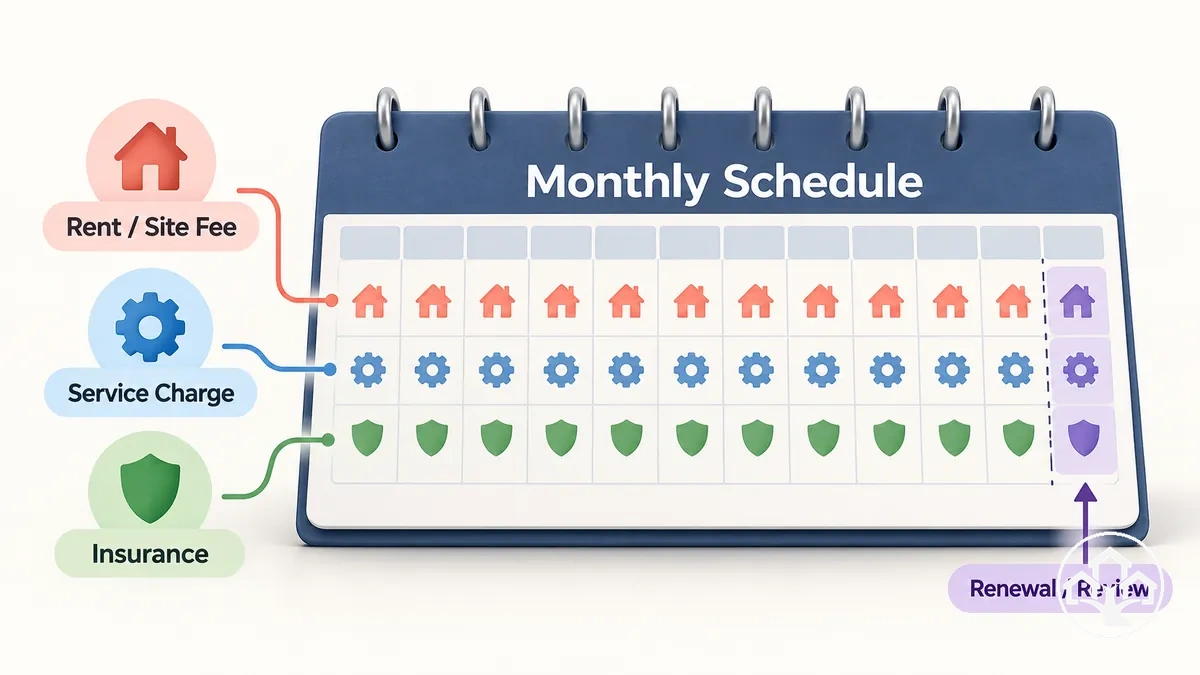 Fixed does not mean unchangeable; it means the amount or schedule is comparatively stable for the period being budgeted.
The following cost classes are grouped by that predictable recurrence and the condition that could change the charge.
Rent, a site fee, a service charge, an insurance premium, or another obligation belongs in this category only when its actual billing terms make the payment relatively predictable.
The housing budget should record the current stable amount and billing schedule rather than assuming the expense category is fixed in every arrangement.
If a renewal, rate review, or contract change is already known, record that review point so the budget can be updated when the current amount stops applying.
This treats stability as a condition of the present budget period rather than as permanence.
A variable recurring housing cost is a recurring expense whose amount changes with an observable condition such as usage, distance, season, or occupancy.
The image connects these costs to the conditions that create monthly variation.
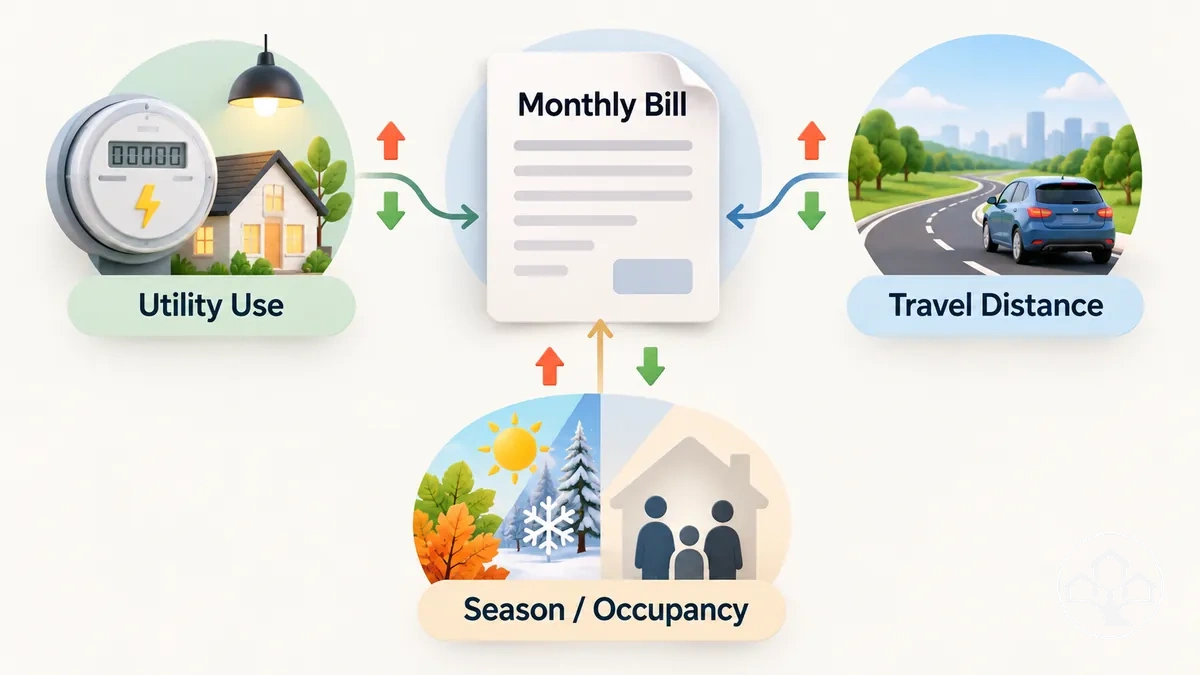 An expense is variable when a specific cost driver changes the amount charged, rather than because the expense category is inherently variable.
The bullets below group recurring expenses by the condition that can move their monthly amount up or down.
The monthly implication of a variable cost follows the driver that changes the charge.
Greater usage can increase a consumption-based bill when the tariff links usage to cost, while greater travel distance can increase transport spending when it requires more fuel or fares.
Seasonal or occupancy changes affect the amount only when the relevant service or billing arrangement responds to those conditions.
One unusually low month should not be treated as the expected baseline unless its usage, distance, season, and occupancy conditions are representative.
Variability should therefore be identified from the actual cost driver and billing method rather than assumed from the expense name.
Before assigning a housing expense to the budget, check whether the charge applies, who must pay it, how much it costs and when it is due. The advertised payment alone may not show separately billed services, entry charges, renewals or responsibility for repairs.
Use the current agreement, provider schedule, invoice or relevant policy terms to record known charges. For usage-sensitive costs, use a realistic planning estimate based on expected consumption, occupancy, season or travel rather than presenting one unusually low month as typical.
A confirmed annual charge can be converted to its monthly equivalent. An unresolved variable charge should remain an estimate with stated assumptions, while a disputed or unclear contractual charge should be checked with the responsible provider rather than assigned a fabricated value.
Recheck the record when a contract renews, rates change, occupancy changes or the planned length of stay shifts. This keeps the housing-cost calculation responsive to real terms without turning uncertainty into a false guarantee.
A housing-related service cost can be included in the base payment, separately billed, usage-based, shared among occupants, or replaced by another paid service when the original service is unavailable.
Utilities such as electricity or power, water, and gas where relevant can therefore enter the monthly budget differently from one arrangement to another.
Connectivity can likewise involve included internet, a separate internet charge, or mobile data used as a replacement service.
The table organizes each applicable service by its billing basis, inclusion status, variability, and resulting budget implication.
| Service | Billing basis | Included or separate | Variability | Budget implication |
|---|---|---|---|---|
| Electricity or power | Flat charge, metered usage, or shared allocation | May be included or separately billed | Stable when flat; usage-based when consumption determines the charge | Record a separate monthly amount only when the base payment does not fully cover the service |
| Water | Included charge, metered usage, or shared allocation | May be included or separately billed | Stable when bundled or flat; usage-based when metered; shared when allocated among occupants | Include the applicable charge according to the actual billing method rather than assuming a separate utility bill |
| Gas where relevant | Flat charge, metered usage, or arrangement-specific billing | May be included, separate, or unavailable | Stable when flat; usage-based when consumption determines the charge | Budget it only when the arrangement uses gas and the occupant is responsible for the charge |
| Internet or mobile data | Bundled service, separate plan, or replacement connectivity service | May be included or separately billed | Stable when the plan fee is fixed; variable when usage-based charging changes the amount | Record the service actually required for connectivity, including mobile data when it replaces unavailable internet |
| Laundry | Included facility, per-use charge, or shared service fee | May be included or separate | Variable when charged per use; stable when bundled or charged as a fixed service fee | Add the charge when the arrangement requires paid laundry or a shared-facility fee |
| Waste or other shared service | Included fee, scheduled service charge, or shared allocation | May be included or separately billed | Stable when charged as a fixed fee; variable when usage or allocation changes the amount | Include the service cost when the arrangement makes the occupant responsible for all or part of it |
Billing basis and inclusion status determine whether a service adds a separate amount to the monthly housing budget.
A higher base housing payment can sometimes include utilities, connectivity, or shared services that would otherwise appear as separate charges, so the headline payment alone does not show the service-cost difference.
Conversely, a lower base payment may require additional separately billed services, but only the services that actually apply to the arrangement should be counted.
Record both the service and how it is charged so the monthly total reflects the actual inclusion, sharing, and usage conditions.
A lower base housing payment can still create additional transport cost or storage cost when the housing arrangement changes location, distance, or available space.
A more distant location may require additional travel, while limited space may create a storage need that did not exist under another arrangement.
These expenses belong in the housing budget when they are created or materially changed by the arrangement rather than being ordinary spending that would occur anyway.
The conditions below link housing location and space constraints to the additional mobility or storage spending they can create.
The monthly implication depends on the specific condition created by the housing arrangement rather than on the housing type alone.
Greater distance can increase fuel or fares when it causes additional travel, while parking or an access charge adds cost only when that charge applies to the location or route being used.
A storage need adds to the budget when limited space requires paid storage, and higher relocation frequency can create repeated mobility or storage expenses that would not occur under a more stable arrangement.
These costs should therefore be recorded according to the actual distance, access conditions, space constraint, and relocation pattern that the arrangement creates.
For example, an arrangement with a lower base housing payment may still produce a higher full monthly cost than expected when its location creates extra travel and its limited space requires paid storage.
The budgeting point is the offset between the lower housing payment and the additional transport or storage expense, without extending the calculation into broader vehicle-living or moving requirements.
A required insurance or fee belongs in the housing budget only when the arrangement, contract terms, provider, vehicle, site, or applicable jurisdiction makes the charge relevant.
An insurance premium, required fee, site fee, service fee, administrative charge, permit, or registration should therefore be treated as a committed cost only after its applicability is verified.
Billing frequency also matters because some charges recur while others apply once or at a specific renewal or registration point.
The categories below separate required commitments from optional protection and identify how each charge enters the budget.
The distinction between a required cost and an optional protection depends on the current conditions that make the charge applicable.
A recurring insurance premium or compulsory service charge affects the ongoing budget, while a one-time administrative charge, permit, or registration may need to be allocated separately when the monthly estimate is normalized later.
Policy wording, provider terms, site rules, vehicle or property characteristics, and jurisdiction can change both applicability and billing frequency, so the same charge should not be assumed across all housing alternatives.
Verify the current contract terms, policy terms, provider requirements, and applicable rules before treating any amount as a committed housing cost.
A maintenance reserve covers housing-related maintenance, repair, or replacement costs that are irregular but foreseeable enough to include in the budget when the user is responsible for them.
These irregular costs do not disappear merely because they are not charged every month.
The relevant asset or component, the trigger or frequency of the expense, and the responsibility assigned by the arrangement or contract terms determine whether a reserve is appropriate.
The table connects responsibility and timing to the monthly allowance without assuming that every asset is the user's responsibility.
| Cost type | Asset or component | Trigger or frequency | Responsibility condition | Monthly reserve implication |
|---|---|---|---|---|
| Routine maintenance | Housing-related equipment, vehicle component, appliance, or applicable facility | Periodic upkeep when required by the asset or arrangement | Include only when maintenance is the user's responsibility under the applicable arrangement or contract terms | Set aside a monthly allowance when a foreseeable periodic maintenance obligation applies |
| Unexpected repair | User-responsible equipment, appliance, vehicle component, or other housing-related asset | A fault, damage, or other condition that requires repair | Reserve for the cost only when the user bears the relevant repair responsibility rather than the provider or landlord | Maintain a reserve for irregular repair costs when that responsibility can create an occasional budget obligation |
| Replacement | User-responsible component, appliance, equipment, or other housing-related asset | Replacement becomes necessary when the applicable component can no longer continue in its required role | Include a replacement provision only when replacement responsibility belongs to the user | Build a monthly reserve toward the foreseeable future cost when the replacement obligation and planning basis are known |
Routine maintenance is a foreseeable upkeep obligation with irregular timing, while an unexpected repair arises when a responsible asset or component needs corrective work and eventual replacement creates a future cost when the user bears that responsibility.
If the provider or landlord is responsible for a particular maintenance, repair, or replacement obligation, that cost should not be assigned to the user's reserve.
Specific maintenance frequency, repair cost, or replacement timing should be based on information applicable to the asset and arrangement rather than assumed.
The reserve therefore follows responsibility first and timing second, not ownership by default.
For example, if an applicable annual maintenance allowance is identified, dividing that amount across 12 months converts it into a monthly reserve.
The same treatment applies only when the underlying cost is actually the user's responsibility.
The real monthly cost is calculated by combining fixed charges, a realistic variable-cost estimate based on expected use or recent bills, monthly equivalents of predictable non-monthly costs, a clearly stated treatment of relevant upfront costs, and separate contingency when justified.
Every component should use the same time basis and the same housing-cost boundary before the amounts are added together.
The result is a planning total based on stated assumptions rather than an exact or guaranteed monthly cost.
Upfront cash required at entry should remain visible even when part of it is also converted to a monthly equivalent for comparison.
Use the same calculation sequence for every housing arrangement so that each component is normalized consistently.
Record the assumption behind any estimate or allocation before adding it to the monthly housing total.
The final check is consistency: fixed charges, variable costs, monthly equivalents, upfront-cost allocations, and contingency must all follow the same assumption set and time basis.
The budget boundary must also remain unchanged so ordinary personal spending is not added to one option but excluded from another.
Keep actual cash timing distinct from normalized comparison values, especially for upfront costs.
Comparisons are valid only when every housing option uses the same time basis, cost boundary, and treatment assumptions.
A monthly equivalent converts a known annual cost or other predictable periodic expense to the same monthly time basis used by the rest of the housing budget.
Divide a known expense across the billing period it covers; for an annual cost, that means spreading it across 12 months.
For a foreseeable replacement or other irregular cost, spread the amount across the stated period during which the reserve needs to be accumulated.
The calculation is reliable only when the source amount, frequency, billing period, and assumption about timing are explicit.
For a confirmed quarterly charge that covers three months, divide that charge by 3 to obtain its monthly equivalent; do not count the same charge again under fixed monthly costs.
A known irregular cost should remain separate from contingency because the two represent different budgeting conditions.
A known expense with an identifiable amount and planning period can be allocated to a reserve, while contingency is a separate buffer for uncertainty that is not already represented by a specific known expense.
If the frequency or timing of an irregular event is too uncertain to define a defensible accumulation period, do not create an arbitrary average; record the uncertainty and keep any contingency treatment separate.
This prevents the same risk from being counted once as a reserve and again as contingency.
Monthly equivalentA ÷ 12
A is the applicable bill for a full 12-month period. The result is a planning allocation, even if the bill is paid once annually.
Monthly reserveR ÷ N
R is the expected cost and N is the number of months available to accumulate the reserve. Use a defensible period; do not assume one where timing is unknowable.
A cost range is more credible than one precise forecast when a variable expense changes with observable conditions such as season, usage, distance, or occupancy.
The low case, expected case, and higher-cost case should each correspond to a plausible condition rather than an arbitrary minimum, average, or extreme.
The comparison below uses one variable transport expense to show how an observable cost driver can change the budget implication without inventing a universal numerical range.
Each case keeps the condition and cost driver explicit so the estimate remains explainable.
| Case | Condition | Cost driver | Budget implication |
|---|---|---|---|
| Low | Necessary travel distance or trip frequency is lower than expected for the planning period | Distance and transport frequency | Represents a plausible lower transport cost, but should not become the default unless those conditions are expected to persist |
| Expected | Travel distance and frequency match the conditions reasonably expected during the planning period | Expected distance and transport frequency | Provides the planning amount when these conditions best represent normal anticipated use |
| Higher-cost | Necessary travel distance or trip frequency increases under a plausible change in circumstances | Greater distance or more frequent travel | Shows how the variable cost could rise under a credible condition and can be retained for later stress testing |
The same method can be applied to another variable cost only by changing the named cost driver: seasonal utility use should reflect season and usage, while an occupancy-sensitive service should reflect occupancy and consumption.
The direction and size of the range should therefore come from observed or expected conditions rather than from an unexplained average.
A low case should not be treated as the planning assumption merely because it is the least expensive observed condition, and a higher-cost case should remain plausible for the arrangement rather than represent an extreme event.
The expected case should be carried into the planning amount when its condition best matches the anticipated month, while the low and higher-cost cases preserve uncertainty for comparison and later stress testing.
Compare housing alternatives only after each has been converted to the same monthly basis, uses the same cost boundary, and follows the same assumptions.
The comparable monthly housing cost should consistently include the base payment, separately billed services, housing-created transport or storage, specific reserves and the monthly equivalent of applicable non-refundable upfront expenses. Keep refundable deposits visible as entry cash, not automatically as a recurring or amortised expense.
Without that standardization, a lower headline payment may reflect different inclusions or omitted housing-created costs rather than a genuinely lower monthly total.
The table aligns each alternative across identical cost fields instead of ranking overall suitability.
| Alternative | Base payment | Included services | Separate housing-created costs | Monthly equivalent of upfront costs | Reserve or contingency treatment | Comparable monthly total |
|---|---|---|---|---|---|---|
| Alternative A | Record the base payment on the common monthly basis | Record services already covered by the base payment | Include applicable separate utilities, transport or storage, insurance and fees | Allocate relevant upfront costs over the stated expected period using the same assumption as other alternatives | Include the applicable maintenance reserve and any separately justified contingency without double counting | Sum the normalized cost fields using the shared cost boundary |
| Alternative B | Record the base payment on the common monthly basis | Record services already covered by the base payment | Include applicable separate utilities, transport or storage, insurance and fees | Allocate relevant upfront costs over the stated expected period using the same assumption as other alternatives | Include the applicable maintenance reserve and any separately justified contingency without double counting | Sum the normalized cost fields using the shared cost boundary |
| Alternative C | Record the base payment on the common monthly basis | Record services already covered by the base payment | Include applicable separate utilities, transport or storage, insurance and fees | Allocate relevant upfront costs over the stated expected period using the same assumption as other alternatives | Include the applicable maintenance reserve and any separately justified contingency without double counting | Sum the normalized cost fields using the shared cost boundary |
The comparison should align the same dimensions for every alternative: base payment, included services, separate housing-created costs, transport or storage, insurance and fees, maintenance reserve, upfront-cost equivalent, and resulting monthly total.
Differences in the comparable total then reflect the inputs for each arrangement rather than a change in the calculation basis between rows.
Which alternative has a lower monthly total depends on the actual costs and assumptions entered for each case.
Cost comparison stops at that boundary; privacy, access, practical constraints, and overall fit remain separate suitability considerations.
A housing-budget contingency is a separate buffer for a plausible uncertain cost that remains after every known cost and reasonably estimable reserve has already been included.
A known irregular expense belongs in the main budget or its specific reserve when its amount and timing can be estimated well enough for planning.
Contingency covers residual uncertainty rather than replacing those known provisions.
Keeping the two separate prevents double counting and makes the purpose of the buffer explicit.
The appropriate contingency depends on the uncertainty in the arrangement rather than on one fixed percentage.
Greater cost volatility can justify a larger buffer because plausible monthly outcomes are less stable, while available savings affect how much unexpected cost can be absorbed outside the housing budget.
The potential disruption also matters: an uncertain cost that would create a material shortfall has a different planning implication from one that could be absorbed without changing essential payments.
Use the following criteria to assess how much uncertainty needs buffering rather than to prescribe a universal amount.
After choosing a contingency, stress test the budget under a plausible higher-cost month rather than an extreme scenario.
Apply the relevant higher-cost conditions, add the contingency only where the uncertainty is not already covered, and check whether the resulting monthly requirement creates a shortfall that would require an adjustment to the plan.
A failed stress test indicates that the assumptions, buffer, or available savings may need reconsideration; it does not mean that a larger contingency guarantees affordability.
Keep contingency reserved for uncertain plausible costs, while known irregular expenses remain in their own identified reserves.
An underestimated cost can create a shortfall even when the main housing-budget categories are already present because the estimate may omit an applicable charge, assume a lower price than occurs, place a payment in the wrong period, or miss a one-off event.
An omitted cost leaves a direct budget gap, while price variance can make a recorded service or utility cost exceed its planning value.
A timing surprise can concentrate an otherwise recognised expense in a higher-cost month, and a one-off event can add a housing-related cost that was not part of the base estimate.
The four categories below separate these failure modes by the reason the planned amount can be exceeded rather than by their severity.
A foreseeable irregular expense should have its own reserve when the cost and likely timing can be estimated well enough for planning.
A genuinely uncertain plausible expense belongs in contingency only when it is not already represented by a known cost, variable estimate, or reserve.
This distinction prevents the same repair, renewal, or other expense from being counted once as a reserve and again as contingency.
Where the amount or timing remains uncertain, record the source of that uncertainty rather than substituting a generic percentage.
The resulting buffer should address the identified uncertainty that could otherwise produce a shortfall.
Scenario: seasonal utility increase
In a plausible higher-usage season, a utility bill can exceed the expected case. A contingency may help cover the difference only if the higher amount is not already in the variable-cost range.
Scenario: unexpected repair
If a user-responsible housing component needs an unplanned repair that a dedicated maintenance reserve does not cover, contingency may absorb some of the cost. It does not turn every possible repair into a known expense.
A higher-cost-month stress test checks whether the budget remains workable when plausible seasonal or periodic peaks occur together rather than only during an average month.
An average-month estimate can understate the required monthly total when seasonal utilities, increased travel, a fee renewal, maintenance or repair, or a service-price change coincides in the same period.
The test should use only cost drivers already identified in the budget and should not introduce catastrophic scenarios as normal assumptions.
Its purpose is to reveal whether the available buffer absorbs a plausible peak or whether the month produces a shortfall.
Combine the relevant higher-cost conditions only when they could plausibly occur in the same month, then compare the resulting requirement with the planned monthly resources and available buffer.
A shortfall indicates that at least one assumption may need revision, such as the expected utility range, travel frequency, timing of an irregular cost, service-price assumption, reserve, or contingency.
The checklist below verifies grounded peaks, their combined effect, and which assumption would need adjustment without recalculating the contingency itself.
Passing one stress scenario does not establish that every future month will remain affordable.
The fully loaded monthly housing total should be compared with the amount actually available for housing after income and essential non-housing obligations are accounted for.
A housing total can fit only when those available monthly resources can cover it while leaving an appropriate remaining buffer for other required spending and plausible higher-cost months.
Affordability is therefore a household-specific comparison of resources, obligations, and the calculated housing cost rather than a verdict based on income alone.
The following criteria move from the available resources through household conditions to the residual buffer that remains after housing is paid.
The affordability implication depends on the relationship between income, essential obligations, the monthly housing total, and the remaining buffer.
Two households with the same income can have different amounts available for housing because their essential commitments differ, and the same base payment can produce different monthly totals when included services and separate costs differ.
Income stability also affects how confidently the available amount can be treated as recurring, while exposure to higher-cost months affects how much residual buffer may be needed.
A housing total that leaves little room after essential obligations may therefore create a shortfall under plausible cost increases even when the average month appears manageable.
For example, two households can receive the same monthly income while one has substantially higher essential non-housing obligations; the household with higher commitments will have less available for housing and a smaller remaining buffer at the same housing total.
A percentage-of-income rule can be used as a reference point, but it does not replace this household-specific affordability check because obligations, income stability, included services, and separate costs can differ.
A housing-budget mistake can make the total unreliable when an omitted cost, inconsistent time basis, weak assumption, or double counting distorts the calculation.
Using only the headline payment can hide separate housing-created expenses, while ignoring an upfront cash need can make the arrangement appear easier to fund than it is at entry.
Treating an irregular cost as zero or relying on one unusually low variable-cost estimate can also suppress the expected monthly total.
These errors arise from incomplete scope or inconsistent treatment rather than from one isolated arithmetic mistake.
The summary below maps each underestimation or accounting mechanism to its consequence, recognition cue, and corrective direction.
Each correction restores the budgeting principle that was violated without repeating the full calculation process.
| Budgeting mistake | Consequence | Recognition cue | Corrective direction |
|---|---|---|---|
| Using only the headline payment | Separate housing-created costs are omitted, producing an understated total. | The budget contains the base payment but no check for separately billed services, fees, transport, storage, or other applicable housing costs. | Apply the established housing-cost boundary and include every applicable separate cost alongside the base payment. |
| Ignoring an upfront cash need | The monthly view may look manageable while the cash required to enter the arrangement remains unfunded. | Deposits, setup charges, relocation costs, or other applicable entry expenses are absent from the cash plan. | Record the full upfront cash requirement separately and, where appropriate for comparison, also calculate its upfront-cost monthly equivalent over the stated period. |
| Treating an irregular cost as zero | A foreseeable non-monthly expense disappears from the budget simply because it is not billed every month. | A known maintenance, renewal, replacement, or other irregular cost has no reserve or normalized provision. | Allocate the known irregular cost across its relevant time basis or establish the specific reserve required for that foreseeable obligation. |
| Mixing different time periods | Annual, quarterly, seasonal, and monthly amounts become incomparable and can distort the monthly total. | One cost is entered as a full annual amount while another is recorded monthly, or a periodic charge is added without conversion. | Normalize every applicable amount to the same monthly time basis before combining or comparing costs. |
| Using one low variable-cost estimate | The budget can understate months in which usage, season, distance, occupancy, or another cost driver is less favourable. | The variable-cost estimate reflects only a low observed or assumed condition and contains no expected or higher-cost case. | Use a condition-based range and carry the expected case into planning while retaining plausible higher-cost conditions for the stress test. |
| Double counting a reserve or contingency | The same expected expense can be included more than once, making the total internally inconsistent rather than more conservative. | A known irregular expense appears both in its dedicated reserve and again inside contingency or another allowance. | Assign each known cost to one appropriate category and reserve contingency for plausible uncertainty that is not already represented elsewhere. |
| Including an unrelated living expense | The housing total becomes inflated by spending that the housing arrangement did not create or materially change. | A personal expense would remain substantially the same regardless of the housing arrangement but is still counted as housing cost. | Reapply the housing-cost boundary and exclude unrelated living expense items that are not caused or materially changed by the arrangement. |
The corrective pattern is consistent: use a complete cost scope, normalize every relevant amount to the same time basis, and make each assumption visible.
Keep known irregular costs in their appropriate reserve, keep contingency separate from already counted costs, and use a realistic variable-cost estimate rather than the lowest available figure.
A final stress test should then check whether plausible higher-cost conditions expose a shortfall or a weak assumption.
A credible housing budget is complete, consistently normalized, assumption-based, and stress-tested rather than merely low on paper.