
When Rent Is Unaffordable: Finding a Lower-Cost Housing Path
If you cannot afford your rent, work out the payment shortfall and protect essential living costs, then contact your landlord or property manager early about realistic payment options and check available local assistance. If normal income still cannot cover rent and essentials, reduce recurring housing costs or compare sustainable lower-cost housing options by total cost, safety, stability and eligibility.

Housing budget decision guide
What should you do next when rent is unaffordable?
Two checks separate the current payment risk from the ongoing affordability problem. Choose the conditions that fit your household to see the relevant first actions and longer-term pathway.
Your immediate priority
Manage the current rent payment
Confirm the amount due and the available cash left after essential needs. Contact the housing provider early about a realistic proposal; check assistance without assuming approval.
See the immediate stepsWhat determines the longer-term path
Check the normal-month budget
Compare income available to spend with rent and other essential costs over otherwise normal months. A rent-to-income percentage is a screen, not a final affordability test.
Check the affordability signalsIf you are at risk of losing your home or have nowhere safe to stay, seek prompt advice from a local tenancy or homelessness support service. Legal rights, assistance and waiting times vary by location; this guide does not determine eligibility or tenancy rights.
Rent becomes a budget problem when housing costs plus essential living expenses exceed the income available to cover them across otherwise normal months. A high advertised rent by itself does not show whether an individual household has an ongoing shortfall.
The appropriate response depends on household circumstances, including recurring costs, available income and whether the shortfall is temporary or persistent.
For example, one difficult month caused by an unusual expense may create a temporary cash-flow problem, while a shortfall that continues during otherwise normal months points to an ongoing affordability problem.
Table of Contents
How to Tell When Rent Is Unaffordable for Your Budget
Rent is more likely to be unaffordable when it repeatedly leaves too little household income for essential expenses or produces an ongoing monthly deficit.
Rent affordability therefore depends on both the income share going to housing and the amount of usable money left after housing costs are paid.

An income-share benchmark can provide a rough screening signal, but it does not show whether the household budget actually works after food, utilities, transport, healthcare and other necessary costs.
Stronger warning signs appear when budget pressure repeats across normal months, routine rent requires debt or savings, or the household develops an arrears risk.
The following signals combine income-share screening with evidence of what rent leaves unfunded, so they are more useful when interpreted together than as separate pass-or-fail tests.
- Income share: A larger share of household income committed to rent can flag greater rent burden, but the percentage needs to be checked against the household's remaining essential expenses.
- Repeated monthly deficit: If normal income repeatedly fails to cover rent and essential costs in the same month, the pattern indicates an ongoing affordability gap rather than an isolated expense shock.
- Debt for routine costs: Regularly using credit or borrowing to cover rent or basic living expenses indicates that current income is not meeting recurring commitments.
- Savings depletion: Repeatedly drawing on savings to pay ordinary rent or essentials reduces the financial buffer and can indicate that current housing costs are not sustainable from regular income alone.
- Arrears risk or displaced essentials: Falling behind on rent or bills, or repeatedly cutting food, utilities, transport or healthcare to keep rent paid, is a stronger sign of material budget strain than the rent percentage alone.
For example, two households can devote the same income share to rent but have different outcomes: a larger household with higher essential costs or unstable income may be left with a monthly deficit, while another household with lower essential costs and steadier income may retain enough disposable cash for its needs.
Screening benchmarks therefore need to be checked against household size, essential costs, income stability and the actual remaining budget.
Use Rent-to-Income Rules as a Screening Benchmark
A rent-to-income ratio is a screening benchmark that can flag possible rent burden, but it cannot determine household affordability on its own.
In Australian housing research, rent exceeding 30% of gross household income is often used as a screening signal for housing stress, especially for lower-income households. It is not a universal pass-or-fail rule: the money available after rent and essential costs remains decisive.
The image illustrates how the ratio compares income with rent while leaving essential expenses for a separate budget check.

- What it measures: The ratio expresses rent as a percentage of household income, so a higher housing-cost share can flag a need for closer affordability review.
- What it misses: A ratio based on gross income does not show the cash remaining for food, utilities, transport, healthcare and other essential expenses. Higher-income households may have more capacity to meet those costs at the same rent share.
- What to check next: Compare the screening result with the household's actual remaining cash and essential costs instead of treating the percentage alone as proof that rent is affordable or unaffordable.
- Gross monthly income, each household
- A$5,000
- Monthly rent, each household
- A$1,500
- Rent-to-income calculation
- A$1,500 ÷ A$5,000 × 100 = 30%
- What still needs checking
- Actual essential costs and remaining usable cash
One household may have fewer essential expenses and a comfortable remaining balance; another may have higher essential costs and little money left despite the same 30% ratio.
A rent-to-income ratio should trigger further budget review when it signals possible pressure, not replace that review.
Check Whether Rent Is Crowding Out Essential Expenses
Rent crowding out essential expenses is a stronger warning sign when the pattern repeats across otherwise normal months, leaving food, utilities, transport, healthcare or other necessary costs unfunded.
A single difficult month may reflect a temporary cash-flow shock, while repeated displacement of essential spending points to a recurring shortfall; the image shows this distinction by relating rent payments to essential bills across time.

Repeated displacement of essentials is more informative than an isolated incident because it shows whether normal housing costs consistently leave necessary commitments unfunded.
Check the pattern across regular months and interpret each signal by what remains unpaid or how the household has to compensate.
- Skipped or delayed essentials: Repeatedly postponing food purchases, utilities, transport, healthcare or other necessary spending to pay rent suggests that housing costs are displacing essential expenses.
- Credit for basics: Regularly using credit or borrowing for routine necessities after rent is paid suggests that ordinary income is not covering both housing and essential living costs.
- Emergency savings depletion: Repeated withdrawals from emergency savings to meet ordinary rent or essential bills reduce the household's financial buffer and can indicate a recurring shortfall rather than a temporary mismatch.
- Missed bills: Bills that repeatedly become overdue because rent is paid first indicate continuing competition between housing costs and other required payments.
- Rent arrears: Falling behind on rent while also struggling to meet essential expenses signals that the recurring shortfall is affecting both housing payments and other commitments.
- No room for a modest cost increase: If a routine increase in an essential cost would push the household into another deficit, the budget has little capacity to absorb normal variation and may require immediate stabilisation.
For example, an unexpected repair or medical expense can create a one-month shortage without showing that rent is persistently unaffordable.
If missed bills, credit for basics or depleted emergency savings continue during normal months after the one-off expense has passed, the pattern is more consistent with a recurring affordability problem and calls for stabilising the budget rather than treating the shortfall as temporary.
What to Do First When You Cannot Cover the Current Rent
When you cannot cover the current rent, first quantify the rent shortfall, protect essential needs, and communicate early with the housing provider where appropriate.
The image summarises this immediate stabilisation sequence and the point where a temporary problem may need to become a longer-term housing decision.

Work through the actions in order so the amount due, available cash and timing are clear before you commit to a response.
This reduces uncertainty and helps separate immediate payment risk from an ongoing affordability problem.
- Quantify the shortfall: Confirm the total amount due, the due date and how much available cash can realistically go toward rent. The difference is the immediate rent shortfall that needs to be addressed.
- Protect essential needs: Identify the near-term money required for food, utilities, transport, healthcare and other essential needs. Avoid treating every available dollar as rent money if doing so would leave necessary expenses unfunded.
- Communicate with the housing provider: If a payment will be late or incomplete, contact the housing provider as early as practical and explain the amount you can pay and the timing you can currently meet. Any payment arrangement depends on the provider, the tenancy agreement and applicable local rules, so do not assume an extension or alternative arrangement will be accepted.
- Check available assistance: Look for rent, housing or emergency assistance that applies to your location and circumstances, and check eligibility, application timing and what costs the support can cover. Availability and response times can vary, so assistance should be treated as possible support rather than a guaranteed solution.
- Reassess whether the problem is temporary or ongoing: Compare expected income and essential costs for the next normal payment period. If the shortfall disappears after a one-off disruption, temporary stabilisation may be enough; if the same gap is likely to return, the problem is ongoing.
- Decide whether a broader housing change is needed: If regular income is unlikely to cover rent and essential needs after the immediate situation is stabilised, begin considering a lower-cost housing path. Keep that decision separate from the urgent task of managing the current payment gap.
A temporary shortfall may be manageable once timing, communication or available assistance is addressed.
If the rent shortfall continues under normal income and expense conditions, immediate stabilisation alone is unlikely to resolve the underlying affordability gap, and a lower-cost housing path may need to be considered.
Reassess the Gap After a Rent Increase or Income Change
A rent increase or income change alters the affordability gap immediately because the previous budget margin may no longer reflect the household's current position.
Recalculate the monthly surplus or deficit using the new rent or income, with essential expenses kept visible. Monthly balance = income available to spend − rent − other essential costs. A negative balance means those costs exceed the income available that month; repeat the check for normal months before deciding whether a change is sustainable.
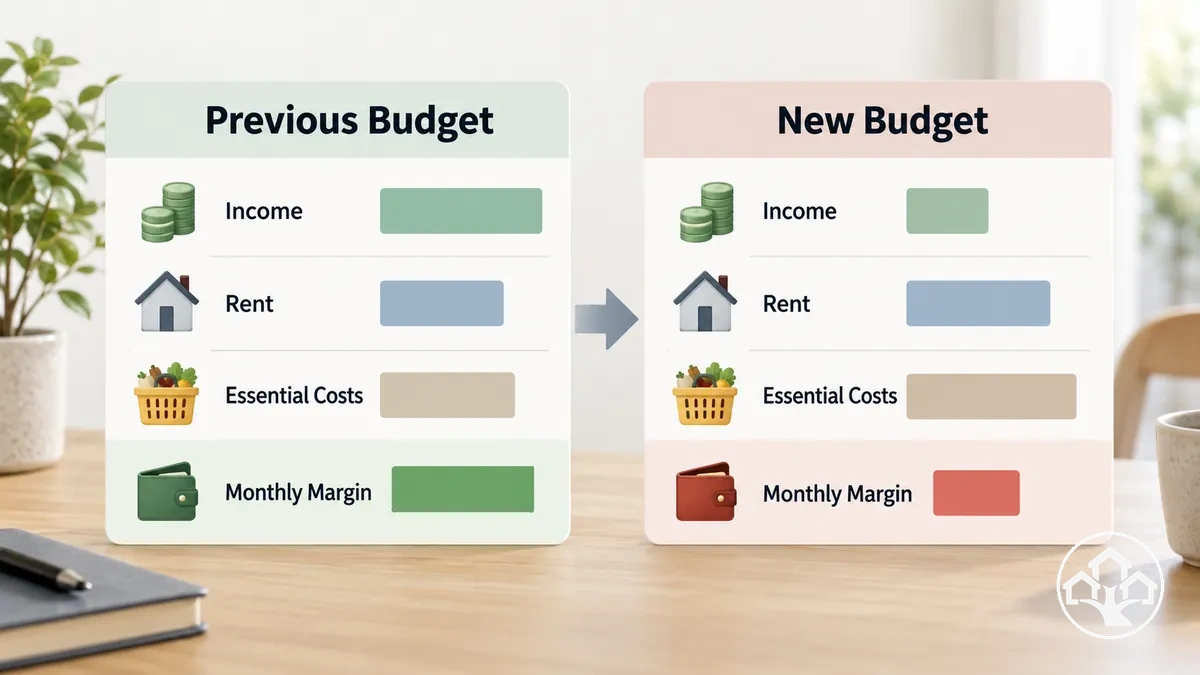
The following example compares the previous and current budget position to show how the same essential costs can produce a different result after a change.
| Budget factor | Before change | After change |
|---|---|---|
| Monthly income available to spend | A$5,000 | A$5,000 |
| Monthly rent | A$1,700 | A$2,000 |
| Essential costs | A$3,100 | A$3,100 |
| Monthly surplus or deficit | A$200 surplus | A$100 deficit |
In this illustrative example, an increase of A$300 in rent changes the monthly budget from an A$200 surplus to an A$100 deficit when income and other essential costs stay the same.
An income reduction can narrow the margin or create a new shortfall even if rent does not change.
Reassess whether the changed affordability gap is temporary, absorbable, or persistent before deciding what broader adjustment may be needed.
Ask About Rent Negotiation or a Temporary Payment Arrangement
Early communication about a rent shortfall may create options, but agreement on proposed terms is not guaranteed.
Make the request specific: explain the amount unpaid, the payment date you can realistically meet and whether you need a lower amount, a later due date or a repayment schedule. The choice should reflect whether the gap is temporary or expected to recur.
- Rent negotiation: A request to discuss a lower rent amount may fit when the current rent no longer matches the household's changed circumstances. Whether a different amount can be agreed depends on the situation and the willingness of both parties to accept proposed terms.
- Delayed payment request: A request to change payment timing may fit when the shortfall is temporary and income or available cash is expected at a later date. The request should clarify the amount involved and the proposed payment timing.
- Temporary payment arrangement: A repayment arrangement may fit when the full amount cannot be covered immediately but a realistic schedule exists for addressing the shortfall. Feasibility depends on the proposed terms, timing and whether future payments can be maintained.
Check Whether Short-Term Rent Assistance Is Available
Short-term rent assistance may help bridge an immediate affordability gap only when eligibility, availability and application timing match the household's circumstances.
Assistance is most useful when its covered costs, start date and duration match the immediate rent gap. A program that has a waiting period or excludes the amount due may not prevent the current shortfall.
Verify current local rules before relying on any option, because assistance programs and requirements can change.
- Eligibility: Check whether the household meets the current eligibility requirements for the assistance available in the relevant location. Eligibility conditions can differ based on household circumstances and the type of support.
- Availability: Confirm whether assistance is currently open and accessible. Funding availability, program capacity or local limits may affect whether support can be provided.
- Application timing: Consider the application process, any waiting time and whether the timing fits the immediate rent shortfall. Assistance that arrives after the payment gap may not solve the immediate problem.
- Covered costs: Check which housing costs or related expenses the assistance may cover and whether those covered costs match the specific shortfall.
- Duration: Review how long the support may apply and whether it addresses only the immediate shortfall or contributes to longer-term stability. Short-term assistance may require a separate plan if the affordability gap continues.
How to Prioritise Expenses During a Rent Shortfall
During a rent shortfall, prioritise essential expenses and high-consequence obligations before discretionary spending, but do not use a rigid universal payment order.
Order payments by necessity, due date, consequences of delay and flexibility, not by a rigid category ranking. Housing stability and immediate health and safety risks deserve explicit attention.
- Housing stability: Assess rent and other necessary housing costs according to their due dates and the consequences of non-payment because they directly affect the ability to maintain the current housing arrangement. Their position may change when another expense has a more immediate health, safety or income-related consequence.
- Food and essential healthcare: Protect the food needed for the household and necessary healthcare, including essential treatment or medication. An urgent healthcare need may move ahead of another cost when delaying it would create an immediate health risk, while food spending may have some short-term flexibility when adequate supplies are already available.
- Utilities: Prioritise utilities that are necessary for basic household functioning, health or safety, while checking their due dates and available flexibility. Their position can change according to the importance of the service, the timing and consequences of delayed payment, and whether part of the cost can be adjusted.
- Essential transport: Protect transport when it is required to earn income, obtain healthcare or meet another essential obligation. Transport can move lower when a workable lower-cost alternative exists or when the travel is discretionary rather than necessary.
- Minimum contractual obligations: Consider minimum amounts due under existing commitments where applicable, using the specific due date, payment consequences and available flexibility to judge their position. Do not assume every contractual payment has the same urgency; its priority depends on what delaying or adjusting that particular payment would mean for the household.
- Discretionary and adjustable spending: Defer, reduce or remove spending that is not currently necessary for housing, food, utilities, healthcare, essential transport or another high-consequence need. A normally discretionary cost may move higher if household circumstances make it necessary for work, health or safety.
Higher immediate priority: work transport
A transport pass required to attend paid shifts may protect the income needed for future rent and necessities.
More adjustable: optional subscription
A discretionary subscription can generally be deferred before an expense that protects income, health or safety.
Necessary healthcare may similarly take priority over a recurring expense that can safely be adjusted or deferred; the decision turns on the actual consequences for the household.
Expense prioritisation during a rent shortfall therefore depends on the function and consequence of each cost, not merely its category.
Ways to Reduce Housing Costs Without Moving Immediately
Staying in the current home may become more affordable when recurring housing costs can be reduced safely, realistically and without simply shifting the shortfall elsewhere.
Prefer changes that lower recurring housing costs, rather than a one-off cash injection. Feasibility, household conditions and the effect on housing stability determine whether a method is practical.
- Reduce rent through negotiation: Rent negotiation may lower the recurring monthly rent if the housing provider agrees to a different amount or arrangement. The recurring impact depends on what is actually agreed, so there is no fixed saving; feasibility also depends on the existing arrangement and the other party's willingness to negotiate. A successful change can reduce costs without affecting privacy, but it may not be available or may involve conditions that need to be assessed before agreement.
- Share housing costs: Adding another household member may create shared costs that reduce the amount each person contributes to rent and other household expenses when the arrangement is lawful, permitted, safe and practical for the dwelling. The recurring saving depends on which costs are genuinely shared and how they are divided. The principal trade-offs are reduced privacy, changes to household routines and responsibilities, and lower reversibility if changing the arrangement later is difficult.
- Reduce housing-related expenses: Review optional services or extras connected with the home and reduce, downgrade or remove those that are not necessary, such as optional service packages or separately charged amenities where applicable. This lowers recurring housing-related expenses only by the amount of the service actually reduced or removed, so the impact may be smaller than changing rent or sharing costs. This method can be relatively reversible when a service can later be restored, but feasibility depends on whether the charge is optional rather than part of the housing agreement or an essential household need.
A suitable method should be judged by feasibility, recurring impact, privacy and reversibility rather than by an assumed level of savings.
Rent negotiation may preserve the household arrangement but depends on agreement, while shared costs can change household privacy and flexibility.
Reducing optional housing-related expenses is less disruptive when those charges can be adjusted, but it is useful only when the resulting recurring savings materially narrow the housing-cost gap.
Lower-Cost Housing Paths When Staying Is Not Sustainable
Lower-cost housing paths become relevant when the current rental arrangement cannot be made sustainable, but the alternatives differ in duration, stability, privacy, eligibility and total cost.
A lower nominal housing payment does not necessarily mean a lower total cost once location, shared facilities, eligibility conditions or housing-for-work responsibilities are considered.
The main categories are short-term arrangements, ongoing arrangements, subsidised housing and housing-for-work.
The table provides a consistent screening view of their typical function, duration, stability and privacy, and the main condition that can affect suitability.
| Housing path | Primary function | Duration | Stability and privacy | Key suitability condition |
|---|---|---|---|---|
| Short-term arrangements | Provide temporary lower-cost accommodation while the household stabilises finances or searches for a longer-term path. | Temporary or transitional rather than intended as a permanent housing solution. | Stability and privacy may be reduced when accommodation is temporary, shared or subject to short stays. | Total cost, availability, location and the practical length of stay need to fit the transition period. |
| Ongoing arrangements | Reduce recurring housing costs through longer-term shared or alternative living arrangements. | Suitable for an ongoing period when the arrangement remains workable for the household. | Stability may be greater than with short-term accommodation, while privacy may decrease when space or facilities are shared. | The cost structure, household fit, location and practical conditions of sharing need to remain sustainable. |
| Subsidised housing | Provide supported housing pathways for eligible households whose market housing costs are difficult to sustain. | Duration may depend on the particular program, continuing eligibility and available housing. | May offer a more stable housing path, while property or location choice can be constrained by program availability. | Eligibility, application requirements, waiting periods and local availability affect whether the pathway is practically accessible. |
| Housing-for-work | Reduce or replace part of the direct housing cost when accommodation forms part of a work arrangement. | May be connected to the duration and conditions of the work arrangement. | Housing stability may be tied to continued work, while privacy depends on whether accommodation and facilities are shared. | Work duties, employment conditions, location and the implications of the work arrangement ending need to be acceptable. |
This comparison is a screening overview rather than a complete method for selecting among lower-cost housing options.
Suitability depends on whether the required duration matches the household's needs, whether the level of stability and privacy is workable, whether any eligibility conditions can be met, and whether the total cost remains affordable after related expenses and responsibilities are included.
A path with a lower direct housing payment may therefore be unsuitable when its location, reduced privacy, limited duration or additional obligations create trade-offs the household cannot reasonably accept.
Short-Term Arrangements for an Immediate Affordability Gap
Short-term housing arrangements may bridge an immediate gap while a more stable housing path is being assessed, but a temporary arrangement is useful only when its duration, total cost, safety and exit plan fit the household's circumstances.
Temporary stays with trusted contacts, short-duration accommodation, or emergency or transitional options where applicable should not be treated as suitable merely because they are temporary, especially when privacy and stability are limited or uncertain.
Four checks before using temporary accommodation
- Duration
- Enough time to cover the immediate gap and reach the next housing step.
- Total cost
- Manageable for the entire expected stay, not just the first night or week.
- Safety and privacy
- Acceptable conditions for everyone in the household.
- Exit plan
- A realistic way to move into stable, sustainable housing.
For example, a temporary stay may provide useful cover when it is safe, affordable for the expected period and linked to a realistic next housing step; the same stopgap may become unsuitable if the stay continues and cumulative cost rises, privacy deteriorates, or the arrangement becomes unstable.
The practical distinction is whether the temporary arrangement closes the immediate gap without creating a growing cost, safety or stability problem before the household can exit into more sustainable housing.
Ongoing Lower-Cost Housing Arrangements
Ongoing lower-cost housing arrangements should be evaluated by recurring cost and living-condition trade-offs rather than nominal rent alone.
A longer-term arrangement may lower rent while changing privacy, stability, responsibilities, location or entry conditions. Its suitability depends on whether all of those ongoing conditions remain workable, not rent alone.
- Recurring cost: Consider the ongoing housing payment together with recurring transport, utilities or other required costs, because a lower direct housing cost may not produce a lower overall household burden.
- Stability and privacy: Assess whether the expected living conditions provide enough continuity and personal space for the household's needs; reduced privacy or uncertain stability may make a lower-cost arrangement a poor practical fit.
- Responsibilities: Identify any household, property or work-related responsibilities attached to the arrangement and whether they can be sustained alongside other obligations.
- Location: Consider access to work, education, healthcare and essential services, because greater distance or transport requirements may offset part of the benefit of a lower housing payment.
- Entry requirements: Check any eligibility, household-fit or other entry requirements before treating the arrangement as available, because an ongoing housing path is only practical when the household can meet its conditions.
Subsidised or Supported Housing Pathways
Subsidised or supported housing pathways can reduce housing costs, but practical access depends on eligibility, availability, any waiting period and current local program rules.
Meeting eligibility requirements does not by itself mean that suitable housing or cost support is immediately available.
Short-term rent assistance
Addresses a current payment gap when the household qualifies and help is available in time; it does not necessarily change future rent.
Subsidised or supported housing
Provides a potential longer-term pathway, subject to local eligibility, available places, waiting periods and continuing conditions.
Because application and placement timing can differ from the timing of an immediate housing need, a household may still require an interim plan while seeking longer-term support.
The conditions below determine whether a pathway is practically accessible and what support it may provide.
Verify current local program rules before relying on a pathway, because eligibility criteria, availability and support conditions are program- and location-specific.
- Eligibility: Check the eligibility basis for the relevant program, including any household or circumstance requirements, before treating the pathway as available.
- Cost support: Confirm what housing costs the program may subsidise or otherwise support and what costs remain the household's responsibility rather than assuming a fixed benefit.
- Availability: Check whether suitable housing or support is currently available in the relevant location, because eligibility does not establish that a placement is open.
- Waiting period: Verify the current application and waiting conditions and compare their timing with the household's immediate housing needs; an interim plan may be necessary when support is not available when needed.
- Tenure conditions: Review the applicable tenure conditions, support requirements and continuing eligibility rules so the household understands the conditions attached to the longer-term pathway.