
Housing provided
Public housing
- Managed by
- State or territory housing authority
- Cost approach
- Rent set by the relevant public housing policy
- Check next
- Local eligibility rules, intake and dwelling availability
Subsidised housing helps eligible Australian households reduce housing costs through supported rental housing or other program arrangements. Public housing and community housing are two forms of social housing; direct rent assistance works differently. Eligibility, rent and housing offers depend on the relevant program and jurisdiction, and qualifying for a program does not guarantee a dwelling.
Housing pathways · Australia
Compare the support model, then check the rules
Start with who provides the housing or support. The program—not the label alone—determines your eligibility, rent and application process.
The three checks that determine your next step
Important: Public and community housing commonly sit within Australian social housing. Being eligible to apply is different from receiving a housing offer; no universal income limit, rent formula or waiting time applies to every program.
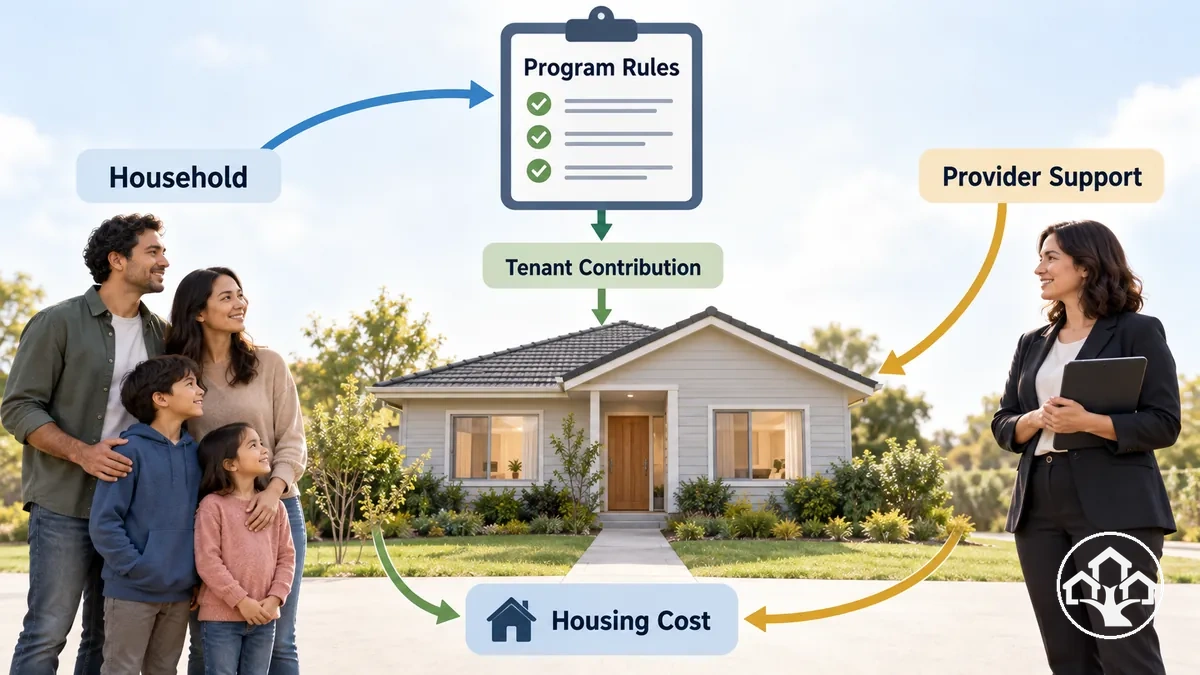
Subsidised housing lowers an eligible tenant's housing cost through a subsidy, regulated rent, or housing-provider arrangement.
The exact funding method and rent-setting model are set by the relevant program, so the tenant contribution is not determined by one universal formula.
The diagram shows these connected steps; it does not imply a fixed subsidy percentage or funding formula.
Direct rent assistance and a subsidised dwelling can use different delivery models.
Rent assistance supports an eligible tenant's housing cost through a payment or subsidy, while a subsidised dwelling incorporates affordability through its program, housing provider, or rent-setting arrangement; which model applies depends on the program.
This mechanism is narrower than the broader set of low-cost housing alternatives, which can include arrangements that lower housing expenses without a subsidy or regulated rent.
Those neighbouring arrangements are separate from the program-based relationship among eligibility, tenant contribution and housing support described here.
Subsidised housing in Australia can be delivered through different provider, ownership and management arrangements rather than one universal housing form.
The Australian Institute of Health and Welfare identifies public housing and community housing within the broader social housing system, with each using a different provider model to deliver lower-cost rental housing to eligible households.
The useful classification basis is who manages the housing, how ownership is arranged, and how affordability support is delivered.
Access and rent-setting rules remain tied to the relevant program and jurisdiction rather than to the category name alone.
The illustration below shows the provider relationships among the principal housing forms without turning them into a detailed comparison.
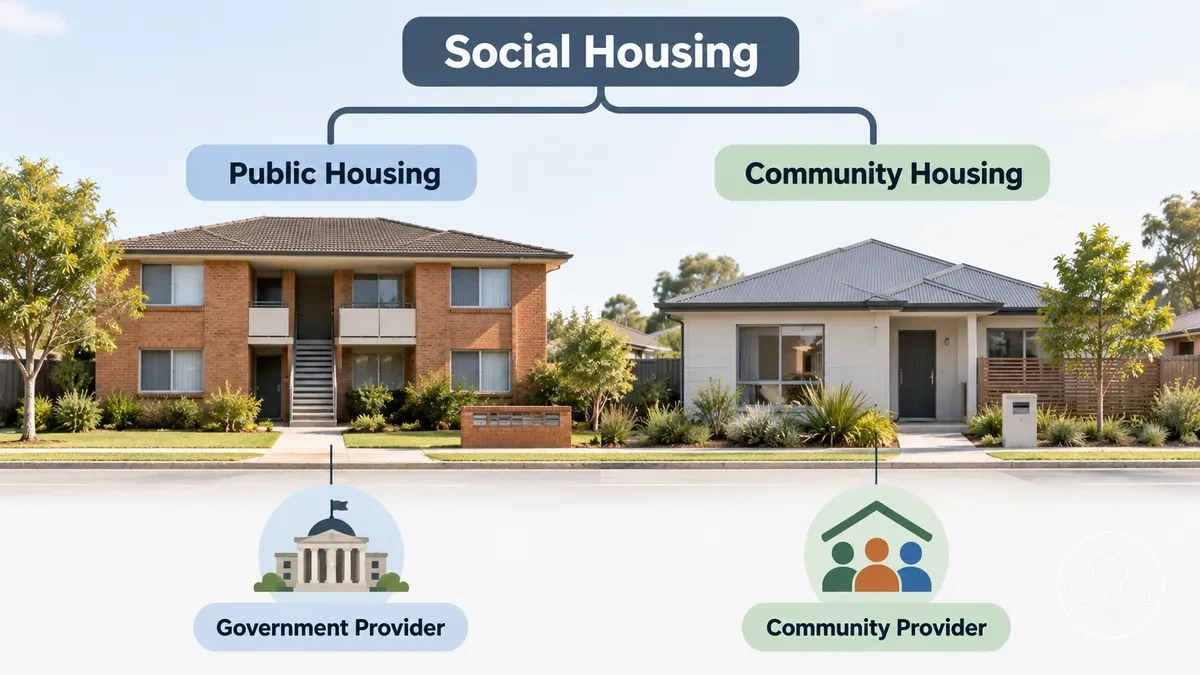
Program names, provider structures, access pathways and management arrangements can vary between Australian jurisdictions, so these labels should not be treated as one exhaustive universal taxonomy.
Households considering arrangements beyond subsidised or social housing can separately compare lower-cost housing paths without changing the provider-based classification used here.
Public housing and community housing are both forms of social or subsidised housing in Australia, but their administration differs.
The Australian Institute of Health and Welfare identifies public housing as rental housing managed by state and territory housing authorities, while community housing is managed by community-based organisations.
The image below isolates this provider and management distinction, while the table compares administration, application pathway, access and broad rent-setting context.

| Dimension | Public housing | Community housing | Why it matters |
|---|---|---|---|
| Provider and management | Generally managed by a state or territory housing authority; the dwelling may be government-owned or leased for public housing use. | Managed by a community housing provider; ownership may sit with government, the provider or another organisation, depending on the arrangement. | The administering provider determines who manages the tenancy and applies the relevant program rules. |
| Application or access pathway | Access is administered through the applicable state or territory public or social housing process. | Access may be administered through a jurisdictional social housing process, a community housing provider, or another approved pathway under local program rules. | The correct application pathway is determined by the jurisdiction and provider arrangement. |
| Broad rent-setting approach | Rent setting follows the applicable state or territory public housing policy rather than one national formula. | Rent setting follows the applicable community housing program or provider rules, which can differ by jurisdiction and program. | The housing category alone does not establish the tenant's rent formula; the relevant program rules do. |
| Program availability and local variation | Availability is determined by the public housing stock, allocation settings and program rules in the relevant state or territory. | Availability is determined by local community housing stock, provider coverage and applicable program rules. | A household's access depends on the housing and program arrangements available in its jurisdiction. |
The practical distinction is administrative rather than a judgment about housing quality: public housing places management with a government provider, while community housing places management with a community housing provider.
Ownership can be less clear-cut because a community housing provider may manage dwellings owned by government or another organisation.
Application pathways, rent-setting policies and availability can differ by state, territory and provider, so neither category has one nationally uniform process.
These local rules determine how a household gains access and how its tenancy is administered.
Social housing and subsidised housing can overlap in their affordability purpose, but they are not reliable universal synonyms because their exact relationship depends on local terminology and program design.
Social housing commonly refers to housing provided or managed through government or community providers, while subsidised housing can describe arrangements in which a subsidy or other support reduces a tenant's housing cost.
The illustration shows this relationship as an overlap rather than a universal legal or program hierarchy.
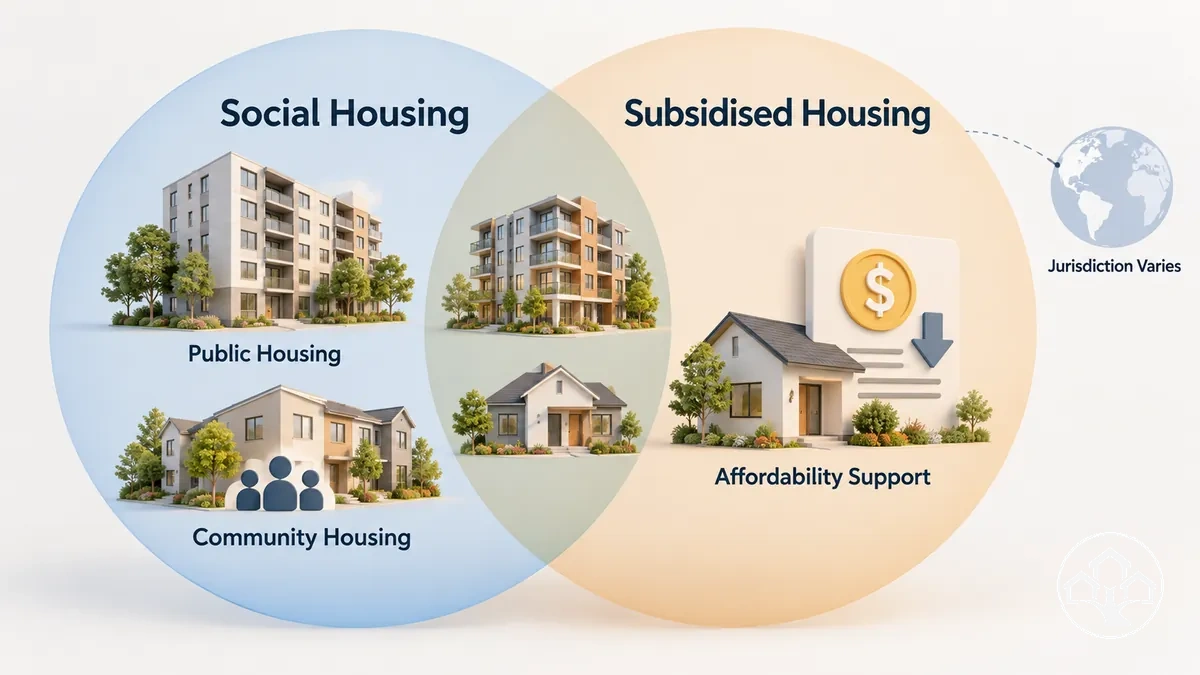
The practical meaning therefore depends on how the relevant housing system defines each category and form of support.
For example, one jurisdiction may describe government- or community-provided below-market rental housing as social housing while using subsidised housing more broadly for other supported housing arrangements.
Another housing system may use the terms differently, so the relationship between social housing, subsidised housing and affordability should be interpreted according to the definitions and program structure of the relevant jurisdiction.
Subsidised housing eligibility is usually assessed against several program-specific eligibility criteria rather than household income alone.
An applicant household may need to meet requirements relating to income, household composition, housing need, residency and other program rules, with the applicable threshold or condition set by the relevant jurisdiction or provider.
Basic eligibility determines whether an applicant can be considered under a program, while priority, waiting list position and allocation are separate decisions about relative need and available housing.
The illustration groups the main factors considered in a multi-factor eligibility assessment without implying that any single criterion guarantees qualification.
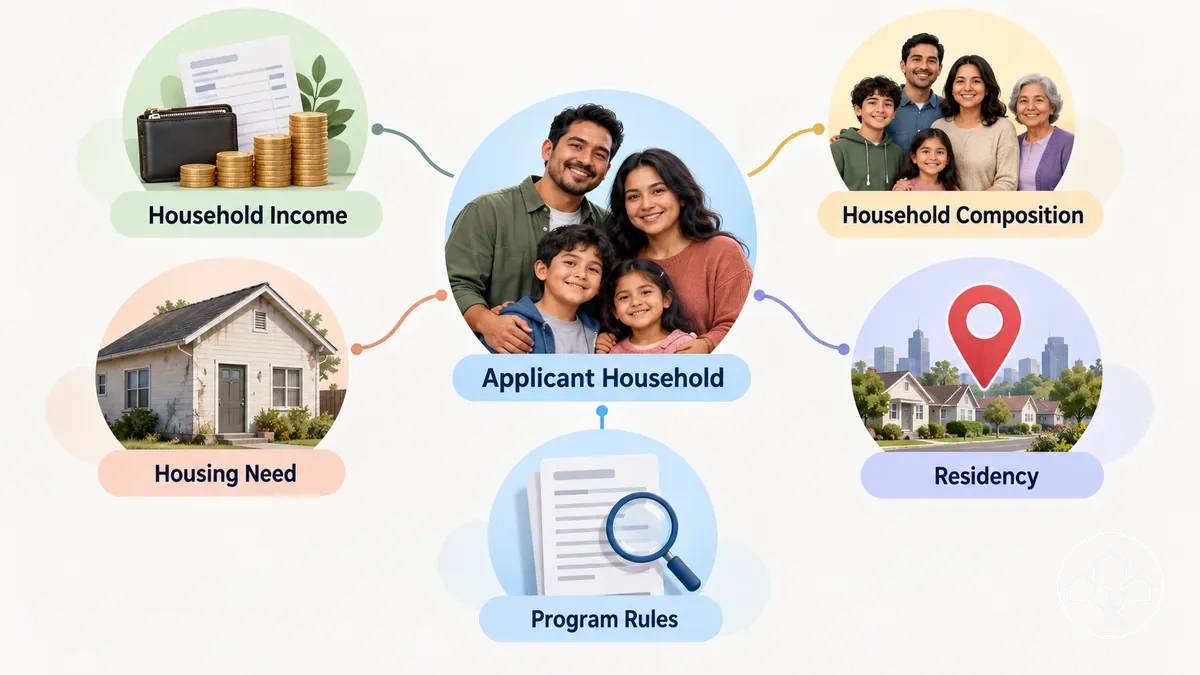
These conditions are assessed together, so satisfying one criterion does not establish eligibility when another required condition is not met.
For example, the NSW Government's social housing eligibility rules include NSW residency or an established need to live in NSW, citizenship or permanent residency, household income requirements and asset or property conditions among other criteria.
Housing Victoria applies its own identity, residency, income and asset eligibility rules, illustrating why thresholds and qualifying conditions are jurisdiction-specific rather than national.
The responsible housing authority or community housing provider's current program rules control the final eligibility determination, including thresholds, evidence requirements and exceptions.
Meeting basic eligibility criteria does not by itself establish priority or guarantee an allocation, so a general criteria list should not be treated as self-certification of qualification.
There is no single Australia-wide subsidised housing income cutoff. Compare your household's assessable income with the current income schedule for the specific program and household category.
Household size, composition and dependants can change which limit applies; indexed, area-based or program-specific adjustments may also affect the threshold.
For example, two households with the same household income may have different eligibility implications if their household composition differs or if they are assessed under programs with different thresholds.
Use the administering housing authority's or provider's current published rules to identify the applicable income limit, the income sources counted and how the household is assessed.
Eligibility for one subsidised housing program does not establish eligibility for another. The same household can meet one program's conditions but not another's.
Important differences include income thresholds, target groups, residency, housing-need assessments and provider requirements, as set out below.
Example: an applicant could meet the income threshold and housing-need test for one program but not qualify for another that targets a different household group or applies a different residency condition.
Qualification is therefore determined by the current eligibility rules of the program being assessed, not by the criteria used by another program or provider.
In many social housing programs, rent is linked to assessable household income; other subsidised arrangements use a regulated rent or provider-supported charge instead.
To estimate what the household pays, first identify the specific program's current rent policy. Income definitions, permitted adjustments and any caps can change the result.
An income-related calculation may use the following inputs, subject to the program's rules:
Income-related rent
Start with assessable household income, apply any permitted allowance or deduction, then apply the program's rent formula. A specified minimum, maximum or market-rent cap may limit the result.
Other supported rent models
A regulated charge, provider subsidy or another program mechanism may set the rent without using a direct income-based formula. The governing policy determines which method applies.
An exact rent cannot be calculated reliably without the relevant policy's verified formula, adjustments and limits. Do not apply one program's rent percentage to a different provider or jurisdiction.
The subsidised housing application process usually moves from application and verification to an eligibility decision, waiting-list status, priority assessment and possible allocation of a suitable dwelling.
The exact sequence, notification method and timing vary by program, and completing one stage does not guarantee that the next stage or a housing offer will follow immediately.
The stages below show the common status progression and the information or response that may be required before an application can advance.
Program rules determine the exact requirements at each stage.
An eligibility decision establishes whether the applicant can participate in the relevant program, while waiting-list status records the applicant's current status within the allocation process.
Neither status is itself a housing offer; allocation depends on the program's priority and matching rules, suitable dwelling availability and any other applicable conditions.
Programs may notify applicants when an eligibility decision, status change or housing offer requires attention.
Where the program requires current contact, household or housing-circumstance information, the applicant should provide changes through the prescribed process so the application can continue to be assessed using current information.
After a housing offer or allocation is made, the applicant may need to accept, decline or otherwise respond according to the program's instructions before the process can proceed.
Once an offer has been accepted and the next housing arrangements are confirmed, the household can plan a housing transition without treating the allocation stage itself as a general moving process.
Waiting-list status describes whether a provider accepts applications for a particular intake. It does not determine an applicant's eligibility or guarantee a housing offer.
An open list does not by itself establish eligibility, priority or eventual allocation; those decisions remain subject to the program's separate rules.
Some housing providers may permit restricted applications or defined exceptions while general intake is closed, so the applicable provider rules control whether any new application can still be accepted.
Reopening arrangements differ between administering bodies: an application window may be temporary, and notification of reopening may be given through the housing provider's own public notices or application channels.
Because no reopening date or notification method applies universally, applicants facing an unavailable intake may separately consider options when rent is unaffordable while keeping the waiting-list process distinct from those neighbouring housing responses.
Subsidised housing waiting time depends on both assessed priority and the availability of a suitable dwelling, so a waiting-list position usually cannot be converted into a reliable offer date.
Higher priority can affect how an applicant is considered, but an offer still depends on housing stock that matches the household's requirements.
Applicant-side priority and matching requirements interact with supply-side availability when a provider considers allocation.
The following factors can narrow or widen the range of suitable dwellings without implying a fixed change in waiting time.
Three different questions—not one approval
Eligibility and priority do not themselves guarantee an offer; the allocation also needs a suitable available dwelling.
Two eligible households can therefore experience different waiting times when their priority, household size, dwelling type, location or accessibility needs require different matches within the available housing stock.