
How Live-In Jobs With Accommodation Work
Live-in jobs with accommodation link work to housing: lodging may be a benefit of paid employment, a requirement of the role, or provided in return for agreed work. Accommodation is not automatically free, and living on site does not mean being on duty at all times. Pay, charges, work hours and occupancy after the job ends depend on the arrangement and applicable rules.
The live-in arrangement at a glance
A live-in job has two connected parts. The agreement sets the duties and explains how those duties affect access to accommodation.
- Work obligations
- Identify assigned duties, scheduled hours and any specifically agreed on-call period or response trigger.
- Real housing cost
- Confirm accommodation fees or pay deductions, utilities, other inclusions and who pays each charge.
- Living conditions
- Check the room, facilities, private space, shared areas and house rules separately from job duties.
- When work ends
- Check what changes occupancy, applicable notice, move-out timing and any separate housing agreement.
Key boundary: The phrase “live-in job” alone does not establish employment status, tenancy rights, 24-hour availability or a universal move-out date. Check the actual terms and applicable rules.
Table of Contents
How Work and Accommodation Are Linked in a Live-In Job
In a live-in job, a work obligation and accommodation can be linked in three broad ways: accommodation can be provided as an employment benefit, required as a condition of employment, or exchanged for specified work.
The employer or host and the worker define that connection through the relevant work agreement and housing terms.

Accommodation access and occupancy are connected to the conditions governing the work relationship rather than to the label “live-in job” alone.
Continued occupancy may also be linked to continued work, although the exact housing status and conditions depend on the agreement and applicable jurisdiction rather than being automatically equivalent to an ordinary tenancy.
Here, accommodation means lodging connected to the work role; it does not mean a workplace adjustment provided for disability, flexibility, or another employment need.
Employer-Provided Housing as Part of Paid Employment
Employer-provided housing within paid employment means a worker receives wages while accommodation is supplied or arranged as a separate but connected part of the employment package.
Paid work and staff accommodation are linked by the employment arrangement, without implying that the housing is automatically free or equivalent to a standard rental.
 Depending on the agreement, employer-provided housing may function as a housing benefit, a practical requirement of the work role, or accommodation for which the worker is separately charged.
Accommodation Provided in Exchange for Work
Accommodation provided in exchange for work is a work exchange in which specified duties contribute to obtaining lodging from a host.
The work contribution may cover all or only part of the accommodation, and the arrangement may also include cash pay when applicable.
The exact exchange depends on the agreed work, lodging, and compensation terms.

What does the agreed work cover?
Full lodging exchange
Agreed work contributes to the entire lodging benefit. Cash pay, if any, is a separate term to establish.
Partial lodging exchange
Agreed work contributes to part of the accommodation; check any remaining housing charge or obligation.
For either model, specify duties and hours, accommodation provided, inclusions, any cash payment and the length of the stay.
Unclear hours or duties can increase the practical burden of a work exchange because the worker cannot easily compare the required contribution with the lodging received.
Clear limits on tasks, time commitments, inclusions, and duration make the exchange relationship more explicit without determining whether the arrangement is legally employment, volunteering, or another status.
Calling the arrangement a “work exchange” does not, by itself, determine whether it is employment, volunteering or another legal arrangement; the duties, terms and applicable rules matter.
A defined work-for-accommodation exchange is different from a temporary housing arrangement where occupancy is not primarily provided in return for labour.
Required On-Site Housing and Optional Staff Accommodation
Required on-site housing makes residence a condition of employment or of performing the role, while optional staff accommodation gives the worker a housing choice alongside the job.
This distinction changes whether on-site presence is required and how accommodation relates to work responsibilities.
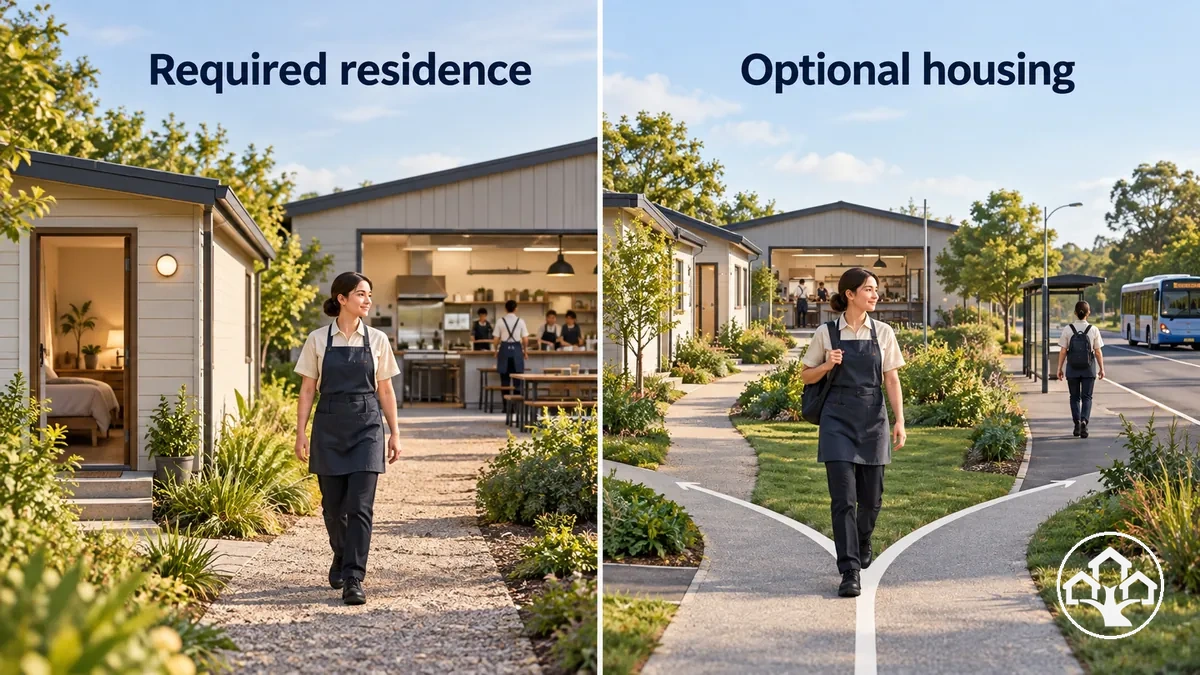 The practical implications can be separated by housing choice, presence, availability, commuting, and continued housing access.
- Housing choice: Required on-site housing requires residence at the specified location while that condition applies; optional staff accommodation allows the worker to use other housing where the employment arrangement permits it.
- On-site presence: Required residence can support duties that depend on the worker being based at the property or workplace; optional accommodation does not by itself make residence part of the role.
- After-hours response: A required-residence role, such as a caretaker position, may include defined after-hours response expectations, while optional housing does not automatically create those expectations.
- Commuting: Required on-site housing can eliminate a separate commute between home and the work location; a worker who declines optional staff housing may need to commute from other accommodation.
- Housing continuity: Where housing access is tied to the role, a change or end to employment may affect continued occupancy; optional staff housing may also carry employment-related conditions specified in the agreement.
The exact availability requirements, permission to use alternative housing, and consequences of an employment change depend on the role and agreement.
Housing access may therefore change with the work relationship when residence is employment-linked, while optional accommodation can still carry conditions of use.
Living on site does not by itself mean the worker is continuously on duty.
Responsibilities in a Live-In Work Arrangement
Responsibilities in a live-in work arrangement come from two distinct sources: the work role creates job duties, while occupying employer- or host-linked accommodation creates housing responsibilities.
Keeping those sources separate matters because residence does not make every living-space expectation part of the job or make personal time automatically available for work.
 The distinction is clearest when work obligations and occupancy obligations are considered separately.
Which agreement creates the obligation?
Work responsibilities
Assigned tasks, performance expectations and defined schedules or on-call periods belong to the work role.
- Job duties: Tasks assigned as part of the work role remain work obligations.
- Performance expectations: Standards, outputs, or role-specific responsibilities apply where they are part of the agreed work role.
- Schedule and on-call availability: Scheduled work or defined on-call periods govern availability where the agreement requires them; living on site alone does not create constant availability.
Housing responsibilities
Upkeep, shared-space use and house rules govern residence unless particular tasks are separately agreed as work.
- Accommodation upkeep: Care of the living space applies according to the agreed occupancy conditions rather than automatically becoming a job duty.
- Shared space: Responsibilities for using or maintaining communal areas remain housing obligations unless the work agreement separately assigns them as job duties.
- House rules: Agreed rules for occupying the accommodation govern residence and do not by themselves expand the worker's job duties or control personal time.
Job Duties and Scope of Work
The scope of work defines the assigned job duties by identifying the core duties, their limits, frequency or trigger, expected standard, and location.
Incidental tasks should remain distinguishable from recurring work responsibilities, and expressly excluded tasks should sit outside the duty scope unless the agreement is changed.
A useful scope connects each task to when it occurs, what result is expected, and the practical time burden it may create.
- Core duties: Identify the main assigned tasks and the result each task is expected to produce.
- Frequency or trigger: State whether a duty occurs on a schedule, when a defined condition arises, or only on an occasional basis so its practical time burden can be understood.
- Expected standard: Describe the required outcome or level of completion clearly enough to distinguish satisfactory performance from an undefined expectation.
- Location: Specify where the duty is performed when the work may occur across different parts of a property, workplace, or other agreed location.
- Excluded or incidental tasks: Identify tasks that are outside the regular scope or arise only under stated circumstances rather than treating them as open-ended duties.
Vague wording can materially change the apparent workload because a phrase such as helping as needed could refer to an occasional incidental task or to repeated duties with a substantial practical time burden.
The actual effect depends on the task, frequency or trigger, expected standard, and location rather than on the vague phrase itself.
An unclear scope of work should therefore be clarified rather than treated as permission for unlimited duties.
Working Hours, On-Call Time and Availability Expectations
Scheduled hours, on-call or standby periods, and genuine off-duty time are different time categories in a live-in work arrangement.
Three different time states
- Scheduled work
- The period when assigned duties are to be performed.
- On-call or standby
- A defined availability window with agreed triggers and response expectations, even when work is not active.
- Off-duty time
- Personal time outside agreed work or availability obligations; living on site alone does not make it working time.
- Scheduled hours: The arrangement should identify applicable start and finish times or other defined periods when assigned work is expected.
- On-call or standby: Any on-call period should identify when availability is required and what event or request triggers active work.
- After-hours and emergency response: Overnight or after-hours duties should be distinguished from ordinary scheduled work by stating the circumstances that require an emergency response.
- Response time: Where the role requires a response within a particular period, that expectation should be stated in the arrangement rather than inferred from living on site.
- Days off and interruptions: Defined days off and the expected frequency of after-hours interruptions help distinguish genuine off-duty time from periods of continuing availability.
- Additional time: If the arrangement provides for recording or compensating work performed outside scheduled hours, the applicable method depends on the role, agreement, and relevant jurisdiction.
An on-site caretaker, for example, may have scheduled daytime duties and a separate on-call requirement for specified after-hours events without being continuously on duty whenever present at the property.
The practical availability expectation depends on the response trigger, required response time, frequency of interruptions, and whether particular periods are designated as days off or off-duty time.
Any legal treatment of on-call periods, additional working time, or compensation must be determined from the applicable agreement and jurisdiction rather than assumed from residence alone.
Housing Terms and Living Conditions to Check Before Accepting a Live-In Job
Housing terms and living conditions should be evaluated together with the employment terms before accepting a live-in job.
A favourable wage can be offset by accommodation that is costly, restrictive, unsuitable for the worker's needs, or heavily dependent on continued employment.
The main checks should show how the accommodation affects cost, privacy, usability, and housing dependency.
Examine the physical setup rather than the label “staff accommodation”: a private sleeping space can still have shared bathrooms, kitchens and laundry, and the location affects commuting, transport and access to services.
Calculate the worker's housing outlay by checking rent or accommodation fees, any pay deductions, and utilities or services that must be paid separately. Compare that outlay with the cash pay actually received, and do not assume that furnishings, internet access or other inclusions are supplied.
Check house rules, private-room access, occupancy dates and the conditions linking housing to the job; also establish what notice and move-out terms apply when employment ends.
- Room type: Verify whether the accommodation is a private room, shared room, self-contained unit, or another stated arrangement because the room type affects privacy and usability.
- Shared facilities: Check which bathrooms, kitchens, laundry areas, or other facilities are shared and with whom because shared facilities can affect daily access and privacy.
- Location: Confirm where the accommodation is located in relation to the workplace and necessary services because location affects commuting, access, and practical use of the housing.
- Deductions and housing costs: Identify any rent, payroll deduction, bond, or other stated accommodation charge because these costs change the financial value of the arrangement.
- Utilities and inclusions: Clarify which utilities, furnishings, internet access, meals, or other stated inclusions are provided because omitted items may create additional costs or practical requirements.
- House rules and access: Review agreed house rules, shared-area conditions, visitor restrictions, and access arrangements because these terms can affect privacy and day-to-day use of the accommodation.
- Occupancy duration: Confirm when occupancy begins, how long it continues, and any conditions that can change that period because these terms determine how long the accommodation remains available under the agreement.
- Employment ending: Check what happens to housing access, notice, and move-out expectations if the work relationship ends because employment-linked accommodation can create immediate housing dependency.
Material accommodation terms should be clarified in writing where possible, supported by evidence such as current photos, an accommodation description, or the wording of the agreement.
These checks concern the conditions of the live-in arrangement itself; they do not replace practical planning for moving into the accommodation or finding somewhere else to live when leaving.
Room Type, Facilities and Shared Areas
Staff accommodation can differ materially in room privacy, facilities, and access to shared areas even when the same general housing label is used.
A private room may still rely on a shared bathroom, kitchen, laundry, or other communal facilities, while a shared room also shares the sleeping space itself.
The practical setup should therefore be identified by each physical attribute rather than inferred from the accommodation label.
- Room type: Confirm whether the sleeping space is a private room or shared room because sharing the bedroom directly affects privacy and personal space.
- Bathroom: Check whether the bathroom is private or shared and who shares it because availability and privacy depend on the actual access arrangement.
- Kitchen: Identify whether a kitchen is provided, whether it is shared, and what access is available because meal preparation depends on usable kitchen facilities.
- Laundry: Confirm whether laundry facilities are available within the accommodation or elsewhere because their location and sharing arrangement affect day-to-day use.
- Storage: Check what personal storage is provided in the room or shared areas because limited storage can affect how practically the living space can be used.
- Furnishings and essential services: Identify which furnishings, internet access, or other relevant services are actually included because missing items may require the worker to make separate arrangements.
- Shared areas: Clarify which living, dining, outdoor, or other communal areas are shared and any agreed conditions for their use because access can affect privacy and everyday usability.
Room type and facility access determine how the accommodation functions in daily use rather than whether it can simply be described as staff housing.
A private room with shared facilities provides private sleeping space but still requires shared access to areas such as the bathroom or kitchen, whereas a shared room reduces privacy in both the sleeping area and any communal facilities.
The relevant practical question is which spaces and services are private, shared, available, or absent in the actual living arrangement.
Housing Costs, Rent Deductions, Utilities and Inclusions
Housing described as provided or included with employment can still contain separate rent, an accommodation fee, a payroll deduction, utility charges, or other recurring costs.
The full housing cost structure is clear only when each cost item identifies the payer, billing method, frequency, and conditions attached to any inclusions.
| Cost item | Payer | Billing or deduction method | Frequency | Practical implication |
|---|---|---|---|---|
| Rent or accommodation fee | Worker, employer, host, or another stated payer | Direct payment, payroll deduction, or included under the agreement | As stated in the arrangement | Determines whether the accommodation itself creates a separate housing charge. |
| Utilities | Worker, employer, host, or shared according to the agreement | Included, separately billed, or incorporated into another housing charge | As billed or specified | Shows whether electricity, water, gas, or other stated utilities create additional recurring costs. |
| Internet | Worker, employer, host, or another stated payer | Included, separately billed, or arranged independently | As specified | Clarifies whether internet access is an inclusion or an additional service the worker must arrange. |
| Deposit or bond | The party identified in the agreement | Separate upfront payment or another stated method | Once or as otherwise specified | Creates an additional initial housing cost and may be subject to conditions stated in the agreement. |
| Meals | Worker, employer, host, or shared where meals are explicitly part of the arrangement | Included, separately charged, or deducted according to the stated terms | As specified | Affects the effective value of the arrangement only when meals are expressly included or charged. |
| Other inclusions | As stated in the agreement | Included without a separate charge or subject to stated limits or conditions | As applicable | Identifies whether furnishings, services, or other benefits remain included under particular conditions. |
For a fair comparison, the worker-paid recurring housing cost is the rent or accommodation fee the worker pays plus separately billed utilities and services. A charge already taken from pay should be counted only once, not added again as an out-of-pocket payment. Check the pay amount alongside these costs rather than treating accommodation described as “included” as automatically free.
A deposit or bond, where applicable, is an upfront payment rather than an ordinary recurring charge; its amount, handling and return conditions depend on the arrangement and applicable rules.
The existence, amount, frequency, and treatment of each charge depend on the actual agreement and relevant jurisdiction rather than on the phrase used to describe the accommodation.
For example, a hypothetical arrangement could include the room itself while separately charging utilities and internet through different billing methods, creating several housing-related costs even though accommodation is described as included.
Identifying each payer, charging method, frequency, and inclusion condition shows the effective cost structure without relying on unsupported market prices.
What Happens to the Accommodation When Employment Ends
Housing access linked to a job may end or change when employment ends, but the timing and conditions depend on the agreement and applicable rules.
The key issue is whether occupancy is strictly conditional on the work relationship or can continue under separate housing terms.
The relevant terms should identify the event that changes housing access, the move-out timing, and what the worker must do next.
The end-of-employment terms should make clear how notice, continued occupancy, keys, belongings, and any final charges or deposit handling are dealt with where applicable.
These conditions can differ according to the agreement and jurisdiction, so no universal notice or move-out period should be assumed.
The practical checks are:
- Ending condition: Identify which event changes or ends housing access, such as the employment relationship ending or another condition stated in the agreement, because that trigger determines when the housing terms change.
- Notice and move-out timing: Check what notice applies and when the worker is expected to leave because the time available to arrange alternative accommodation depends on the actual terms and applicable rules.
- Continued occupancy: Confirm whether any occupancy may continue after employment ends and under what conditions because job-linked housing and housing governed by a separate rental agreement can have different continuity arrangements.
- Keys and property: Clarify when keys, access devices, or employer- or host-owned property must be returned because the return requirement may be tied to the end of occupancy rather than the final working day.
- Final charges or deposit handling: Check how any final charges, deposit or bond handling, or other stated amounts are addressed because their timing and treatment depend on the agreement and relevant jurisdiction.
- Belongings: Confirm how long the worker can access the accommodation to collect personal belongings because access after employment ends may be limited by the occupancy terms.
Privacy and Work-Life Boundaries in Staff Accommodation
Living where one works can blur physical, temporal, and communication boundaries because the same setting may function as both accommodation and a workplace.
Privacy problems are more likely when expectations about private space, shared space, access, time, and communication are left unclear rather than explicitly agreed.
Assessing each boundary area separately makes it easier to identify where ordinary living conditions end and work-related expectations begin.
| Boundary area | What to clarify | Practical consequence |
|---|---|---|
| Private and shared space | Which areas are private space and which are shared space, including any conditions on use. | Clarifies where the worker can expect personal use of space and where shared-living arrangements apply. |
| Access to accommodation | Who may access the worker's room or accommodation, under what circumstances, and how access is communicated. | Determines how much control the worker has over entry to personal living space. |
| Guest rules and house rules | What guest rules and other house rules apply to the living arrangement and whether they concern shared areas, private areas, or both. | Shows how occupancy conditions may affect personal use of the accommodation without automatically making those rules work duties. |
| Work contact and communication | When work contact is expected outside scheduled hours, which communication channels are used, and whether a response is required. | Clarifies whether contact during personal time is informational, optional, or connected to a defined work obligation. |
| On-call expectations | Whether on-call expectations apply, when they apply, and what type of event requires a response. | Distinguishes defined availability periods from time when the worker is not expected to respond to work demands. |
| Off-duty time | When off-duty time begins and ends and whether any work-related availability applies during that period. | Supports separation of personal time from working time according to the actual agreement. |
Space and access boundaries depend on the actual living setup rather than on the label used for staff accommodation.
A private room can provide personal space while kitchens, bathrooms, or other shared areas remain subject to ordinary house rules, and access to the worker's room may require separate clarification.
For example, a rule about cleaning a shared kitchen after use concerns use of shared space, while an expectation that the worker remain available there for work tasks would create a different boundary condition.
Time and communication boundaries depend on when work contact, on-call expectations, and response obligations apply.
A message sent during off-duty time does not by itself establish that a response is required; that depends on the agreed communication and availability expectations.
For example, a defined on-call period can create a work-related response obligation, whereas contact during a period designated as off-duty time may fall outside that obligation unless the arrangement states otherwise.
Clear agreed boundaries therefore distinguish personal time from working time without assuming that every staff-housing rule is intrusive or that every restriction has the same practical effect.
Private Space, Access and House Rules
Private space, access conditions, and house rules determine how much day-to-day control a worker has over staff accommodation.
A private room should be distinguished from shared facilities and common areas, and the arrangement should state who may access each space and under what conditions.
These details affect practical privacy without establishing any particular legal entry right or tenancy status.
- Private room: Clarify whether the room is for the worker's exclusive use and what access, if any, the employer or host may have under the stated arrangement because this affects control over personal space.
- Shared facilities: Identify which bathrooms, kitchens, laundry areas, or other shared facilities are used by multiple occupants because shared use affects privacy, availability, and everyday routines.
- Employer or host access: Confirm when access to the worker's room or accommodation may occur and how it is communicated because unclear access conditions can reduce predictability in the living space.
- Guests: Check whether guests are permitted, restricted, or subject to stated conditions because guest rules can limit how the worker uses the accommodation during personal time.
- Quiet hours: Identify any quiet hours and which spaces they govern because these rules can shape when noise, visitors, or shared activities are permitted.
- Cleanliness: Clarify expected cleanliness responsibilities for the private room, shared facilities, and common areas because household upkeep rules govern living conditions unless separately assigned as work duties.
- Common areas: Confirm how kitchens, lounges, outdoor areas, or other common areas may be used because shared-space rules can affect access, storage, gatherings, and everyday living.
House rules concerning guests, quiet hours, cleanliness, and common areas should remain distinct from employment duties unless the work arrangement expressly makes a particular task part of the job.
For example, a rule requiring residents to clean a shared kitchen after personal use can function as an ordinary shared-living condition, while requiring a worker to remain in that kitchen during personal time to respond to work requests would create a separate work-availability expectation.
Explicit rules about who may use or access each space make the practical effect on privacy and daily living clearer without assuming that every household restriction is a work obligation.
Off-Duty Time and Personal Boundaries
Off-duty time is personal time outside scheduled work and any agreed on-call window or response period.
By contrast, an agreed on-call period can require availability for defined tasks or an emergency trigger even when the worker is not actively working.
Living on site does not by itself determine availability; the relevant distinction is whether the arrangement expressly requires a response during that time.
- Scheduled end of work: Clarify when scheduled work ends and whether any availability continues afterward because time with no further agreed duty can function as off-duty time rather than an extension of the work period.
- On-call window: Identify the specific on-call window, the expected availability during it, and the types of contact or tasks it permits because an on-call period places different demands on personal time from ordinary non-working time.
- Emergency trigger: Define what event activates an emergency-response obligation and what response is expected because a genuine agreed emergency trigger is different from an informal request made during personal time.
- Communication expectation: Clarify whether messages or calls outside scheduled work require a response, can wait until the next work period, or are permitted only for specified reasons because communication expectations affect how protected personal time is in practice.
- Days off: Confirm whether days off include any agreed availability, on-call duty, or emergency-response condition because a day without scheduled work may still contain a defined response obligation if the arrangement states one.
- Interruptions: Establish how work-related interruptions during off-duty time are handled, including when a task becomes an active work obligation, because repeated or undefined interruptions can reduce the practical separation between personal time and work.
An agreed emergency-response obligation may require contact and action when its stated trigger occurs, while an informal request during off-duty time does not create the same expectation unless the arrangement makes that response part of the worker's availability.
Exact limits on contact, emergency definitions, compensation, and legal requirements depend on the agreement and applicable jurisdiction.
Clear communication expectations, days off, and interruption rules therefore make personal boundaries easier to understand without assuming either constant availability or guaranteed uninterrupted time.
Benefits and Trade-Offs of Housing Included With Employment
Employment-linked housing can offer practical benefits or create trade-offs depending on housing cost, proximity to work, privacy, work demands, and dependence on the job.
The same feature can help one worker while restricting another because its value depends on the actual accommodation terms and personal situation.
Comparing each shared criterion against both its potential benefit and potential trade-off makes that difference explicit.
| Shared criterion | Potential benefit | Potential trade-off | Suitable condition |
|---|---|---|---|
| Housing cost | Included or predictable accommodation costs can reduce uncertainty about the worker's housing expense when the stated inclusions are favourable. | Rent, deductions, utilities, or other charges can reduce that advantage when important costs remain separate. | The arrangement is more favourable on this criterion when the worker can identify the full housing cost and finds the stated charges acceptable for the accommodation provided. |
| Proximity to work | Living on or near the work site can reduce commuting and simplify access to scheduled work. | The same proximity can make physical separation between work and personal life more difficult when work demands extend beyond agreed periods. | Proximity is more useful when reduced travel matters to the worker and availability expectations remain clearly defined. |
| Convenience and temporary housing access | Staff accommodation can simplify obtaining housing for a temporary, seasonal, or location-specific role when suitable accommodation is otherwise difficult to arrange. | Convenience may come with restricted housing choice or less control over location and living conditions. | This feature is more useful when short-term access matters more than having a wider choice of independent housing. |
| Privacy and shared facilities | A private room or clearly defined personal space can provide practical separation within staff accommodation. | Shared facilities, house rules, or limited private space can reduce privacy compared with a more independent arrangement. | The arrangement is more suitable on this criterion when the actual level of privacy and sharing matches the worker's preferences and needs. |
| Work demands and availability | Living on site can make agreed response duties or location-dependent work easier to perform. | On-call pressure or unclear availability expectations can allow work demands to extend into off-duty time. | On-site living is more workable when scheduled duties, on-call periods, and personal time are explicitly distinguished. |
| Housing choice and job dependence | Connecting accommodation to employment can provide housing without requiring the worker to arrange a separate residence for the period of the role. | Job dependence increases because employment ending may also create a risk of housing loss or a change in occupancy conditions. | The arrangement is more manageable when the worker understands how housing access changes if the work relationship ends and is comfortable with that dependency. |
Potential cost and convenience benefits depend on what the employment-linked housing actually includes rather than on the presence of staff accommodation alone.
Living close to work may be convenient during scheduled hours but less desirable if work demands regularly extend into personal time.
Employment-linked housing also creates a compound dependency because income and accommodation may be affected by the same change in employment.
Same arrangement, different priorities
Short-term, location-specific work
On-site accommodation can be useful when proximity and quick access to housing matter more than independent housing choice.
Preference for independent housing
The same accommodation may be less suitable when privacy, choice and separation from work take priority.
Suitability therefore changes with the worker's housing priorities, work demands, tolerance for shared facilities, and ability to manage possible housing loss if the job ends.
A broader housing-option comparison should use those needs and constraints consistently rather than treating live-in work as universally better or worse than other low-cost housing alternatives.