
Long-Term Hostel Living as a Low-Cost Housing Alternative
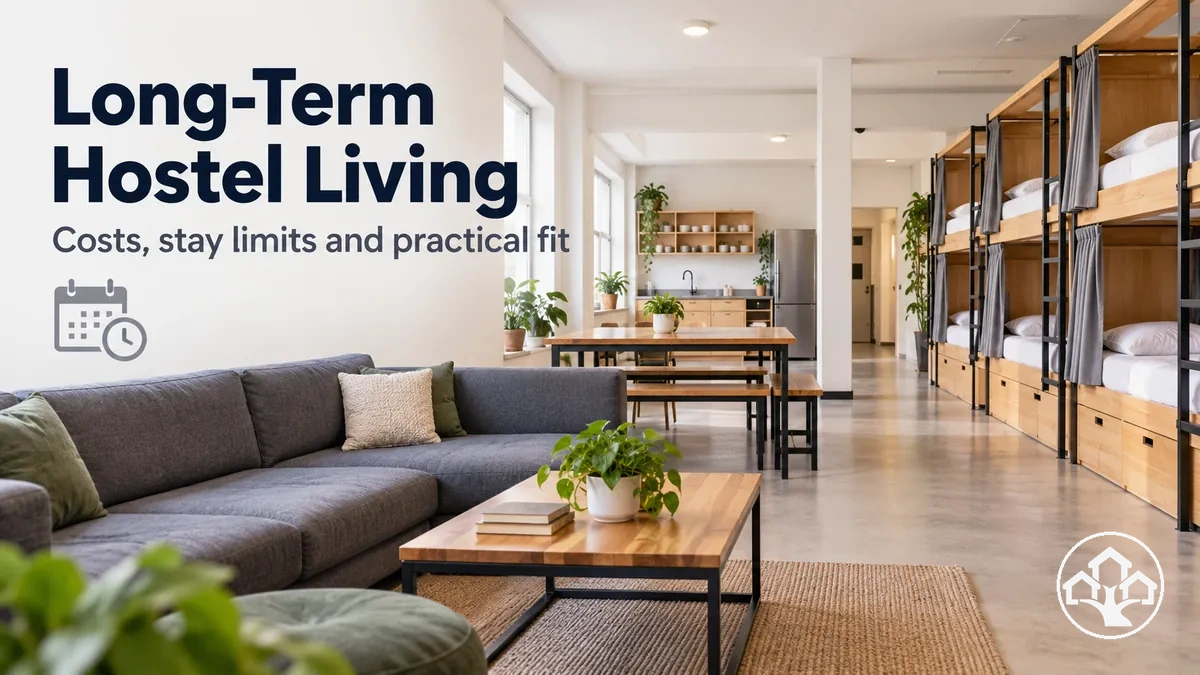
Long-term hostel living can be a lower-cost housing option if the hostel permits your full intended stay, the total price including applicable extras fits your budget, and the room and shared facilities support your daily needs. There is no universal hostel stay limit or monthly price: both depend on the property, room, dates and booking conditions.
Practical stay check
Would this hostel work for your extended stay?
Check six conditions against the specific hostel, room and dates. Choose an answer for each; the result flags unresolved requirements, not a guaranteed booking.
Checks still needed. Confirm each condition before relying on an extended booking.
A permitted extension is not a confirmed reservation. Treat a requirement that cannot be met as a reason to change room, dates or property, rather than letting a lower headline price decide the stay.
A longer hostel booking offers a different living arrangement from a conventional room rental; do not assume the same booking terms or tenancy protections apply. Check the agreement and any local rules relevant to your stay.
Table of Contents
How Long-Term Hostel Living Works
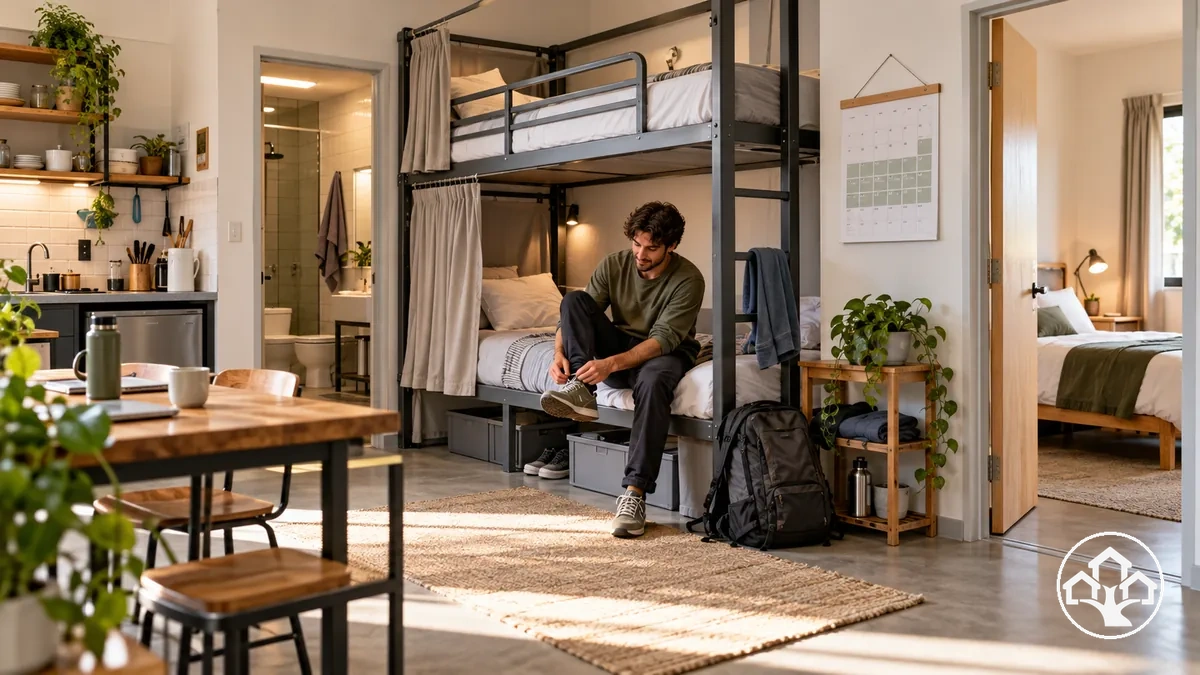
An extended hostel stay works by booking hostel accommodation for repeated nights or a longer block, then using the assigned sleeping space and available shared facilities under the property's hostel rules.
The room type may be a dorm room or, where offered, a private room.
How the arrangement functions day to day therefore depends on the booking period, room setup, facility access and property-specific conditions.
-
Establish the booking period
The stay may be arranged as one longer reservation or as repeated bookings, according to what the property accepts.
-
Use the available facilities under hostel rules
Common areas, kitchens and bathrooms are usable only where provided; access can be limited by the property's rules and hours.
-
Confirm any continuation
Extra nights require both the property's permission and an available bed or room. These conditions determine whether the guest can maintain the intended routine without an interruption.
During an ordinary short stay, temporary limits on cost, storage, privacy or facility access may have relatively little effect, but extended use makes those recurring conditions more important.
Long-term continuity therefore depends on the specific booking terms, extension conditions, hostel rules and facilities of the property rather than on a universal hostel arrangement.
Stay Limits and Rules for Extended Hostel Stays
There is no single universal maximum stay that applies across all hostels.
The permitted number of consecutive nights is set by the individual hostel policy and, where relevant, local accommodation conditions, so the allowed duration must be confirmed for the specific property.
For an extended stay, the main property rules to check are maximum duration, extension conditions, booking continuity and guest eligibility.
These criteria determine whether the intended stay is allowed in full, limited to a shorter period or dependent on approval and continued availability.

- Maximum stay: Check the permitted number of consecutive nights. If the intended duration exceeds the property's stay cap, the booking cannot cover the full period under that rule.
- Extension: Confirm whether an extension is permitted and what conditions apply. An existing booking does not establish that additional nights will be approved or available.
- Booking continuity: Verify whether the maximum stay applies to one reservation, consecutive reservations or the guest's overall stay. This determines whether separate bookings can provide continuous accommodation.
- Availability: An extension-dependent stay also requires an eligible bed or room to remain available for the additional period. Permission to request an extension does not by itself establish continuity.
- Guest eligibility: Check current age restrictions, room rules and other guest requirements stated by the property. If an applicable eligibility condition is not met, the intended booking or extension may not be available.
Hostel stay limits and guest eligibility should therefore be confirmed for the specific property and intended dates rather than inferred from another hostel's rules.
The usable duration is the period actually permitted by the current property rules, including any conditions attached to an extension or continued booking.
Maximum-Stay Policies and Extensions
A maximum-stay policy can cap a particular reservation, consecutive nights or repeated bookings, depending on its wording. No single maximum number of nights applies across all hostels.
A request to extend is not a confirmed booking. Check the limit that applies to your dates, whether an extension is allowed, and whether a suitable bed or room can actually be booked.
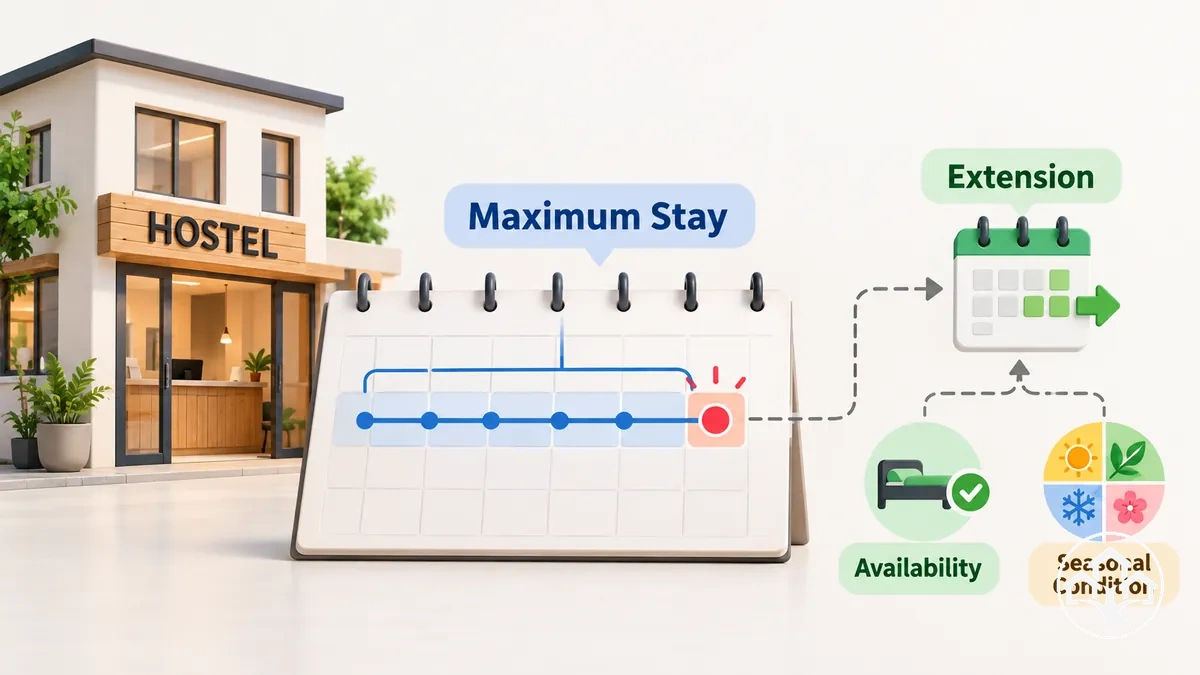
- Stated maximum: Check the exact number of consecutive nights permitted by the property policy. If the intended stay exceeds that limit, further nights require a policy that actually allows continued or additional booking.
- Extension: Confirm whether the property accepts extension requests and under which conditions. Permission to request an extension does not mean that additional nights will be approved.
- Availability: Even where an extension is permitted, continuity requires a suitable bed or room to remain available for the requested dates.
- Seasonal condition: If the property applies different stay limits or extension rules by season or another stated booking condition, the rule that applies to the intended dates determines the permitted duration. Extension eligibility should therefore be confirmed for the specific property and dates.
Age Limits and Other Guest Restrictions
Guest eligibility is property-specific: an age limit, minimum age or other guest restriction must come from the individual hostel policy rather than from hostel branding alone.
Hostel branding does not establish a universal upper-age restriction, and eligibility may also differ between a dorm room and a private room.

- Minimum age: Check whether the property sets a minimum age for booking or staying without an accompanying eligible guest. If that condition is not met, the booking may not be accepted.
- Upper-age restriction: Confirm whether the specific hostel applies an upper-age restriction to any room type. An upper age should not be assumed when the property rules do not state one.
- Dorm eligibility: Verify whether age-based or other guest rules apply specifically to dorm accommodation. A guest may be ineligible for a dorm room even when another room arrangement remains available under the hostel policy.
- Private-room eligibility: Check private-room eligibility separately rather than assuming dorm restrictions apply in the same way. The applicable condition is the rule stated for that room type.
- Other booking restrictions: Review any additional guest requirements that materially affect the intended stay. If a stated condition is not satisfied, the guest may be unable to make or continue that booking.
Age alone does not determine eligibility across hostels. Verify the current rule for the guest and room type: a condition applying to dorm beds does not necessarily apply to private rooms.
What Long-Term Hostel Living Costs
The all-in accommodation cost is the rate for the actual booked dates plus mandatory charges not included in that rate and separately charged services you expect to use. Compare complete quotes rather than a headline nightly price.
There is no single reliable monthly amount without the specific property's booking terms, because a nightly rate, weekly rate or monthly rate can change with room type, duration, season and availability.
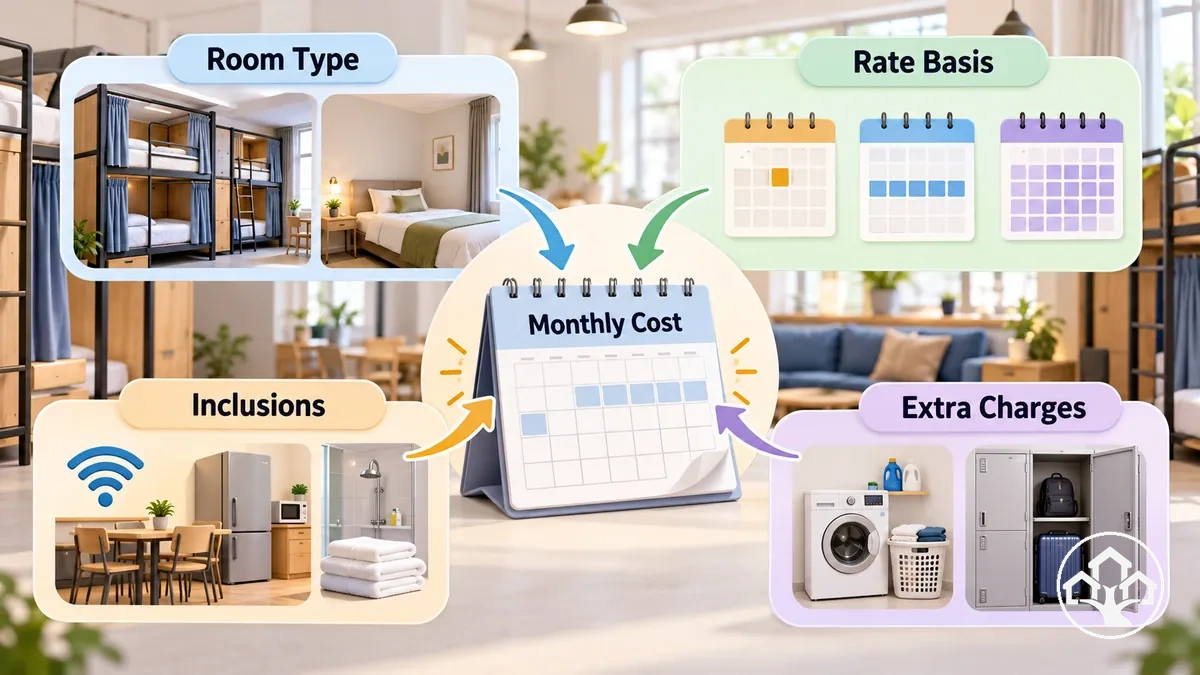
- Room type
- A dorm bed and a private room can have different prices and booking conditions. Price the room type you will actually occupy.
- Rate basis and dates
- The property may quote nightly, weekly or monthly rates. Confirm which rate applies to the exact duration, season and availability of your stay.
- Included services
- Only facilities or services included in the quoted rate are covered without a separate charge. Check what the room rate actually includes.
- Extras and up-front payments
- Add any payable laundry, storage or booking charges. If a refundable deposit is required, plan for the up-front payment separately from non-refundable accommodation costs.
Long-Stay Rates, Discounts and Extra Charges
A long-stay rate structure combines the applicable nightly rate, weekly rate or monthly rate with any discount, included service and extra charge attached to the booking.
A lower rate for a longer duration can reduce the recurring cost, but the reduction is property-specific and must be assessed together with charges that remain outside the base rate.
Without the specific property's booking terms, no reliable standard discount or extra-charge amount can be stated.
- Nightly rate: A stay priced by the night uses the property's applicable nightly rate for each booked night. Without a separate long-stay arrangement, the effective cost follows that nightly pricing basis for the full duration.
- Weekly or monthly rate: A weekly rate or monthly rate may use a different pricing condition from the nightly rate. If the property offers a lower long-stay rate for the required duration and dates, that rate reduces the accommodation component of the recurring cost; no standard reduction can be assumed.
- Discount: A discount applies only when the property's booking conditions make the guest and dates eligible for it. Its effect on the total depends on the stated reduction, duration and availability rather than on a guaranteed long-stay discount.
- Included service: An included service adds no separate charge under the stated booking terms, so its cost is already contained within the applicable accommodation rate.
- Extra charges: Separately priced items such as laundry or storage increase the effective long-stay cost only when the property charges for them and the guest uses or requires them.
The useful comparison is therefore the rate that applies to the intended stay plus the recurring extras actually payable under the same booking conditions.
A discounted weekly rate or monthly rate can still produce a higher effective total than the headline rate suggests when separate extra charges recur during the stay, so any discount should be evaluated alongside those recurring costs.
Daily Living Conditions During a Long-Term Hostel Stay
Daily hostel living conditions become more important when a shared environment is used repeatedly rather than for only a short stop.
Over an extended stay, sleep, personal space, access hours and shared-space activity affect day-to-day routine more than during a short visit. How significant they are depends on occupancy and the guest's work, study and sleep needs.
- Shared space: Repeated use of common areas means other guests' schedules and activities become part of the daily environment, which can affect how easily a consistent routine is maintained.
- Dorm room: Sharing a sleeping area reduces control over the immediate living environment compared with having an individual room, making the dorm arrangement more significant over a longer stay.
- Noise: Noise levels can change with occupancy, guest schedules and common-area activity. When noise overlaps with sleeping, working or studying periods, it can disrupt the routine even if the same level would be tolerable during a short visit.
- Personal space: The amount of space available for personal belongings and everyday activities affects how easily the accommodation can support repeated daily use.
- Facility access: Access to shared facilities for daily needs matters more when those facilities are used continuously, particularly when availability or access conditions affect when routine tasks can be completed.
A social traveller staying briefly may accept irregular activity and shared-space interruptions that are less compatible with a fixed work, study or sleep routine over several weeks.
Privacy, storage and facility access are therefore separate dimensions of the living setup that need their own assessment when judging the long-term practicality of a hostel stay.
Privacy in Dorm Rooms and Shared Facilities
Hostel privacy depends on room type, dorm occupancy, bed design, bathroom arrangements and property practices rather than on the word hostel alone.
A dorm room may offer only shared sleeping-space privacy, while a private room can provide greater separation where the property offers one; features such as a privacy curtain or private bathroom should be confirmed rather than assumed.
- Dorm occupancy: A dorm with more occupied beds creates more shared use of the sleeping area, which can reduce control over personal space and increase the chance of routine disturbance.
- Bed layout and privacy curtain: A privacy curtain, enclosed bunk design or greater separation between beds can increase sleeping-space privacy when provided. If those features are absent, the sleeping area remains more visually open to other occupants.
- Shared bathroom: A shared bathroom requires facilities to be used alongside other guests and may provide less individual control over timing and privacy than a private bathroom where one is available.
- Private room: A private room separates the sleeping space from other hostel guests, but bathroom facilities and surrounding common areas may still be shared depending on the room configuration.
- Quiet expectations: Property rules and guest behaviour can influence disturbance during sleeping or working periods, but quiet should not be treated as guaranteed unless the hostel states and manages specific quiet conditions.
- Personal space: The amount of space available around the bed, for belongings and for routine activities affects how easily a guest can maintain privacy and daily organisation during an extended stay.
These features should be checked individually because the same hostel can offer different privacy levels across room and facility configurations.
For a long stay, their importance is reflected in how well the setup supports sleep, personal space and a repeatable daily routine.
Storage and Security for Personal Belongings
Hostel storage and security should be verified at the property level because a locker or other lockable storage cannot be assumed to be available or suitable for every stay.
Match usable storage capacity and access controls to the bags, electronics and valuables you will bring; a lockable space reduces access but does not guarantee protection against loss or theft.
- Lockable storage: Confirm whether a locker or another form of lockable storage is provided and whether the guest must supply a compatible lock. The presence of a locking mechanism can restrict access, but it does not establish that belongings are completely protected.
- Storage size: Check the usable capacity against the personal belongings that need to be stored. A locker that accommodates small items may not be large enough for luggage or larger equipment.
- Location: Verify where the storage is positioned in relation to the dorm room or other guest areas. Storage located away from the sleeping space may change how convenient it is to access belongings during the daily routine.
- Access control: Confirm whether access is limited to the guest, shared with staff or governed by another restricted-access arrangement. The relevant security condition is the property's actual access procedure rather than the presence of a locker, camera or staff member alone.
- Valuables: Check the property rule for valuables such as a laptop or camera and whether the available storage size and access conditions are appropriate for those items. Storage suitability should be verified against the value, size and access needs of the belongings actually carried.
Kitchen and Laundry Access
Kitchen and laundry access can make an extended hostel stay more practical by supporting regular meal preparation and clothing care, but the available facilities and conditions are property-specific.
A communal kitchen may offer different cooking facilities and food storage arrangements, while laundry access may or may not include a washing machine, dryer or unrestricted access hours.
The criteria below separate equipment, availability, access rules and charges that affect daily routine and recurring cost.
- Cooking facilities: Check which cooking facilities are actually available in the communal kitchen, such as basic preparation space or cooking equipment permitted by the property. Limited equipment can restrict the types of meals that can be prepared during the stay.
- Food storage: Confirm whether food storage is provided and what allocation or labelling rules apply. Limited storage capacity can affect how much food can be kept between shopping trips.
- Kitchen access: Verify the communal kitchen's access hours and usage rules. Restricted periods or temporary closures can affect when meal preparation fits into the guest's routine.
- Washing machine: Confirm whether laundry facilities include a washing machine and whether access is included, scheduled or subject to a usage fee. Paid or limited washing access can add both a routine constraint and a recurring cost.
- Dryer: Check whether a dryer is available or whether another drying arrangement is provided. The absence of a dryer can change the time and space required for clothing care.
- Laundry charges and rules: Verify any separate usage fee, access hours and property rules that apply to laundry. These conditions determine whether regular clothing care adds an additional recurring cost during the extended stay.
Someone who cooks most meals or washes clothes regularly needs the relevant equipment, usable access hours and manageable fees. If any of these is missing, the recurring inconvenience or expense may make the stay less practical.
How to Judge Whether Long-Term Hostel Living Fits Your Situation
Assess non-negotiable needs before optional comforts. A hostel is a workable longer-term option only when its rules, full cost and everyday conditions support your specific requirements for the planned dates.
Check these conditions for the actual property and room. Failing a requirement that is essential to you can outweigh advantages elsewhere.
- Stay rules and continuity: The stay rules must permit the intended duration and provide a workable basis for continuity. If the required period exceeds the permitted stay or depends on extensions that cannot be relied on, practical fit is limited regardless of other advantages.
- Total cost: The total cost should remain affordable after the applicable accommodation rate and recurring charges are combined. If the effective recurring cost exceeds the available budget, the arrangement does not meet a core affordability condition.
- Privacy needs: The available room type, dorm occupancy and shared-facility setup should provide enough privacy for sleep, personal space and daily activities. A guest with stronger privacy requirements may find a shared dorm unsuitable even when the same arrangement is acceptable to someone with lower privacy needs.
- Facility access: Storage, kitchen, laundry and other required facilities should be available under conditions that support the intended routine. Missing, restricted or separately charged facilities can reduce practical fit when they are important to daily living.
- Routine compatibility: Noise, access hours, shared-space activity and other recurring conditions should be compatible with the guest's work, study, sleep or other routine. A social and flexible schedule may tolerate conditions that are difficult to maintain alongside fixed quiet or working periods.
- Shared-space tolerance: The guest should be comfortable with the level of shared space, changing occupancy and reduced control over common areas that the property actually involves. If those trade-offs remain acceptable after the harder constraints are satisfied, the hostel is more likely to function as a workable arrangement for the intended stay.
Two people using the same hostel can therefore reach different conclusions without either assessment being inconsistent: one may accept shared sleeping space and variable routines, while another may require greater privacy and predictability.
Long-term hostel living is a practical fit when the non-negotiable conditions are met and the remaining trade-offs are acceptable for the intended duration.
Conditions That Make a Long Hostel Stay Workable
A workable long hostel stay depends on whether the planned stay fits the property's rules and the guest's day-to-day needs match the conditions actually available.
May be workable
A guest with a flexible schedule, belongings that fit the available storage and tolerance for shared spaces may be able to maintain a routine, provided the stay is permitted and affordable.
Needs a different setup if essential conditions fail
A guest who requires predictable quiet periods, greater privacy or secure space for bulky equipment may need a different room or property if the available arrangement cannot provide these.
Suitability follows individual requirements and property conditions, not an age group or personality label.
First satisfy the hard constraints of permitted duration, continuity and total cost; then consider shared-space tolerance, facilities and storage over the full period.
- Permitted duration: The intended stay is workable when the hostel's stay rules permit the required period or provide an extension arrangement that can support continuity. If the planned duration exceeds the permitted stay without a workable continuation option, the arrangement cannot cover the full period as intended.
- Acceptable cost: The accommodation rate and recurring charges need to remain within the guest's budget for the planned duration. When the total recurring cost is acceptable, the hostel can remain financially workable throughout the intended stay.
- Flexible routine: A flexible routine can accommodate changing occupancy, shared-facility timing and other variations in daily hostel conditions. A routine requiring highly predictable quiet periods or access times instead needs hostel conditions that can support those requirements.
- Shared-space tolerance: The arrangement is more workable when the actual level of dorm and common-area sharing remains acceptable to the guest. Lower shared-space tolerance requires a room and facility configuration that provides greater separation.
- Manageable belongings: A guest carrying belongings that fit the available storage provision can use the accommodation more easily from day to day. Larger luggage or valuable equipment requires storage capacity and access conditions appropriate to those belongings.
- Facility access: Kitchen, laundry, bathroom and other required facilities need to be available under access conditions that support the planned routine. When these practical needs, continuity requirements and the hostel's actual conditions remain aligned, the extended stay can function as a workable arrangement for the intended period.
Trade-Offs That Can Make a Long Hostel Stay Unsuitable
A long hostel stay can become unsuitable when a non-negotiable requirement is repeatedly unmet rather than when the guest simply encounters an ordinary inconvenience.
The criteria below separate preferences that may be manageable from constraints involving continuity, privacy, quiet, secure storage, facility access or predictable cost that can materially affect the viability of the arrangement.
- Continuity: If stay limits, extension conditions or availability cannot support the required period, the guest may face repeated booking uncertainty or an interruption in accommodation. When uninterrupted housing for the planned duration is a non-negotiable requirement, that lack of continuity can make the hostel arrangement unsuitable.
- Privacy: If the available room and shared-facility setup does not provide the level of privacy required for sleep, personal activities or daily routine, the same limitation recurs throughout the stay. Reduced privacy may be an acceptable trade-off for one guest but a deal-breaker when greater separation is essential.
- Quiet: If the hostel's actual sleeping environment and quiet conditions repeatedly conflict with required sleep, work or study periods, routine disruption can accumulate over time. Occasional noise may be manageable, but a recurring conflict with a required quiet period can make the arrangement a poor practical fit.
- Secure storage: If the available locker or other secure storage cannot accommodate important belongings or its access conditions do not meet the guest's requirements, valuables may need another storage arrangement. When suitable storage for essential equipment or personal belongings is non-negotiable, that unresolved constraint can make a long stay impractical.
- Facility access: If required kitchen, laundry, bathroom or other facilities are unavailable, restricted at necessary times or subject to conditions that conflict with the guest's routine, everyday tasks become harder to manage repeatedly. The limitation becomes a suitability issue when the facility is essential rather than merely preferred.
- Predictable cost: If accommodation rates, recurring charges or required facility fees prevent the total cost from remaining sufficiently predictable for the planned period, budgeting becomes harder. When cost certainty within a fixed budget is required, that financial uncertainty can make the arrangement unsuitable even if other hostel conditions are acceptable.