
Shared Housing and Room Rentals as a Low-Cost Housing Option
Shared housing can reduce individual housing costs by sharing a dwelling and some expenses, while a room rental usually provides a private room with access to shared facilities. To decide whether a particular home is a good fit, compare total rent and separate bills, the privacy it offers and the house rules and responsibilities you can accept—not the advertised room price alone.

SHARED HOUSING DECISION AID
Check a room's real cost and everyday fit
Use one prospective room rental at a time. Enter weekly amounts in Australian dollars and consider the living conditions you would actually accept. Results flag possible conflicts and unanswered questions; they do not certify that a tenancy is suitable.
Your check
Add the details above and select “Assess this room” to see a weekly cost estimate and practical checks.
- Confirm exactly which bills are included, which areas are private and who handles shared responsibilities.
Budgeting uses weekly total × 52 ÷ 12 for an average calendar-month equivalent, not an exact calendar-month payment. Upfront bond, advance rent, moving costs and personal expenses are excluded; agreement terms and state or territory rules may change what is payable.
Table of Contents
How Shared Housing and Room Rentals Work
A shared housing arrangement combines individual occupancy with shared use of the same dwelling.
What is private, shared and agreed
- Individual occupancy
- A bedroom may be private, or sleeping space may be semi-private. The property's layout and occupancy agreement determine what a resident can use exclusively.
- Shared facilities
- A kitchen, bathroom or living area may be used by several people, requiring coordination over access and daily use.
- Shared costs and duties
- Bills, cleaning and other responsibilities may be divided or handled separately, as the occupants agree; living in the same dwelling does not make every expense communal.
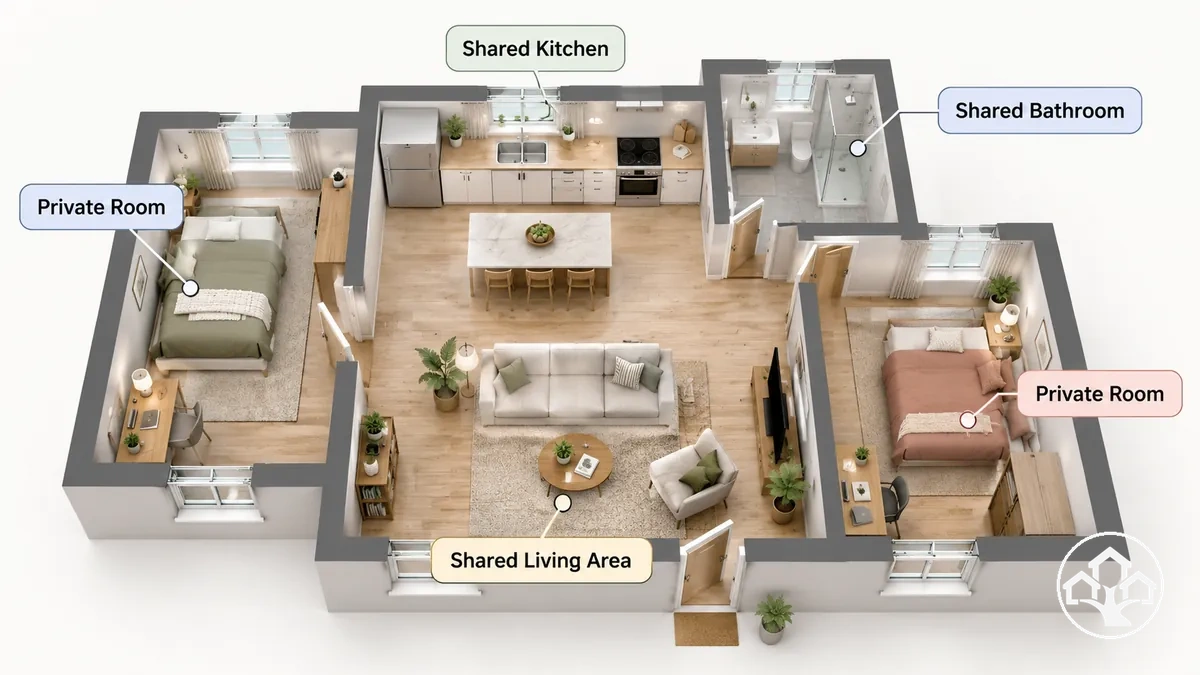
For example, housemates can occupy separate bedrooms while sharing the kitchen and bathroom and coordinating their use of those common facilities.
This operating model makes shared housing one of several low-cost housing alternatives, with the exact balance of private space, shared space, costs and responsibilities determined by the individual arrangement.
The Difference Between Shared Housing and a Room Rental
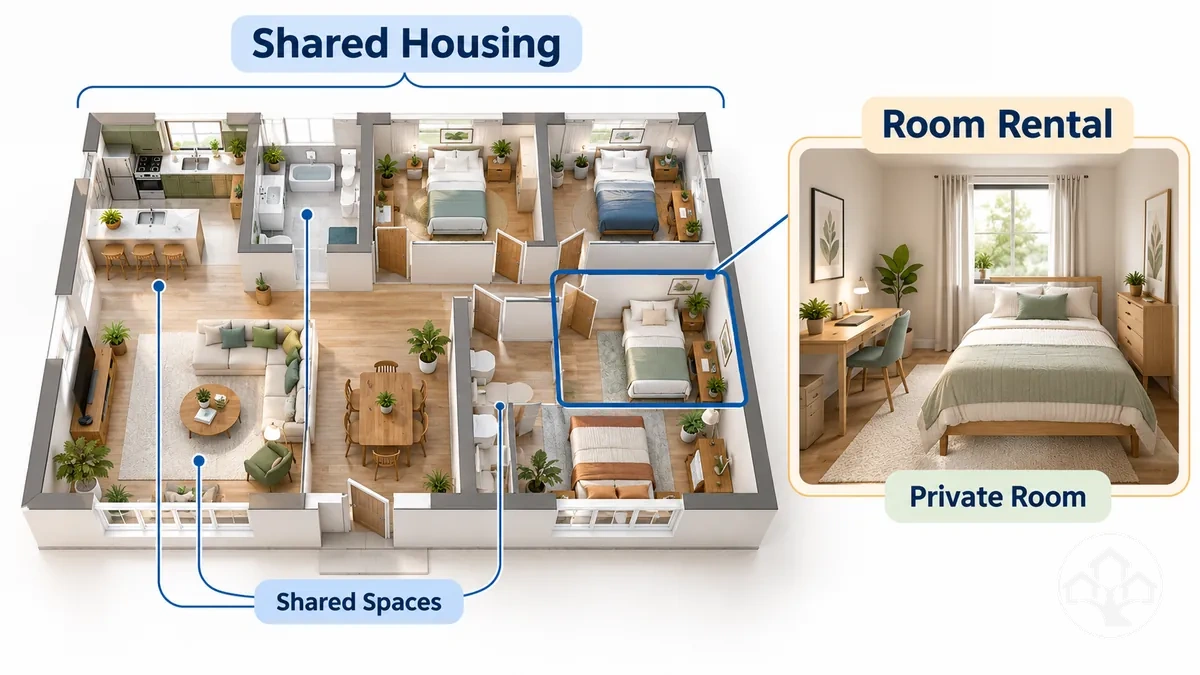
Shared housing describes the broader living arrangement in which occupants use the same dwelling, while a room rental usually describes the specific rented room or occupancy within that living arrangement.
The terms can overlap because a rented room may exist inside shared housing where private space is combined with shared spaces and household coordination.
A room rental can involve a rented room with private space while the kitchen, bathroom or other communal areas are used by multiple occupants.
Shared housing focuses on how the dwelling functions as a shared home, including occupancy patterns, shared spaces and household coordination.
Neither term should be treated as a universal legal category because individual agreements and arrangements vary.
Before paying, check who grants occupancy, who receives rent or bond, what space you can use and which written terms apply. Whether the arrangement is a tenancy, sublet, boarding arrangement or another form of occupancy depends on its facts and the relevant Australian state or territory law.
| Term | Primary emphasis | Typical private/shared arrangement | Practical implication |
|---|---|---|---|
| Shared housing | The overall living arrangement | Occupants share a dwelling with private space and shared common areas | The focus is how the household functions through shared spaces and coordination |
| Room rental | The specific rented room or occupancy | A person rents a room while some facilities may remain shared | The focus is the rented space and the conditions of using shared areas |
Private Rooms and Shared Common Areas
Private rooms and shared common areas define how space is divided within a shared home.
A private room provides exclusive space for an individual occupant, while shared spaces such as a kitchen, bathroom or living area are accessed by multiple occupants.
This balance between private and communal space affects privacy, access and household coordination.
Different space arrangements create different everyday experiences because access conditions determine how occupants use facilities and organise routines.
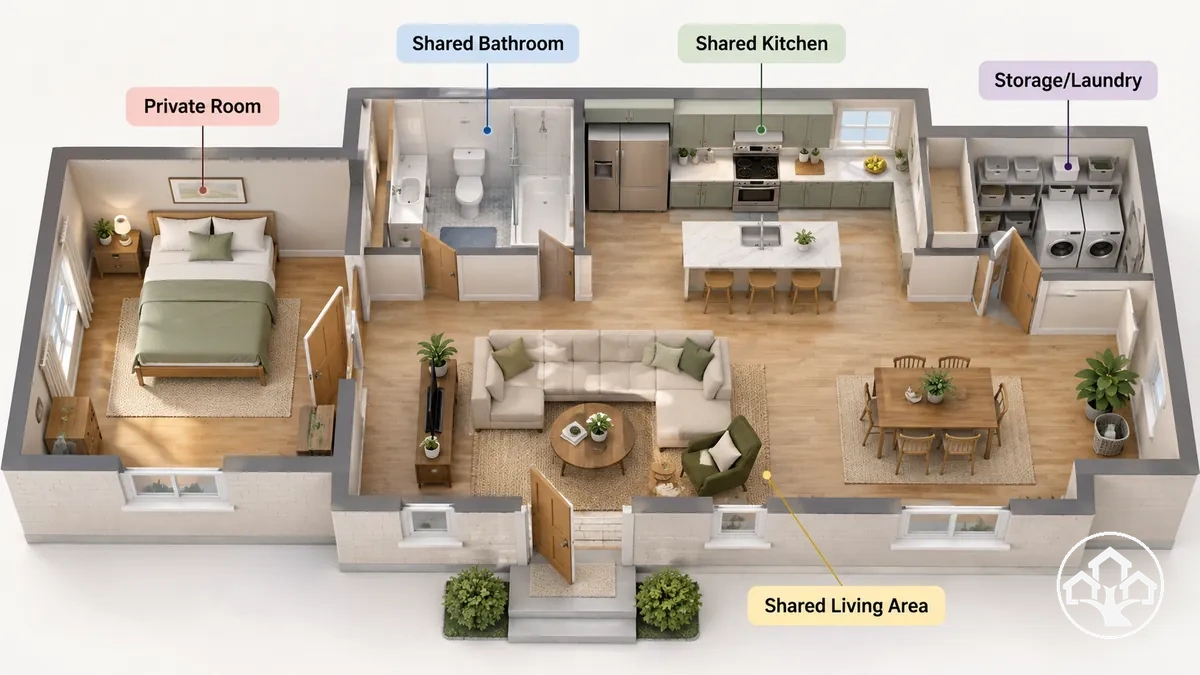 The same room rental can involve different levels of privacy depending on which spaces are private, which are shared and how occupants coordinate their use.
- Private room: provides exclusive personal space for sleeping, storage or individual activities.
- Shared bathroom: is a commonly accessed facility where occupants may need to coordinate timing and routines.
- Kitchen: is a shared space where occupants may coordinate access, storage and everyday use.
- Living area: functions as a communal space used by multiple occupants for shared activities.
- Storage or laundry: may be private, shared or condition-dependent, affecting household organisation.
What Shared Housing Costs Include and How They Are Split
Shared housing costs usually include a base rent or room charge plus any utilities, internet, or agreed shared household expenses that apply to the arrangement.
The full monthly housing cost depends on which costs are included in the rent and which costs are billed separately according to the property and occupant agreement.
An advertised room price may not represent the complete recurring outlay because some arrangements include certain utilities or household costs while others require occupants to handle them separately.
Compare charges on the same time basis: a weekly rent or bill can be converted to an approximate monthly budget using weekly cost × 52 ÷ 12. Use a realistic estimate or range for variable bills, rather than assuming an unconfirmed charge is zero. Bond, rent in advance and moving expenses are separate upfront costs and are not part of this recurring total.
Common cost categories can be understood by separating included costs from separately shared costs.
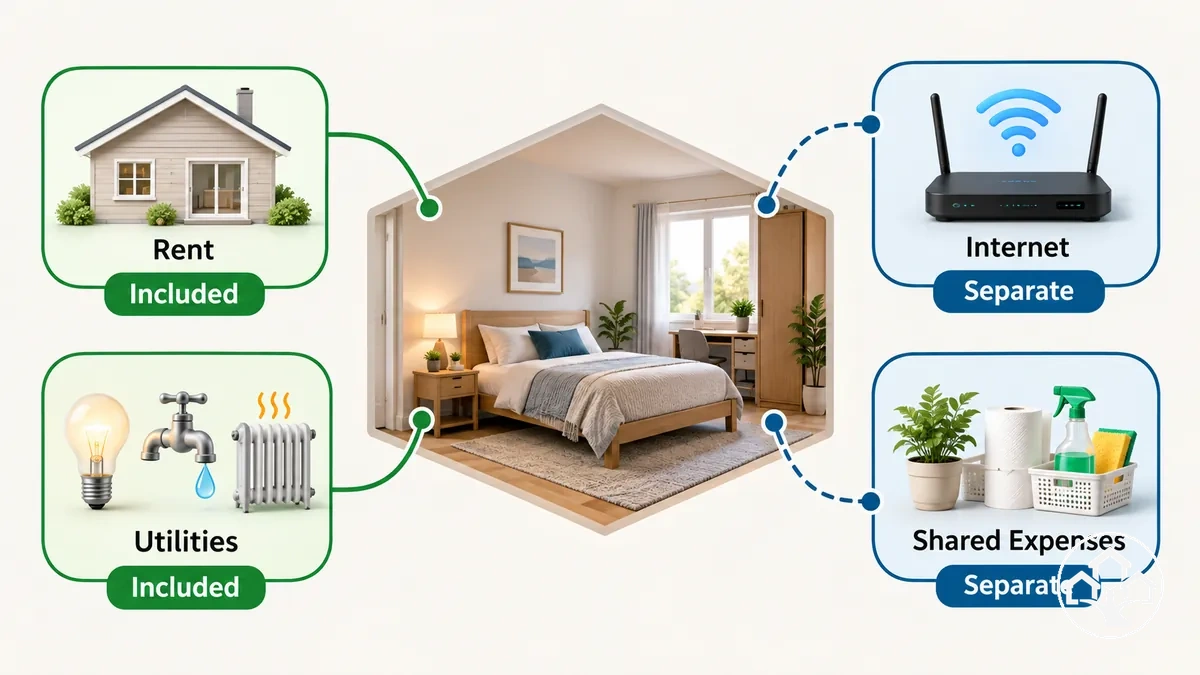
When costs are separate, the occupant share depends on the allocation method used for that expense.
For example, utilities may be included in the room charge in one arrangement but billed separately and divided among occupants in another.
Understanding the cost structure of shared housing helps clarify the recurring charges for the arrangement.
For a broader assessment of total housing expenses, occupants can compare monthly housing costs separately.
| Cost category | May be included? | If separate, how it may be shared | Effect on monthly outlay |
|---|---|---|---|
| Rent | Forms the base housing charge | Assigned according to the room or occupancy agreement | Creates the main recurring housing cost |
| Utilities | May be included or billed separately | May be divided according to the agreed allocation method | Changes the additional amount paid beyond the base charge |
| Internet | May be included or handled separately | May be shared among occupants if agreed | Adds to recurring household costs when separate |
| Agreed communal household expenses | May vary by arrangement | May be shared between occupants based on the agreement | Affects each occupant's share of ongoing expenses |
Rent and Shared Household Expenses
Rent is the recurring charge connected to the room or occupancy, while shared household expenses are additional recurring costs that may be included, billed separately or shared depending on the arrangement.
Separating these categories helps identify which costs belong to the individual occupant and which costs relate to the shared home.
Some expenses are directly connected to the rented room, while others support the ongoing use of shared facilities.
Electricity, gas, water and internet may be included in the rent or handled as separate shared costs according to the agreement.
Cleaning supplies and other communal expenses may be shared when occupants agree to pool them, while personal costs such as groceries or individual subscriptions are not shared by default.
One example is a room with utilities included compared with a lower room charge where several recurring expenses are billed separately.
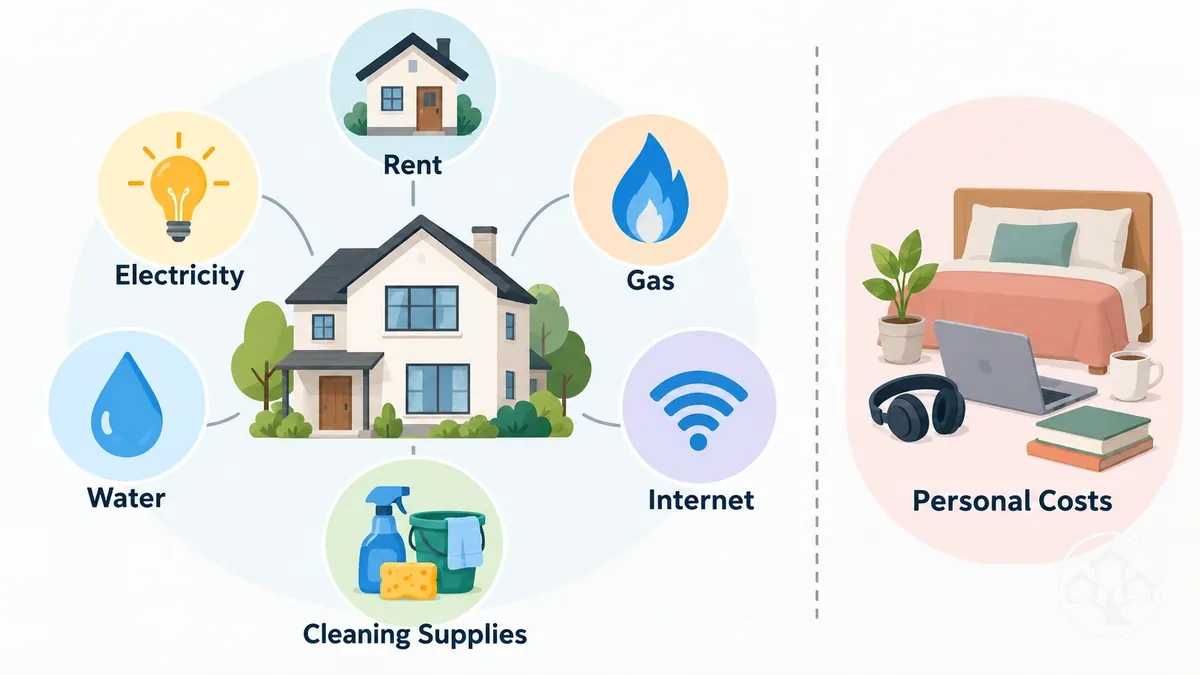
- Rent: the main recurring housing charge for the room or occupancy and usually an individual occupant responsibility.
- Electricity: a utility expense that may be included or billed separately and shared according to the agreement.
- Gas: a utility-related cost that may be included or allocated between occupants when separate.
- Water: a recurring household expense that may be covered by the arrangement or shared between occupants.
- Internet: a connectivity cost that may be included, separately billed or shared depending on the agreement.
- Cleaning supplies: a communal expense that may be pooled when occupants agree to share household items.
- Personal costs: expenses such as groceries and subscriptions that remain the responsibility of the individual using them.
Splitting Rent and Utilities Between Housemates
Housemates can divide rent and utilities using different allocation methods depending on what is being shared and which factors are relevant.
Costs may be split equally or adjusted according to room size, occupancy or measurable use when those differences are important to the arrangement.
The suitable allocation method depends on the conditions of the shared home and the level of administration involved.
An equal split can simplify payments when housemates have similar arrangements, while a room-weighted split may reflect differences in private space.
An equal split among named payers divides a particular bill by the number of people agreeing to pay it. A per-occupant split counts residents even when two people share one bedroom; the results may differ if there are fewer named payers than occupants. A usage-based split requires reliable measurement, and housemates should agree on the method before costs arise.
For example, four housemates with similar rooms may choose an equal split, while a home with one much larger private room may consider a room-weighted approach.
| Method | Best-fit condition | Calculation basis | Main trade-off |
|---|---|---|---|
| Equal split | Named payers agree to share a particular bill equally | Total bill ÷ number of named payers | Easy to administer but may differ from a per-occupant share in homes with multiple occupants per room |
| Per-room or room-weighted split | Rooms differ in size or private-space characteristics | Shares are adjusted according to room differences | May reflect room variations but requires agreement on weighting |
| Per-occupant split | Costs relate to the number of residents, including shared bedrooms | Total bill ÷ number of contributing occupants | Reflects headcount but not differences in private-room size or measured use |
| Usage-based split | Individual use can be measured reliably | Costs are allocated according to measurable use | Can require tracking and additional administration |
Privacy and Personal Space in Shared Housing
Practical privacy in shared housing depends on the balance between private space, shared space and household expectations.
Two dimensions of privacy
- Control over private space
- Who may enter your bedroom, where belongings are stored and how much personal space is exclusively yours.
- Control over shared routines
- Bathroom timing, visitors, noise, time alone and common-area access depend on layout and housemate expectations. A private bedroom does not resolve every privacy concern.
- Bedroom privacy: depends on the level of exclusive space available and how much control an occupant has over access to the bedroom.
- Bathroom sharing: affects privacy through shared access, scheduling needs and coordination between occupants.
- Storage: influences personal control depending on whether belongings are kept in private or shared storage areas.
- Noise: depends on room placement, household routines and expectations around sound levels.
- Guests: can change privacy conditions depending on household expectations and how shared spaces are used.
- Common-area use: affects privacy through shared access to kitchens, living areas and other communal spaces.
- Time alone: depends on whether occupants have opportunities to separate from shared household activity.
For example, two homes with the same number of housemates may create different privacy conditions if one has stronger separation between private and shared spaces while another has more shared activity areas.
The practical level of privacy remains dependent on layout, access patterns and household expectations rather than the number of occupants alone.
Housemate Responsibilities in a Shared Home
Housemate responsibilities are the recurring obligations that help keep shared living workable for everyone in the household.
They include financial reliability, care of common areas, household tasks, shared supplies and communication about agreed expectations.
The way these responsibilities are assigned can vary depending on the shared home arrangement.
Clear responsibility ownership helps housemates understand who manages different aspects of shared living and what standard is expected.
For shared bills, specify who pays the supplier, how each person's share is calculated and when reimbursement is due. For chores, agree whether one person owns a task or whether the duty rotates, with a practical standard for completion.
Financial reliability relates to meeting agreed payments and shared expenses, while common-area care and household tasks support cleanliness and everyday use of the home.
Shared supplies require coordination when communal items are used, and communication helps clarify expectations when routines or responsibilities change.
- Financial responsibilities: cover agreed payments and shared expenses, with each person's responsibility depending on the household arrangement.
- Common-area care: involves maintaining shared spaces so they remain usable for all occupants.
- Household tasks: include recurring duties that support the operation and upkeep of the shared home.
- Shared supplies: involve coordinating agreed communal items and how they are managed.
- Communication: helps clarify ownership, expectations and changes to shared responsibilities.
For example, housemates may experience fewer misunderstandings when they agree who manages certain responsibilities and what standard applies to each area.
The effect depends on the household's expectations, routines and how clearly responsibilities are coordinated.
Chores, Cleaning and Common-Area Duties
Common-area chores are recurring coordination tasks that help maintain shared spaces in a usable condition.
These duties involve assigning responsibility for cleaning, upkeep and replenishing communal supplies rather than creating a fixed obligation that applies identically to every household.
The frequency, standard and ownership of each task depend on how a household uses its shared spaces and how occupants choose to organise responsibilities.
Some households assign fixed ownership for specific duties, while others use rotation so tasks move between housemates over time.
For example, one household may assign one person to manage rubbish consistently, while another may rotate rubbish and cleaning duties among occupants.
- Dishes: need regular attention based on household use and may be assigned to individuals or managed through rotation.
- Rubbish: involves removing waste when required and may be handled by a designated person or shared responsibility.
- Bathroom cleaning: requires recurring upkeep of a shared facility, with frequency and ownership depending on household expectations.
- Kitchen cleaning: covers maintaining shared preparation areas and may be assigned or rotated between occupants.
- Shared surfaces: include commonly used areas that need cleaning according to their use and agreed standards.
- Communal supplies: involve replenishing agreed household items when occupants share responsibility for their availability.
House Rules and Expectations Between Housemates
House rules and expectations convert recurring shared-living needs into clear behavioural boundaries between housemates.
They clarify how occupants use shared spaces, communicate preferences and coordinate routines without creating a universal set of rules for every household.
Different rule areas help define expectations around access, shared resources and everyday habits.
Guests, noise, cleaning standards, food boundaries, storage boundaries, shared supplies and common-area use are areas where agreement can reduce ambiguity and support smoother coordination.
The specific expectations depend on the household arrangement, routines and what occupants agree is practical.
- Guests: an agreement about visitors clarifies expectations around notice, frequency and use of common areas.
- Noise: shared expectations about sound and routines define boundaries around everyday activities and quiet periods.
- Cleaning standards: agreed expectations clarify the condition of shared spaces and how upkeep is coordinated.
- Food boundaries: clear agreements distinguish personal food items from supplies intended to be shared.
- Storage boundaries: agreed use of storage areas clarifies ownership and access to personal or communal space.
- Shared supplies: expectations define which household items are communal and how their use is coordinated.
- Common-area use: shared-space expectations clarify how kitchens, living areas and other communal spaces are used.
Unclear expectation
“Guests are fine” leaves unanswered whether advance notice, overnight stays or shared-space use have limits.
Explicit agreement
Housemates discuss notice, frequency, overnight visits and common-area use, then record whichever boundaries they agree to follow.
Clear expectations also make it easier to prepare when people move into shared housing.
When Shared Housing Is a Practical Fit
Shared housing is a practical fit when its monthly cost, privacy level and coordination demands align with a person's priorities and constraints.
The arrangement may suit someone when shared facilities, household reliability and flexibility match their living needs, but suitability depends on the actual conditions of the shared home.
Start by identifying non-negotiable constraints that determine whether the arrangement is acceptable.
Monthly cost, privacy needs, comfort with shared facilities and tolerance for coordination may limit whether shared housing fits.
Other factors, such as social preference, flexibility and expected duration, may be treated as negotiable preferences.
The balance between these conditions helps determine whether the arrangement is workable.
- Identify non-negotiables: Consider whether essential conditions such as budget constraints, privacy needs or shared-facility requirements can be accommodated. If a key requirement conflicts with the arrangement, the fit may be unsuitable.
- Evaluate acceptable trade-offs: Assess how cost, privacy, coordination and household reliability interact. A person may accept more shared responsibilities or less private space when other priorities align with their needs.
- Form a conditional suitability conclusion: Decide whether the arrangement fits based on the combination of constraints, preferences and expected living conditions rather than a universal rule.
A person prioritising lower monthly cost and comfortable shared facilities may find shared housing suitable when the coordination demands are manageable.
Someone with stronger privacy needs and limited tolerance for shared routines may find the same arrangement less suitable under those conditions.
Evaluating shared housing fit focuses on whether this specific arrangement aligns with a person's needs rather than determining every possible housing option.
For broader selection criteria across different arrangements, people can decide whether shared housing fits within a wider housing decision process.
Benefits That Can Make Sharing a Home Work
Potential benefits of shared housing are conditional outcomes that depend on whether the arrangement matches a person's needs and circumstances.
Features such as shared expenses, shared facilities and household interaction can create practical value when the property conditions, agreement and household dynamic support those benefits.
Each benefit becomes meaningful under a specific condition rather than applying to every shared housing arrangement.
Lower individual housing costs, access to shared facilities, social contact, companionship and flexibility may improve suitability when they align with a person's preferences and the actual terms of the household.
- Lower individual housing costs: can reduce personal housing expenses when shared expenses and the arrangement provide a cost structure that matches the person's budget constraints.
- Shared facilities: can provide practical access to amenities when a person is comfortable with shared use and the available facilities meet their needs.
- Social contact: may support social interaction when a person values regular contact and the household dynamic suits that preference.
- Companionship: can offer a more connected living environment when occupants prefer shared daily interaction and the arrangement supports that expectation.
- Flexibility: may provide value when the agreement, duration and household conditions align with a person's need for adaptable living arrangements.
Trade-Offs That Can Make Shared Housing a Poor Fit
Shared housing can be a poor fit when privacy, control, routines or shared-responsibility demands conflict with a person's priorities.
The arrangement may become less suitable when the conditions of shared living do not align with the level of personal space, coordination or reliability a person needs.
Trade-offs become decision-relevant when specific conditions create practical impacts on everyday living.
Limited privacy, reduced common-area control, noise, schedule mismatch, shared rules, household effort and disputed expenses can each affect suitability depending on the household arrangement.
These factors do not make shared housing unsuitable in every case, but they may become significant when they conflict with a person's needs.
The following criteria show when each trade-off may carry more weight.
- Limited privacy: becomes more significant when a person needs greater personal space and the available arrangement provides less control over private time or areas.
- Common-area control: may become a drawback when an occupant prefers more control over shared spaces and household usage patterns differ.
- Noise: can affect comfort when household activity levels or routines conflict with a person's preferred environment.
- Schedule mismatch: may increase coordination demands when occupants have different daily routines or expectations about shared living patterns.
- Shared rules: can become a constraint when agreed household boundaries limit preferences around shared spaces or routines.
- Household effort: may become significant when expectations around shared responsibilities and contributions do not align between occupants.
- Disputed expenses: can affect suitability when shared costs or contributions are unclear and household members have different expectations.
For example, a person may accept shared facilities because they value lower individual housing costs, but the arrangement may become a poor fit if limited privacy and schedule mismatch have a greater impact on their daily comfort.
These trade-offs describe shared housing suitability rather than every shared-accommodation option.
A separate comparison can explore how this arrangement relates to long-term hostel living without expanding that comparison here.