
How to Move Into Shared Housing
To move into shared housing, confirm the rent, any bond, included bills, room and access before arrival, then agree on privacy, guests, chores and shared payment responsibilities. Coordinate keys and the arrival time, check the room and inclusions on move-in day, and record issues for follow-up. Formal tenancy and bond requirements depend on the agreement and applicable state or territory rules.

Plan your move
Shared-house move-in checklist
Follow the move from agreeing on a room through arrival and the first household review. Tick an action only when you have actually confirmed or completed it.
0 of 9 actions marked complete. Next: confirm the occupants, assigned room and access to communal areas.
This is a household planning aid, not a legal tenancy check. Selections reset when this page is reloaded.
Use the detailed checks below to record what each housemate has agreed, distinguish shared routines from formal obligations, and adjust only those arrangements that need attention once the household is running.
Table of Contents
Confirm the Shared-Housing Arrangement Before Moving In
The shared-housing arrangement should be confirmed before move-in by checking the practical terms that affect occupancy, access and responsibilities.
Before belongings are moved in, housemates need clear agreement on the conditions that shape how the shared home will operate, including room allocation, payment obligations and access to shared facilities.
The main verification points are the agreed terms that affect daily use of the home.
Confirming who occupies each space, which services are included, what costs are assigned and how shared spaces are used helps identify unresolved expectations before they become practical problems.
Household agreements should be clear between housemates, while formal tenancy or landlord obligations depend on the specific agreement and location.
The following criteria identify the practical terms that should be confirmed before committing belongings to the shared housing arrangement.
Each criterion highlights the condition to check and the move-in implication if that condition remains unclear.

- Occupancy: Confirm who will live in the shared home and whether the agreed occupancy matches the available space. Unclear occupancy expectations can affect privacy, routines and shared-space use.
- Room allocation: Verify which bedroom or private area each housemate will use and what access applies to each space. Clear room allocation helps establish privacy boundaries before move-in.
- Payment obligations: Confirm the agreed rent, bills and other shared costs, including who is responsible for each payment. Unclear payment obligations can create disagreements after the arrangement begins.
- Included services: Check which services or utilities are included in the arrangement and which responsibilities remain separate. This clarifies the ongoing obligations each housemate should expect.
- Shared facilities: Confirm access to communal areas such as kitchens and bathrooms and how those spaces are intended to be used. Shared facilities require clear expectations because multiple people rely on the same areas.
- Access: Verify how housemates enter the property and use keys or other access methods. Unclear access arrangements can affect daily routines and practical responsibilities.
- Existing household expectations: Confirm any agreed routines, boundaries or responsibilities already established in the home. Unresolved expectations can create avoidable friction after move-in.
These checks help separate confirmed move-in terms from details that can be adjusted after arrival.
For a wider overview of available arrangements, see shared housing and room rentals.
Clarify Rent, Bond, Included Bills and Payment Responsibilities
Each payment obligation in shared housing should be identified by its amount or basis, payer, timing and inclusion status before move-in.
Confirming these details shows what each housemate is expected to pay and separates the agreed housing amount from costs that may be paid separately or change over time.
Rent is the main housing payment, while a bond or deposit, utilities and recurring shared costs can have different payment conditions.
A bond or deposit is generally an upfront amount held as security rather than a regular rent instalment. Confirm who receives it, whether any required lodgement applies, and how its return or deductions are handled; these obligations depend on the occupancy arrangement and applicable state or territory rules.
Utilities and shared bills also need clear responsibility because included services and separately paid charges affect the actual payment obligations of each housemate.
The following criteria separate costs included in the agreed housing amount from costs that require separate payment or ongoing confirmation.
Use these checks to identify unresolved payment terms before moving in.
Each item clarifies the payment basis, responsible person, timing and practical implication of an unclear obligation.

- Rent: Confirm the agreed rent amount or payment basis, the payer responsible for it and the due date. This identifies the main recurring housing payment for the shared arrangement.
- Bond or deposit: Confirm whether a bond or deposit applies, the agreed amount or basis, who provides it and any conditions connected to it under the relevant agreement. Also ask for a record of the amount paid and verify any bond-lodgement or return process that applies to the arrangement.
- Included bills: Check which utilities or services are included in the agreed housing amount. Included bills clarify which costs are already covered by the arrangement.
- Separate utilities: Confirm which utilities or bills are paid separately and how responsibility is assigned. Separate charges affect the total payment responsibility of each housemate.
- Shared costs: Identify recurring shared costs, the payer responsible for each charge and when payment is required. Clear assignment prevents uncertainty about ongoing expenses.
- Due dates and payment timing: Confirm when each payment is due and who receives the payment. Clear timing helps housemates coordinate their responsibilities.
- Responsibility for changes: Confirm how changes to variable charges or shared expenses will be handled. Unclear responsibility can create disagreements when payment amounts change.
For example, a room with a lower advertised rent may cost more to occupy once separately billed utilities and agreed shared charges are counted. Compare rent plus separate charges and do not add a utility a second time if the agreement already includes it.
Resolving these terms before move-in helps distinguish the advertised rent from the wider payment responsibilities of the shared-housing arrangement.
Confirm the Room, Furnishings, Utilities and Shared Items Included
Private space, furnishings, utilities and shared items should be checked against what was promised before moving into shared housing.
Verifying these inclusions confirms what is present, the condition of each item and what access or responsibility applies before belongings are moved in.
The verification checklist records the presence, condition and access details of important inclusions rather than creating a complete household inventory.
Checking these details helps distinguish provided items from shared items and identify unclear responsibilities before move-in.
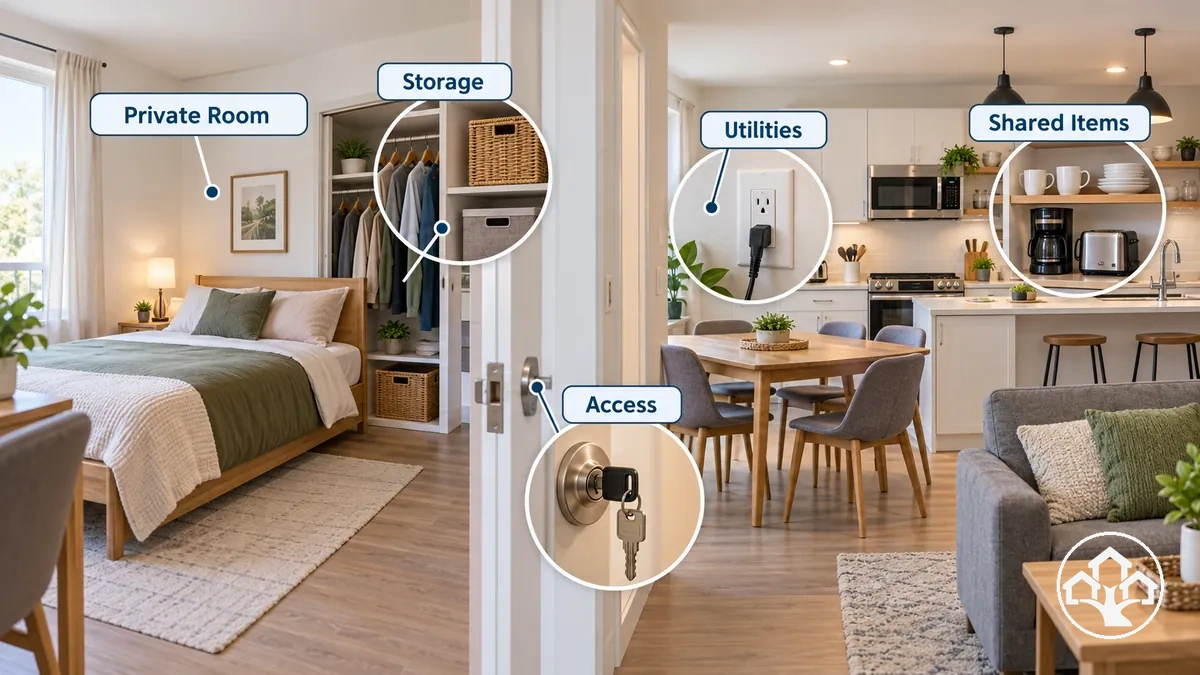
- Room and private space: Confirm the assigned room or private area is available and matches the agreed arrangement. The condition and access of the space affect privacy and move-in setup.
- Storage: Check whether storage areas are available, where they are located and whether access is private or shared. Clear storage expectations help prevent space conflicts after arrival.
- Furnishings: Verify which furniture items are provided and their condition at move-in. The presence and condition of furnishings determine whether additional setup is needed.
- Utilities: Confirm which utilities are available and whether access is ready for use. Utility availability affects the practical use of the shared home.
- Internet access: Check whether internet access is provided, shared or requires separate setup. This clarifies whether connectivity responsibilities remain unresolved.
- Keys and entry devices: Verify that required keys or access devices are available and functional. Clear access arrangements support daily routines after move-in.
- Shared items and appliances: Confirm which communal items, such as kitchen appliances or shared equipment, are available and what responsibility applies for their use or care. This prevents assumptions about shared resources.
Record any significant gaps between the confirmed inclusions and the actual condition or availability of items before move-in so unresolved responsibilities can be clarified early.
Agree on House Rules and Communication Before Moving In
House rules should cover behaviours that materially affect other residents in shared housing.
Before moving in, housemates should agree on expectations for communication, shared spaces and routines so that responsibilities and boundaries are clear before daily use of the home begins.
The most useful expectations are connected to shared impact rather than personal preferences.
These expectations usually involve behaviour, communication and shared-space use because unclear assumptions about guests, noise, food, cleaning or privacy can affect how housemates use the home.
The exact rules needed depend on the people, routines and layout of the shared home, so agreement should focus on matters that affect others.
Group expectations by the areas where shared behaviour has a practical effect:
- Shared-space use: Agree on expectations for kitchens, bathrooms and other communal areas, including how behaviour affects the condition and availability of spaces used by multiple housemates.
- Communication: Clarify how housemates raise concerns, discuss changes and adjust expectations when routines or responsibilities need to change.
- Guests and visitors: Establish expectations around guests because visitors can affect privacy, noise levels and the use of shared spaces.
- Noise and routines: Agree on expectations for noise, quiet periods and daily routines where these behaviours affect other residents in the home.
- Food and cleaning: Clarify shared expectations for food storage, kitchen use and cleaning responsibilities because these activities directly affect communal areas.
- Privacy and boundaries: Agree on boundaries around private rooms, belongings and personal space to support respectful use of the shared home.
When does a preference need a house rule?
Shared-impact rule
Agree on a boundary where behaviour affects someone else's rest, privacy or access, such as quiet periods when noise disturbs housemates.
Personal preference
A preference for everyone to follow the same personal routine need not become a house rule unless it changes how others can use the home.
Focus household rules on an identifiable shared consequence rather than enforcing individual habits without a shared impact.
Set Expectations for Guests, Noise, Food and Shared-Space Routines
Expectations are needed where one housemate's routine affects another resident's access, rest, food use or use of common areas.
Agreeing on boundaries before moving in helps housemates understand how recurring situations should be handled while keeping the focus on shared impact rather than personal preferences.
The main routine groups involve situations where daily behaviour can affect other residents.
Guests, noise, food, kitchen and bathroom use, and other shared spaces each require practical expectations because unclear boundaries can change how people access and use the home.
Group routines by the type of shared impact they create:
- Access and guests: Agree on expectations for guests, including when notice may be needed or when visitors affect other residents. Clear boundaries help housemates manage privacy and access to shared spaces.
- Noise and rest: Clarify expectations around noise, quiet periods and work schedules when one person's activities may affect another person's ability to rest or use the home comfortably.
- Food and property: Agree on food storage, sharing and kitchen-related boundaries so personal items and shared resources are used according to clear expectations.
- Communal areas and routines: Set expectations for kitchen, bathroom and other shared-space use, including access and timing where multiple housemates rely on the same areas.
- Work and daily activities: Discuss routines such as working from home when they may change noise levels, shared-space availability or other residents' access to communal areas.
Household conditions differ, so the exact boundaries may change depending on the people, schedules and layout of the home.
The important point is that each agreed routine connects a behaviour with its effect on other residents and the shared spaces they use.
Decide How Housemates Will Raise Problems and Make Changes
Housemates should raise problems by identifying the specific issue and its shared impact before discussing a change.
Focusing on observable behaviour and its effect on the household keeps the discussion about the situation rather than personal assumptions.
A clear discussion sequence helps housemates move from a concern to an agreed adjustment.
The process focuses on identifying the issue, explaining the impact, hearing perspectives, agreeing on a change and reviewing whether the adjustment works for the household.
- Identify the issue: Describe the specific behaviour or situation that needs attention. A clear issue gives housemates a shared starting point for discussion.
- Describe the impact: Explain how the issue affects access, routines, shared spaces or other residents. This connects the concern to its practical household effect.
- Discuss perspectives: Allow housemates to explain their view of the situation and clarify any different expectations or information.
- Agree on an adjustment: Decide on a practical change or boundary that addresses the shared impact. The adjustment should be clear enough for everyone involved to understand.
- Review the change: Check whether the adjustment is working and whether further discussion is needed. Reviewing keeps household expectations adaptable as circumstances change.
Example: turn a complaint into an actionable request
Vague accusation
“You are always inconsiderate.” This does not identify the behaviour or its practical effect.
Observable concern
“Late-night calls in the shared living area are affecting sleep.” Discuss moving calls to a private space during agreed quiet periods.
Record Agreed House Rules and Responsibilities
Agreed house rules should be recorded clearly enough for each housemate to check who is responsible for what and when the responsibility applies.
A simple written record gives everyone the same reference point later instead of relying on different memories of the agreement.
The household record should preserve the agreed rule, responsibility, timing or trigger, any exception and a review point.
It is an informal shared note for clarity and mutual visibility, not a lease, tenancy agreement or substitute for another formal legal document.
- Agreed rule: Record the specific household expectation or responsibility in clear terms so housemates can identify what was agreed.
- Responsible person or group: Identify the housemate or group responsible for carrying out the agreed responsibility rather than leaving ownership unclear.
- Timing: Note when the responsibility applies, such as an agreed recurring time, frequency or household situation.
- Trigger: Record any event or condition that activates the responsibility so housemates know when action is expected.
- Exception: Note any agreed circumstance where the normal rule changes and who is affected by that exception.
- Review point: Record when housemates will review the rule or responsibility if routines, occupancy or other household conditions change.
Keep the written record limited to materially shared commitments that housemates may need to check, clarify or review later.
Set Privacy Boundaries for Bedrooms, Belongings and Shared Spaces
Privacy boundaries should identify who may access a bedroom, belongings or shared spaces, under what condition, and whether consent is required.
Housemates should make these access expectations explicit before moving in so private control and shared use are not left to assumption.
A private space or personal item normally has a different access boundary from a communal area, while storage and visitor access may depend on the household setup and agreement.
The table organizes each privacy context by its access condition, consent expectation and practical implication.
| Space or item | Access condition | Consent expectation | Practical implication |
|---|---|---|---|
| Bedroom | Private space assigned to a housemate | Housemates normally seek the occupant's consent before entry. Emergencies and any formal right of entry depend on the applicable agreement and law. | Clarifies when other residents or visitors may enter the private space |
| Personal belongings | Used or borrowed only under the owner's agreed conditions | Consent is required before borrowing, using or moving personal items | Distinguishes personal control from items intended for shared use |
| Storage | Access depends on whether the storage area is private, allocated or communal | Consent is required where another housemate controls the allocated space or stored belongings | Clarifies which areas may be used without interfering with another person's storage |
| Shared rooms | Available for communal use subject to agreed household boundaries | Ordinary shared use may not require individual permission, but uses that restrict others should be agreed | Balances reasonable access with the needs of other residents using the same space |
| Visitor access | Depends on which private or shared areas visitors are expected to use | Housemates should agree on access where a visitor's presence affects another resident's private space or shared use | Clarifies where visitors may go without creating uncertainty about household boundaries |
For example, a housemate may have private control over their bedroom and belongings, so entering the room or borrowing an item requires consent, while a shared living room permits ordinary communal use under the household's agreed boundaries.
The exact privacy boundary may differ with room allocation, storage arrangements, visitor expectations and the wider housing setup.
Set Up a Fair System for Rent, Bills and Shared Expenses
A fair shared payment system needs an agreed split basis, a clear payer for each cost, a due date and a method for reconciling changes.
Housemates should make these conditions explicit for rent, bills and shared expenses so each payment has an identifiable responsibility and timing.
Fairness does not always mean dividing every cost equally.
A split basis may reflect equal shares, room arrangements, usage or another household agreement, while fixed or predictable costs can follow a stable rule and variable costs may require reconciliation when the amount or usage changes.
The payment arrangement should move from identifying each cost to settling later changes, with exceptions and reimbursement conditions agreed before they are needed.
To check whether the arrangement fits your finances, plan your monthly housing budget.
- Identify the shared costs: Record which rent, bills and shared expenses belong to the household payment system. Before continuing, each cost type should be clear enough for housemates to distinguish recurring obligations from variable or occasional expenses.
- Choose the split basis: Agree how each cost will be divided, such as an equal share, usage-based share, room-based arrangement or another agreed basis. The chosen method should be clear before anyone calculates or pays their share.
- Assign the payer: Identify which housemate pays each provider or household expense and how other housemates will reimburse that payer when required. Payment responsibility should be explicit so the payer and any reimbursement obligations are clear.
- Set the due date and exceptions: Record when each payment or reimbursement is due and what happens when the normal arrangement changes. Variable costs, temporary absences or other agreed exceptions should have a defined treatment before payment is due.
- Reconcile changes: Compare the agreed split with the actual amount paid when a bill, shared expense or household condition changes. Record any reimbursement or adjustment needed so the cost-sharing system returns to the agreed split basis before the next payment cycle.
Choose a Clear Split for Rent and Shared Bills
Choose a cost-sharing method for each expense before a housemate pays it. An equal split, a room-based split and a usage-based split can all be workable when the people sharing the cost agree on the basis and understand how their shares will be recorded.
Three ways to divide a household charge
Equal shares
Basis: Everyone sharing that particular charge pays the same amount. Each share is the bill total divided by the number of people sharing it.
Check: Who is included in that split and whether the charge is already covered by rent.
Room-based shares
Basis: Housemates agree on different fixed amounts where bedrooms, furnishings or private facilities differ.
Check: Each person's amount and which costs, if any, remain outside the room-based split.
Usage-based shares
Basis: A charge is divided using a measurable usage basis the household has agreed to use.
Check: How usage will be measured; do not assign precise individual shares from guesses.
Different charges can use different methods: rent may follow agreed room amounts while a separate utility bill may be split equally. Record the charge, split basis, each share, payer, due date and reimbursement method. When the actual bill changes, calculate shares again from that bill rather than reusing an old amount.
Set Due Dates and a Method for Tracking and Settling Payments
Payment tracking should record each bill or charge, each housemate's share, the due date and confirmation that the payment has been settled.
The workflow should also identify who receives the bill and who is responsible for making or reimbursing each payment.
A variable bill may change from one payment cycle to the next, so the payment record should capture the updated amount, any reimbursement required and any discrepancy between the agreed share and the amount actually paid.
If a payment is late or a cost changes, housemates should reconcile the difference according to their agreement without treating the informal record as a substitute for any formal payment obligation.
The steps below follow each charge from receipt through confirmation and final reconciliation.
- Record the bill or charge: Enter the amount, the household expense it relates to and the person responsible for receiving or recording it. The charge must be identifiable before shares are assigned.
- Assign each share: Record the amount each housemate is responsible for under the agreed cost-sharing arrangement. For a variable bill, use the current amount rather than assuming the previous payment will apply again.
- Set the due date: Record when the payment or reimbursement is due and who must act by that date. If the timing changes, update the payment record so the current deadline remains clear.
- Confirm payment: Record when the bill, share or reimbursement has been paid and retain enough confirmation to distinguish settled amounts from unpaid ones.
- Reconcile discrepancies: Compare the recorded shares with the amounts actually paid, identify any discrepancy and record the correction or reimbursement needed. The workflow is complete when the settlement record reflects the agreed amounts or clearly records any remaining difference.
Divide Household Chores and Ongoing Responsibilities
Household chores and responsibilities should be divided by the task, expected standard, frequency and workload rather than by task count alone.
Each recurring responsibility should have a visible owner or rotation so housemates know who is responsible and when the task is due.
The allocation process should make each task, standard, frequency and owner clear enough to follow, then include a review point for checking whether the workload remains proportionate.
If one responsibility consistently requires more effort or depends on other housemates completing related tasks, the agreement can be adjusted at review.
- Identify recurring tasks: List the chores and ongoing responsibilities needed for shared spaces, supplies and basic household maintenance. Each task should be distinct enough that its owner can be identified.
- Define the expected standard: State what counts as completing each task without expanding into detailed cleaning rules. The standard should be clear enough for housemates to recognise when the responsibility has been fulfilled.
- Estimate frequency and workload: Note how often the task normally occurs and consider the effort involved. A frequent light task and an occasional heavier task should not be treated as equivalent solely because each appears once on a list.
- Assign an owner or rotation: Give each responsibility to a specific housemate or place it in an agreed rotation. Record any dependency where one person's task relies on another housemate completing a related responsibility.
- Review the allocation: Check whether the workload remains workable after the arrangement has been used. If recurring imbalance becomes clear, adjust the owner, rotation, frequency or task grouping by agreement.
Agree on Cleaning Standards and Assign Routine Chores
Routine cleaning chores need an observable standard, an agreed frequency and an assigned person or rotation.
Each cleaning task should state what completion looks like so housemates can identify whether the responsibility has been carried out without relying on vague descriptions such as “clean enough”.
The standard should describe the result that matters for shared use rather than personal preferences about technique.
For example, a dishes task can be complete when used dishes are washed or placed in the agreed washing system and the shared kitchen area is left available for the next person, while preferences about the exact order of washing do not need to become a household rule.
The appropriate standard and frequency can vary with the household and how often a shared space is used.
The criteria below keep each routine chore observable and assignable while allowing extra cleaning when use or a missed task creates a practical shared-space impact.
- Cleaning task: Identify the specific responsibility, such as dishes, bathroom cleaning, bins or floors, so the assigned person knows which shared-space result they are responsible for.
- Observable standard: Define the acceptable result in concrete terms. A bathroom task, for example, might be complete when the agreed surfaces and fixtures have been cleaned and shared items have been returned to their expected places.
- Frequency: Agree when the task normally occurs based on household use rather than assuming one universal cleaning schedule.
- Assigned person or rotation: Give the task to a named housemate or an agreed rotation so responsibility for each occurrence is visible.
- Extra-cleaning trigger: Agree when additional cleaning may be needed, such as after unusually heavy shared use, an overflowing bin or a missed task that affects access to the space.
Decide How Shared Supplies and Maintenance Tasks Are Handled
Shared supplies and maintenance tasks need different handling: consumables require agreed purchasing or replacement, while a maintenance issue usually requires reporting or another agreed action.
The distinction keeps routine household supplies separate from a property fault whose responsibility may depend on the housing agreement or circumstances.
Two different responsibilities
Shared consumables
For shared consumables, housemates should identify who notices the need, who buys or replaces the item, how any agreed cost handling works and what triggers the next purchase.
Common shared supplies may include cleaning products, toilet paper, light bulbs used as agreed household consumables and shared kitchen basics.
- Replacement trigger: Act when an agreed consumable is used up, nearly depleted or otherwise reaches the household's agreed replacement point.
- Purchasing responsibility: Assign a person or rotation to buy or replace shared items so the next action is visible.
- Cost handling: Follow the household's existing agreement for any shared cost rather than creating a separate payment rule for each purchase.
- Confirmation: Record or communicate that the replacement has been handled when other housemates depend on the item being available.
Property maintenance
Maintenance issues should instead be reported, recorded or arranged according to the responsibility boundary that applies to the home; who must organise or pay for a repair may depend on the housing agreement and the type of property fault.
- Issue trigger: Act when a fault, damage or maintenance problem is noticed rather than waiting for it to become part of a routine supply cycle.
- Reporting responsibility: Identify who will report the property fault or notify the appropriate person under the household arrangement.
- Responsibility check: Confirm whether housemates are expected to arrange any action or whether responsibility depends on the housing agreement or property circumstances.
- Next action: Record what has been reported, what response or arrangement is expected and who will follow up if further action is required.
For example, replacing an agreed shared consumable such as toilet paper is a routine household action, whereas a leaking fixture is a maintenance issue that should be reported or otherwise handled through the applicable agreement before repair responsibility is assumed.
Complete the Shared-House Move-In and Setup
A shared-house move-in should follow a coordinated sequence that confirms access, manages arrival and belongings, protects shared routes, verifies the agreed room and inclusions, and then completes immediate setup.
Each stage should be checked before moving to the next where access or room conditions affect later steps.
The housing arrangement, household expectations, privacy boundaries, payment responsibilities and ongoing duties should already be clarified before moving day.
The sequence below stays limited to shared-house arrival and setup rather than broader relocation, packing or address-change tasks.
- Confirm access: Check that the agreed keys, entry method or other access arrangements are available before arrival. If the property or building has specific access timing or entry conditions, confirm those conditions before belongings are brought in.
- Coordinate arrival: Confirm the arrival time with relevant housemates and identify where belongings can enter without blocking normal access. Verify that another resident does not need the same entry or shared area at the same time where coordination is necessary.
- Move belongings in stages: Bring belongings into the assigned room or agreed storage area while keeping large items under control. Check that items are going to the correct private or shared location before continuing with the rest of the move-in.
- Protect shared routes: Keep entrances, hallways and other shared routes usable while moving belongings. If boxes or large items temporarily occupy a communal area, reposition them once they interfere with normal access.
- Check the room and agreed inclusions: Verify the assigned room, furnishings, storage, keys, utilities and other inclusions that were agreed before move-in. Record or raise any significant difference in condition, availability or access before treating the setup as complete.
- Complete immediate setup: Arrange the belongings and essential items needed to use the room without unnecessarily taking over shared spaces. Confirm that immediate access to agreed utilities and communal areas works as expected.
- Verify the move-in is complete: Check that belongings are out of shared routes, the room matches the agreed setup as far as verified, and any unresolved issue has been identified for follow-up. The move-in sequence is complete when access, room use and immediate shared-space use can continue without an outstanding move-in obstruction.
Coordinate Access, Timing and Large Items
Move-in logistics should confirm access, the arrival window and any large-item constraints before arrival.
Keys, entry arrangements and communication with housemates should be settled early enough to coordinate timing without unnecessarily blocking shared areas.
The main conditions are whether access is available as planned, whether parking or loading affects the arrival window, whether lifts or stairs can accommodate large items, and whether measurements show that furniture can pass through the intended route. Check the narrowest opening and whether there is enough room to turn the item along the route, not just whether it fits the first doorway.
Building-specific restrictions should be confirmed rather than assumed because unresolved conditions can lead to delayed access, congestion, noise, obstruction or greater risk of damage.
- Confirm access and keys: Check how entry will work, who has the keys and whether access will be available at the planned arrival time. If access depends on another person or a building condition, confirm it before travel begins so arrival is not delayed.
- Coordinate the arrival window: Agree the expected arrival timing with relevant housemates and communicate any change before reaching the property. Schedule the move-in so entrances and shared areas are not unnecessarily occupied during periods when other residents need them.
- Check parking and loading conditions: Confirm whether there is a practical place to stop, park or load near the entry and whether any local or building-specific condition affects that use. If loading access is limited, adjust the arrival or unloading sequence to reduce congestion around shared access points.
- Measure routes for large items: Compare the measurements of large items with the relevant doors, corridors, lifts or stairs before attempting to move them through the property. If the available route is too restricted, change the item plan or entry route rather than blocking shared areas while trying to force access.
- Communicate shared-area impact: Tell housemates when large items or repeated trips may temporarily affect entrances, hallways or other shared areas. Keep any obstruction as brief as practical and restore normal shared access once loading or movement through the area is complete.
Check Keys, Room Condition and Agreed Inclusions
Move-in verification should compare the actual keys, access devices, room condition and agreed inclusions with the state expected from the earlier agreement.
Check these items before normal household use begins so any immediate discrepancy affecting access or setup is identified.
For each check, record the expected state, the observed state and the person who needs to be informed or contacted if they differ.
Keep discrepancy notes factual by describing what is present, missing, unavailable or not functioning without assigning blame or assuming legal responsibility. Where appropriate, a dated note or photo of visible pre-existing damage can support follow-up; respect other residents' privacy when documenting shared areas.
- Keys: Expected state: the agreed keys are present and correspond to the required entry points. Observed state: confirm which keys were received and whether they function. If a key is missing or does not provide the expected access, inform the relevant contact because entry or room access may be affected.
- Access devices: Expected state: any agreed fob, card, remote or other access device is present and usable. Observed state: check that each agreed device is available and functions for its intended access point. Record any discrepancy and contact the responsible person if access or immediate setup is restricted.
- Room condition: Expected state: the room matches the condition previously represented or agreed. Observed state: record visible differences that materially affect use of the room. If the observed condition differs, note the specific discrepancy and inform the appropriate person for follow-up.
- Storage: Expected state: agreed storage space is present, accessible and available for the incoming housemate. Observed state: check the allocated storage and whether it can be used as expected. Report missing, inaccessible or occupied storage when it prevents immediate setup.
- Furnishings: Expected state: agreed furnishings are present in the room or designated shared area. Observed state: note whether each relevant furnishing is present and in the expected usable state. If an agreed item is missing or materially differs from what was expected, record the discrepancy and identify who should be informed.
- Utilities: Expected state: utilities represented as available at move-in can be accessed or used as agreed. Observed state: check the relevant service or connection without assuming the cause of any problem. If a utility is unavailable or does not function as expected, record the condition and contact the appropriate person because immediate room or shared-space use may be affected.
- Appliances and shared items: Expected state: agreed appliances or shared items are present and available under the household arrangement. Observed state: confirm their presence and basic availability for the agreed use. Record any missing or unavailable item and raise it with the relevant housemate or other responsible contact.
- Other agreed inclusions: Expected state: any remaining inclusion specifically agreed before move-in is present or available. Observed state: compare the actual inclusion with that agreement and note any obvious difference. A missing inclusion requires follow-up with the relevant contact where it affects access, room use or immediate setup.
Review and Adjust the Arrangement After Moving In
A shared-housing arrangement may need adjustment when a recurring issue shows that daily use does not match the agreed household system.
An isolated inconvenience may be part of normal adaptation, but a repeated pattern with a clear impact warrants review of the relevant routine or responsibility.
Review observations by payment, privacy, communication, chores, shared-space routines and practical setup rather than reopening every agreement at once.
For the affected area, use the same review criteria so the observed pattern, its impact and any proposed adjustment can be evaluated consistently.
- Observed issue: Describe the specific event or condition without assigning motives, such as a payment being repeatedly late, privacy expectations being crossed or a chore remaining incomplete.
- Frequency or condition: Record whether the issue happened once, occurs under a particular condition or has become a recurring issue.
- Impact: Identify the practical effect on another housemate, a shared responsibility or use of a shared space.
- Likely process mismatch and adjustment: Consider whether the agreed routine is unclear, difficult to follow or no longer matches daily conditions, then propose a proportionate adjustment to that specific process.
- Review point: Agree when the adjustment will be checked again and what observable outcome would indicate that the revised arrangement is more workable.
What level of review is needed?
One-off inconvenience
A single inconvenience does not on its own establish a recurring mismatch. Check the immediate impact without assuming the whole agreement needs changing.
Repeated shared impact
If the same issue persists under similar conditions and affects others despite the agreement, review that specific routine or responsibility and test a proportionate adjustment.
Several unresolved problems
If targeted reviews do not resolve material issues across multiple household areas, the arrangement may no longer be workable. Consider options beyond changing one rule or task.
Address Problems With Payments, Privacy or Chores Early
A recurring shared-house problem should be treated first as an observable symptom, not as confirmation of its cause.
Repeated late payment, a privacy boundary breach or an unfinished chore may indicate different process problems, so the likely cause should be checked before choosing a correction.
The diagnostic sequence should separate what happened from why it may be happening, then connect the check to a proportionate corrective action.
Use the same process for payment, privacy or chores without inferring motive or treating a single incident as an established pattern.
- Identify the symptom: Record the observable issue, such as a late reimbursement, entry into a private space without expected consent or an unfinished chore. Note what happened without inferring motive.
- Identify the likely cause: Consider whether the symptom may result from an unclear expectation, a misunderstood agreement, an impractical process or an agreed obligation not being followed. Treat the cause as provisional until it is checked.
- Check the relevant agreement and circumstances: Compare the symptom with the agreed due date, privacy boundary, chore standard or other applicable condition. Confirm what each housemate understood and whether any circumstance changed before deciding what correction fits.
- Discuss and agree on the correction: If the check shows that expectations were unclear, clarify the rule, timing or responsibility. If the agreement was already clear but was not followed, focus the correction on completing the agreed action or changing the process where a practical obstacle is identified.
- Follow up: Review whether the same symptom recurs after the correction. Continued recurrence may indicate that the original likely cause was incomplete or that another part of the household process requires adjustment.
One late payment, two possible explanations
If the due date was unclear
Agree on a clear reimbursement date and a way to confirm payment. The process, rather than the housemate's intentions, may be the problem.
If the deadline was agreed
Discuss why it was missed, check any practical obstacle and address the existing agreement before deciding whether a change is needed.
Update House Rules and Responsibilities When Routines Change
An existing house rule or responsibility should be revised only when a changed household routine materially affects shared living.
A changed work schedule, guest pattern, occupancy level, cost arrangement or other routine may require an adjustment when the current rule no longer matches how people or shared spaces are actually affected.
Start from the current rule rather than rewriting unrelated agreements.
Identify the changed condition, determine which people, spaces or responsibilities it affects, and adjust only the part of the agreement needed to address that practical impact.
- Identify the changed condition: Record what has materially changed, such as a work schedule, guest frequency, occupancy, shared cost or household routine. Confirm that the change affects shared living rather than reflecting only a minor personal preference.
- Assess the current rule or responsibility: Identify the existing rule, responsibility or agreement connected to the changed condition. Check which housemates or shared spaces are affected and whether the current arrangement still fits the new circumstances.
- Agree on a proportionate adjustment: Change only the affected rule or responsibility and keep the adjustment tied to the observed need. The revised expectation should state what changes, who is affected and what practical effect is expected.
- Record the updated agreement: Write down the adjustment so the revised responsibility, timing or boundary is clear to the people affected. Preserve unchanged rules as they are rather than reopening the entire household agreement.
- Review the result: Check whether the adjustment works under the changed condition and whether the expected practical effect is occurring. If the new arrangement creates another recurring problem or does not fit the routine as expected, make a further targeted change rather than assuming the first adjustment will solve every issue.
For example, if a housemate begins working from home regularly, the changed condition may affect an existing shared-space or noise expectation during the day.
The household may adjust the relevant rule for those periods, record the updated expectation and review whether it supports both the work schedule and other residents' use of the shared space.