
Living in a Car as a Housing Alternative
Living in a car can serve as a temporary or ongoing housing arrangement only when there is a workable place to sleep and reliable access to permitted overnight parking, toilets, drinking water, food, hygiene and other essential services. Space, privacy, weather, the car’s reliability and recurring expenses determine whether those arrangements can be maintained day after day.
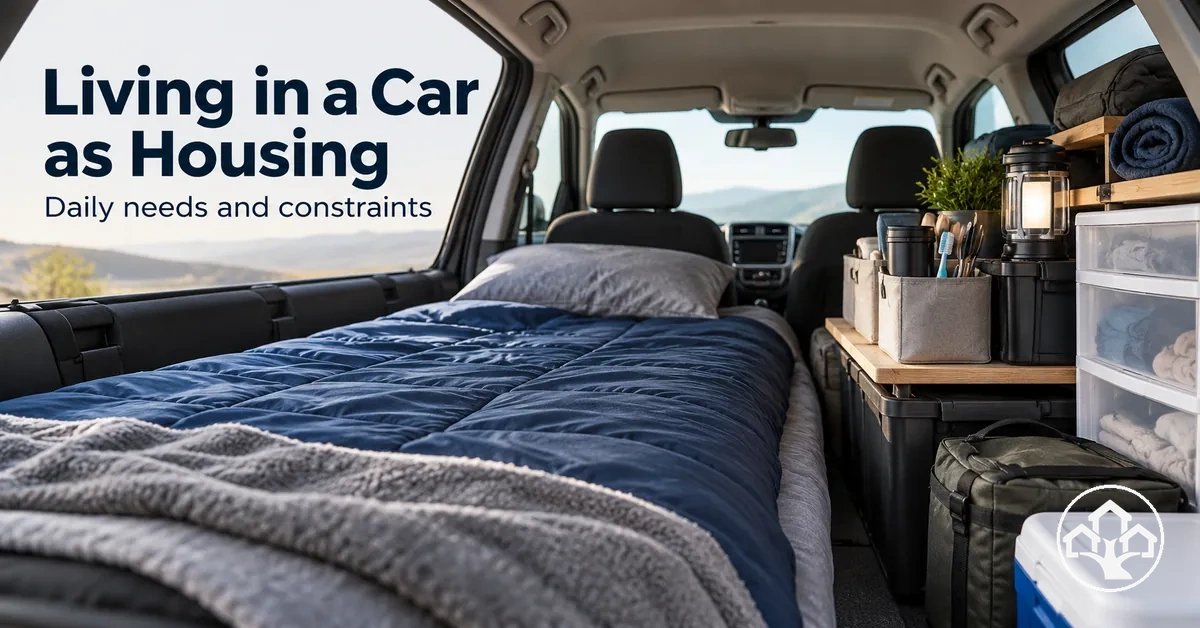
Before relying on a car as housing
Car-living practicality check
A vehicle supplies sleeping space, storage and mobility, but other housing needs must be met somewhere else. Check a condition only when you have verified it for your vehicle, location and routine.
Use the checklist to identify what still needs confirming. These checks are planning prompts, not proof that an arrangement is lawful, safe or affordable.
Unlike an occasional overnight stay, full-time car living requires a repeatable routine: the same compact interior must support driving, storage and rest, while external facilities replace household functions that the vehicle cannot provide.
Table of Contents
How Full-Time Car Living Works as a Housing Arrangement
Full-time car living divides residential functions between the vehicle and outside facilities; unlike a conventional dwelling, a passenger car cannot provide all routine household infrastructure.
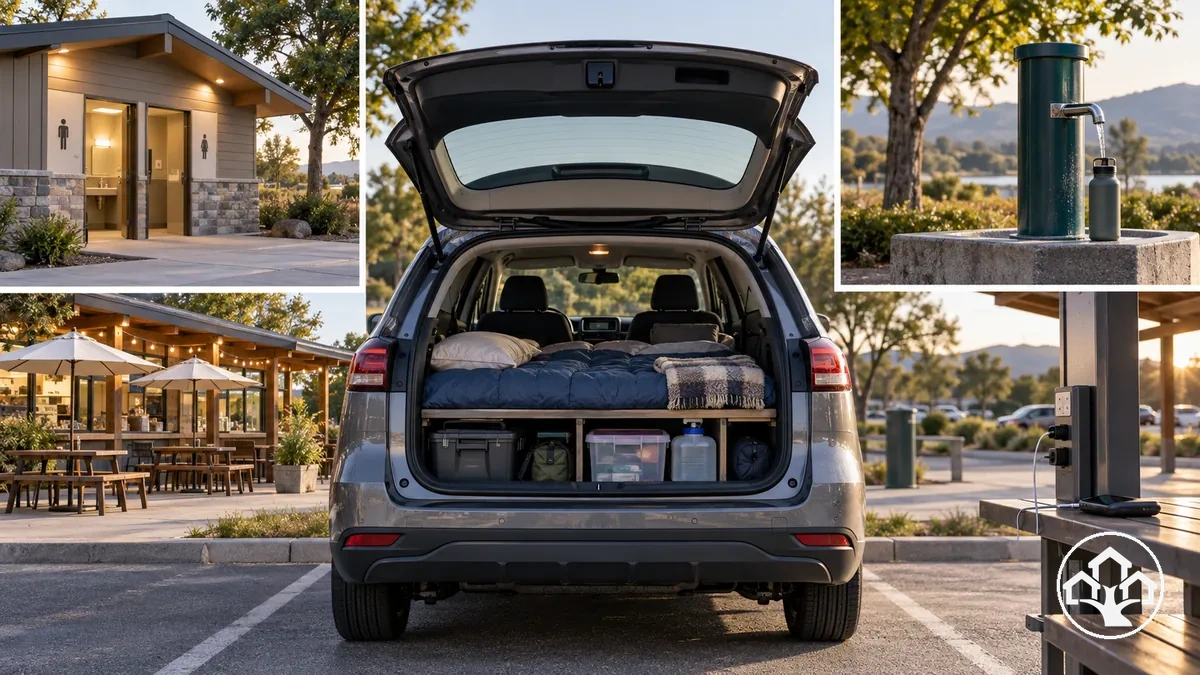
Inside the vehicle
Sleep, stored belongings, mobility and limited personal space share the same cabin. Sleeping and storage occupy usable floor or seat space; changing from daytime use to sleeping may require moving possessions.
Outside the vehicle
Washing, toilets, drinking water, food access, charging and waste disposal generally require other locations. Their value depends on permission, distance, opening hours and reliable access; poor access adds travel and scheduling.
For example, a person might sleep in the vehicle, travel to an available facility for washing and water, obtain food elsewhere, use another location for work or power, and later move to an appropriate place for overnight parking.
That is only one possible routine, but it shows how sleeping, mobility, external facilities, and service access operate as connected parts rather than separate tasks.
Full-time car living remains practical only when those functions can be repeated with enough reliability for everyday needs to be met.
Daily Needs That Full-Time Car Living Must Cover
Full-time car living must repeatedly cover sleeping, hygiene, toilets, water, food, power, communication, laundry, and access to essential services.
Some needs, such as rest, drinking water, food, and communication when required, need daily or on-demand access, while others can usually be accessed periodically according to the person's routine and circumstances.
Car living functions as housing only when these recurring needs can be met with sufficient consistency rather than through occasional access alone.
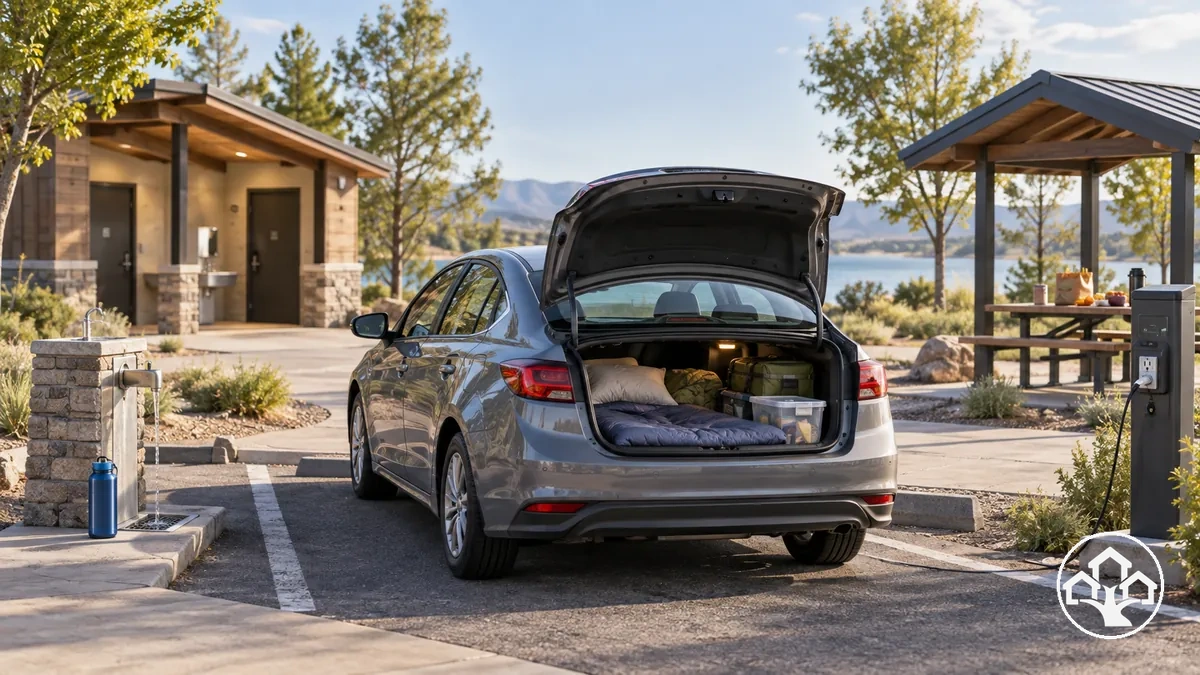
Reliability and frequency matter because a facility that exists but cannot be reached when needed does not provide dependable access.
Distance, opening hours, location, personal circumstances, and available infrastructure can determine how often each need must be addressed and how much travel or scheduling it requires.
The main recurring functions can be separated by what they provide and how their availability affects daily living.
- Sleeping: The vehicle needs usable interior space for regular rest; limited space, noise, temperature, or frequent interruption can make repeated sleeping more difficult.
- Hygiene: Washing facilities need to be accessible often enough to support routine personal hygiene; unreliable access can require extra travel or changes to the daily routine.
- Toilets: Toilet access needs to be available when required, including around overnight locations; restricted opening hours or long distances reduce practical availability.
- Water: Drinking water needs regular replenishment because a passenger vehicle has limited capacity for storing everyday supplies; reliable refill access reduces the need to search for water during the day.
- Food: Food must be obtained, stored, or prepared within the limits of available space and facilities; limited storage increases reliance on repeated access to suitable food sources.
- Power: Phones and other necessary devices require repeated charging, so access to usable power affects communication, navigation, and other device-dependent activities.
- Communication: Phone and data access can support contact, navigation, work, and access to services; poor connectivity at a location can restrict those functions even when the vehicle itself remains usable.
- Laundry: Clothing and bedding need periodic washing, making laundry a recurring service rather than a continuous in-vehicle function; distance, cost, and opening hours influence how easily it fits into the routine.
- Essential services: Healthcare, waste disposal, shopping, transport connections, and other necessary services may be needed less frequently, but practical access depends on their location, availability, and the person's circumstances.
Access can change substantially from one location or time of day to another.
A toilet, water point, laundry facility, or other service may be nearby but unavailable when closed, restricted, or difficult to reach, while a different location may place several essential services within a manageable routine.
The practicality of full-time car living therefore depends not only on whether these services exist, but on whether they remain reliably accessible at the frequency each need requires.
Sleeping and Rest in a Limited Vehicle Interior
Repeated sleeping in a car depends on usable sleeping space and stable environmental conditions, not simply on whether a person can recline inside the vehicle once.
Body position needs enough room for repeatable rest, while bedding, stored belongings, and airflow all affect how much usable space and ventilation remain inside the sleeping area.
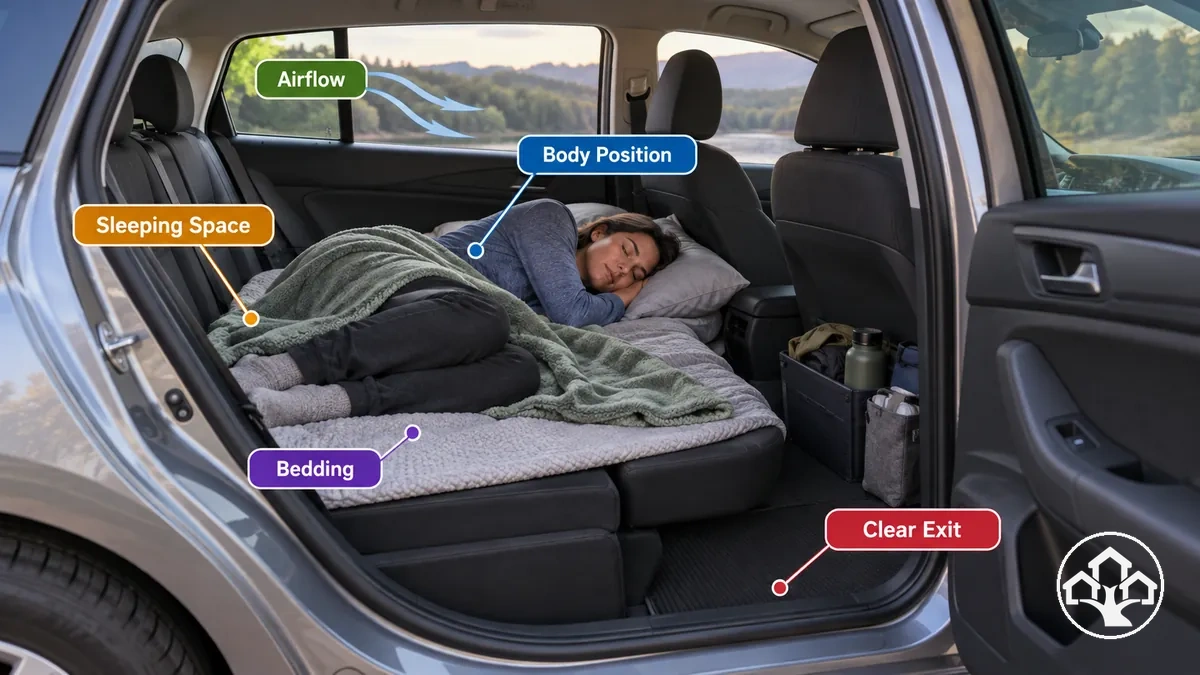
- Body position and bedding
- An uneven or short surface may force a bent or twisted position. Bedding can soften contact, but does not add usable space.
- Airflow and temperature
- Restricted airflow, heat or cold may make repeated rest less comfortable or unsafe. Weather and vehicle characteristics change the conditions.
- Noise, light and disturbance
- Passing traffic, bright surroundings and interruptions can disturb sleep even when there is enough room to lie down.
- Occupancy and exit space
- Sharing a car leaves less room to move or reposition belongings. Sleeping arrangements must also leave a usable way to exit.
There is no single comfort threshold that applies to every person or vehicle, so workable full-time sleeping depends on whether these conditions support repeatable rest in the specific interior.
Hygiene, Toilets and Water Access
Hygiene in car living usually depends on reliable external access to washing, toilets, drinking water, laundry, and other basic sanitation facilities.
A facility is useful only when its availability and access conditions allow it to be used when needed, rather than merely existing somewhere nearby.
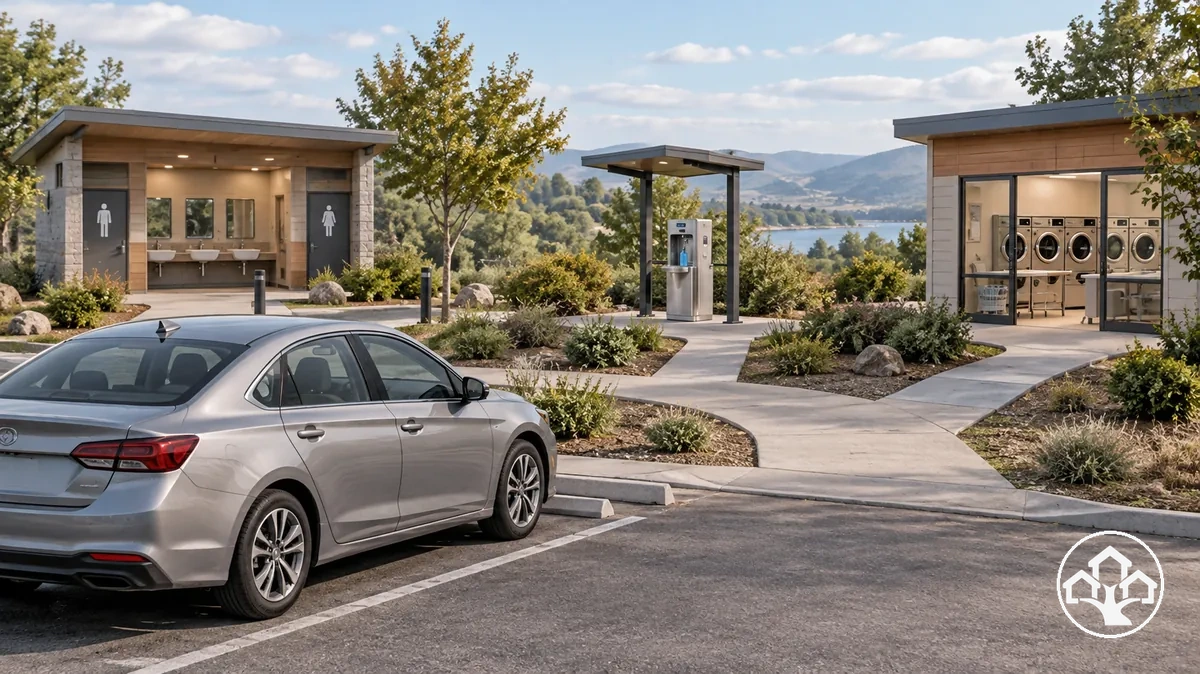
Dependable hygiene access is shaped by permission, distance, opening hours, privacy, cleanliness, and cost, and each condition can change the travel or scheduling required.
The following criteria distinguish nominal facility availability from access that can be relied on in a daily routine.
- Availability: Washing facilities, toilets, drinking water, or laundry services need to be present in locations that can realistically be reached; limited availability increases reliance on fewer alternatives.
- Permission: A facility may exist without being open for general use, so access depends on whether the person is permitted to use it under the facility's conditions.
- Distance: Greater distance between the vehicle and sanitation facilities increases travel time and can make frequent washing, water refills, or toilet access harder to fit into the routine.
- Opening hours: Restricted hours can make a facility unavailable at the time it is needed, requiring hygiene, laundry, or water access to be scheduled around operating periods.
- Privacy: The level of privacy available for washing or personal sanitation affects whether a facility is practically suitable for those activities, even when physical access is available.
- Cleanliness: A facility that is poorly maintained may be less suitable for routine hygiene use, so physical availability alone does not establish dependable usability.
- Cost: When repeated use carries a fee, the expense becomes part of maintaining regular access and may affect how often that particular facility is practical to use.
For example, a location may provide toilets and drinking water during the day but offer no usable washing or laundry access after nearby facilities close, while another location may require more travel but provide several services during suitable opening hours.
Reliable sanitation therefore depends on the combination of location, time, permission, and service conditions rather than on assuming that public facilities, workplaces, gyms, or commercial premises will always be available.
Food, Power and Access to Everyday Services
Food, power, connectivity, and routine services in car living must be managed around limited onboard capacity and repeated outside access.
A passenger vehicle can hold only a limited amount of food and supplies, while charging, communication, waste disposal, laundry, and other service access often depend on locations beyond the vehicle.
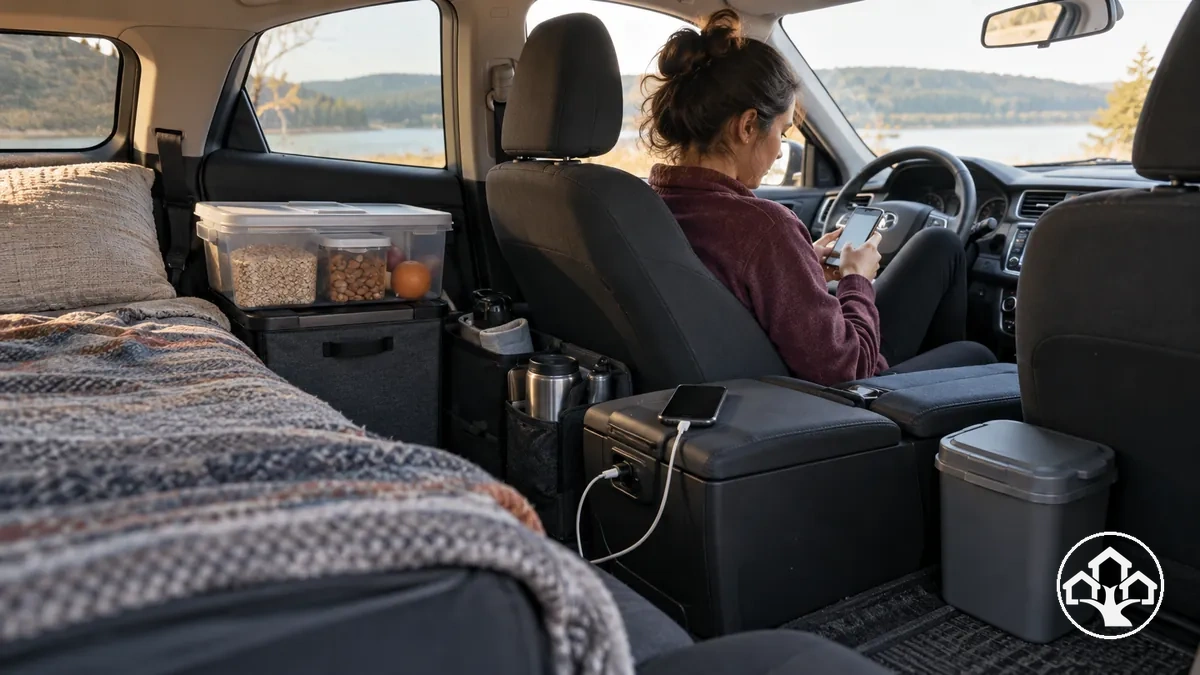
How often outside access is needed depends on storage capacity, the functions available inside the vehicle, and the availability of services at each location.
Limited food storage can require more frequent resupply, limited charging capacity increases reliance on accessible power, and services that are distant or available only at certain times add travel or scheduling to the daily routine.
These parallel functions can be grouped by what must be managed repeatedly.
- Food storage and preparation: Limited space restricts how much food can be stored and how it can be kept or prepared, so meals may depend more heavily on repeated access to suitable food sources and preparation locations.
- Power and charging: Phones and other necessary devices require charging, and limited onboard capacity means charging frequency depends on device use and access to a suitable power source.
- Communication and connectivity: A phone or other communication device can support contact, navigation, work, and access to services, but practical connectivity depends on network availability and the location where the vehicle is parked or used.
- Waste disposal: Limited interior capacity makes regular waste disposal important because accumulating rubbish reduces usable space and can make the interior harder to keep clean.
- Laundry and routine services: Laundry and other periodically needed services are normally handled outside the vehicle, so their distance, availability, and frequency of use affect travel and scheduling.
- Other service access: Shopping, vehicle maintenance, and similar everyday services may be essential in some circumstances and optional conveniences in others; their importance depends on whether the function is necessary for the person's routine or simply makes that routine easier.
Perishable food needs appropriate temperature-controlled storage. Without reliable refrigeration, shelf-stable choices or obtaining perishables shortly before use are more practical than leaving them in a warm car. Charging devices from the vehicle while its engine is off can drain the starting battery, so a dependable charging plan should account for battery capacity and access to other power sources.
Essential access covers functions that must be maintained for the arrangement to keep working, such as obtaining food, maintaining necessary communication, charging required devices, and disposing of waste.
Optional conveniences can reduce travel or make routines easier, but they are not equivalent to a function that has no practical substitute when needed.
The practicality of everyday car living therefore depends less on having household-style infrastructure onboard than on whether limited capacity can be matched with sufficiently regular service access.
Space, Storage and Privacy Constraints in Car Living
Limited car interior space constrains storage capacity, movement, personal organization, and privacy because occupants, belongings, and the sleeping area must share the same usable space.
Higher occupancy or more belongings leaves less room for movement and personal separation.
Storage also becomes harder to manage when frequently used items block other belongings or the sleeping area, increasing clutter and rearrangement.
Visibility from outside can further reduce privacy when occupants or personal items remain exposed.
The main space-related attributes can be compared by the condition that changes each one and its practical implication.
This shows how interior space, occupancy, storage volume, access frequency, visibility, and privacy interact rather than operating as separate constraints.
| Attribute | Condition | Practical implication |
|---|---|---|
| Interior space | More usable area is occupied by belongings or the sleeping arrangement | Less space remains for movement and for separating sleeping, storage, and other activities. |
| Occupancy | Multiple occupants share the same interior | Personal space decreases and movement or sleeping arrangements require more coordination. |
| Storage volume | More belongings are kept inside the vehicle | Clutter and repeated rearrangement become more likely as available storage capacity is occupied. |
| Access frequency | Frequently used belongings are stored behind, beneath, or among other items | Repeated retrieval can disrupt seating, sleeping space, or other stored belongings. |
| Visibility | Occupants or belongings are readily visible from outside | Discretion is reduced and the interior provides less visual privacy. |
| Privacy | Occupants have little separation from each other or surrounding activity | Personal separation is limited when the same interior is used for sleeping, storage, and daily routines. |
For example, the same car may leave workable movement and sleeping space for one occupant with relatively few belongings, while multiple occupants or more stored items reduce the remaining usable space and increase rearrangement.
Even with similar amounts of storage, a routine that requires frequent access to several items can create more disruption than one in which most belongings remain stored.
The practical constraint therefore depends on how occupancy, belongings, access frequency, and privacy interact within the available interior space.
Storage and Access to Personal Belongings
Storage of personal belongings in a car depends on both storage capacity and accessibility: an item can physically fit while still blocking sleeping space, movement, or other belongings.
During driving, keep sightlines, controls, seatbelts and exits unobstructed, and secure heavy belongings so they cannot shift unexpectedly. Storage that technically fits is not usable if it interferes with safe vehicle operation.
Access frequency therefore matters alongside item size and weight because repeated retrieval can increase rearrangement and daily effort.
The main storage attributes below show how fitting an item differs from being able to access it efficiently.
- Storage capacity: As belongings occupy more available storage space, less room remains for other items and for keeping the sleeping space usable.
- Item size: Larger items may fit only in positions that block movement, sleeping space, or access to other stored items, increasing the need to move them.
- Access frequency: Frequently used belongings placed behind or beneath other items require repeated retrieval and rearrangement, while rarely accessed belongings create less daily friction when they remain out of the way.
- Weight: Heavier stored items can require more effort to move when they obstruct another item or when the interior changes between daytime and sleeping configurations.
- Security: Belongings that need more secure placement may be stored in less accessible positions, creating a trade-off between protection and retrieval convenience.
- Configuration changes: Items occupying seats, floor area, or sleeping space may need to be moved when the vehicle changes from daytime use to a sleeping arrangement, adding repeated handling to the routine.
For example, belongings needed several times during the day are more workable when they can be retrieved without moving rarely used items first, whereas items used only occasionally can remain in less accessible positions without creating the same repeated effort.
The practical storage problem is therefore not only whether belongings fit, but whether their placement matches access frequency without repeatedly interfering with usable space.
Privacy and Security Inside and Around the Car
Privacy
How visible occupants and belongings are, how much personal space is available, and whether activities can be carried out discreetly.
Reduced visibility can improve discretion; it does not guarantee safety.
Security
Protection of people and possessions from unwanted access or interference, influenced by surroundings, access control and the ability to obtain assistance.
A more visible setting may provide access to people or services but can also reduce privacy.
These conditions vary with the vehicle's surroundings, who shares the interior, how visible occupants and belongings are, and how exposed the location is to surrounding activity.
The main criteria below separate privacy conditions from personal and property security while showing how each can affect rest, comfort, routine, or location suitability.
- Visual privacy: Greater visibility into the vehicle can reduce privacy during rest or personal activities, while lower visibility can provide more discretion without establishing that the location is secure.
- Personal safety: Conditions around the vehicle, including nearby activity and access to other people or services, can change how comfortable an occupant feels remaining at a location; the practical level of security varies by place and circumstance.
- Security of belongings: Personal items that are easily visible or accessible may have greater exposure to unwanted access, so property security depends partly on placement, access control, and the surrounding setting.
- Discretion and personal space: Sharing the vehicle or being closely observed from outside can reduce personal space and discretion, which may make resting or carrying out private routines more difficult.
- Situational awareness: Being able to observe nearby activity and changes in the surroundings can affect how readily an occupant notices conditions that may alter comfort or location suitability.
For example, a busy public setting may increase visibility and interruptions, reducing privacy even when other people and services are nearby.
An isolated location may offer more visual privacy but less immediate access to surrounding activity or assistance.
Neither setting is inherently more secure; privacy and security depend on the specific location, surroundings, occupancy, and circumstances at the time.
Parking, Overnight Stays and Dependence on the Vehicle
Car living depends on both suitable parking and continued vehicle availability because the same vehicle supports an overnight stay, mobility, storage, and access to daily destinations and services.
A usable stopping place must fit the practical conditions for sleeping there, while the vehicle must remain operable enough to move when required.
Restrictions on parking or vehicle downtime can therefore interrupt both mobility and housing continuity rather than affecting transport alone.
The impact depends on the location, applicable conditions, and the reason the vehicle is unavailable.
Workability can be assessed through two connected groups of conditions: whether an overnight location remains usable and whether the vehicle remains operational.
Each criterion can change how much travel, scheduling, or interruption is required.
- Lawful overnight use: An overnight stay depends on whether sleeping or remaining in the vehicle is permitted at that specific location under applicable rules or permission; if it is not, another stopping place is required and the daily schedule may need to change.
- Time limits: Parking areas may impose limits on how long a vehicle can remain, so a location that is usable for a short stop may not support the full period needed for rest or repeated use.
- Distance: Greater distance between an overnight location and daily destinations can increase travel requirements and reduce the time available for work, services, rest, or other routines.
- Noise: Traffic, nearby activity, or other recurring noise at a parking location can interrupt rest, making an otherwise accessible stopping place less suitable for an overnight stay.
- Facilities: Limited access to toilets, water, food, charging, or other facilities near the stopping place can require additional travel and make service access more dependent on opening hours and location.
- Fuel: Vehicle-based mobility requires sufficient fuel or usable energy for travel between parking places, services, and daily destinations; reduced availability can constrain where and when the vehicle can move.
- Maintenance and vehicle downtime: Maintenance needs can temporarily restrict vehicle availability, and vehicle downtime may interrupt sleeping, storage, and transport functions at the same time if the car cannot be used normally.
For example, if a planned overnight location becomes unsuitable under its access conditions, the occupant may need to travel elsewhere, changing the timing and distance of the evening routine.
If the vehicle is then unavailable because of maintenance or repair, the same disruption can also remove access to the sleeping space, stored belongings, and normal mobility.
This interdependence means that parking suitability and vehicle operability jointly determine whether car living can continue from one day to the next.
If the car cannot be used during maintenance or a planned overnight stop becomes unavailable, an alternative place to sleep reduces the risk of a single interruption affecting both shelter and transport.
Location Rules and Overnight Parking Constraints
The main criteria below organize what must be verified before treating a location as suitable for sleeping or repeated overnight use.
Each criterion affects whether access is permitted, time-limited, conditional, or subject to enforcement.
- Local rules: Check the current requirements that apply in the relevant jurisdiction and at the specific site, including whether they distinguish ordinary parking from overnight use. A location that permits parking may still restrict sleeping, extended occupation, or repeated overnight stays.
- Posted restrictions: Check signs and other posted conditions for restrictions on stopping, parking periods, overnight use, or particular vehicle activities. A posted restriction can make an otherwise available parking space unsuitable for the intended overnight stay.
- Private property and permission: On private property, verify whether the property owner, operator, or other authorised party permits the intended use. General access to the site does not by itself establish permission to remain there overnight.
- Time limits: Check how long parking is allowed and whether different limits apply at particular times. A site may support a short stop but not the duration required for sleeping or repeated overnight use.
- Access conditions: Verify whether gates, operating hours, permits, reservations, or other site-specific conditions affect entry, exit, or continued access. Conditions that restrict access during the intended stay can make the location unreliable even when parking itself is available.
- Enforcement: Check how applicable local rules and site restrictions are administered before relying on a location repeatedly. If the intended overnight use conflicts with current requirements, enforcement action may interrupt the stay and require another location.
These conditions can change between jurisdictions, properties, individual sites, and different times, so a rule that applies in one location should not be assumed to apply elsewhere.
The dependable criterion is whether the current rules, posted restrictions, required permission, time limits, access conditions, and enforcement context collectively allow the intended overnight use at that particular site.
How Weather, Temperature and Ventilation Limit Car Living
A small vehicle interior can amplify the practical effects of heat, cold, humidity, and limited airflow because occupants spend time within a confined space that responds directly to changing weather conditions.
Heat can raise interior temperature when airflow and ventilation are insufficient, while cold conditions can increase exposure to low interior temperatures during rest and sleep.
Humidity can contribute to condensation and moisture on cooler interior surfaces, especially when occupants remain inside for extended periods.
Rain can further restrict ventilation when windows or other openings cannot be used as freely without admitting water.
The main environmental conditions can be compared by the interior effect they create and the practical limitation that follows.
These relationships show how interior temperature, moisture, airflow, ventilation, sleep, and exposure interact under different weather conditions.
| Environmental condition | Interior effect | Practical limitation |
|---|---|---|
| Heat | Interior temperature can rise when warm outside conditions or solar exposure combine with limited airflow. | Rest, sleep, and remaining inside the vehicle for extended periods can become more difficult when ventilation does not provide sufficient relief. |
| Cold | Interior temperature can fall with outside conditions, increasing exposure to cold during stationary periods and sleep. | Comfort and the ability to remain inside depend more heavily on the duration of exposure, vehicle characteristics, climate, and occupant needs. |
| High humidity | Moist air can make the interior feel damp and increase moisture accumulation. | Repeated or extended stays can require more attention to airflow and moisture management to maintain comfort. |
| Condensation | Moisture can collect on cooler windows and other interior surfaces when humid air meets a colder surface. | Damp surfaces can make the interior less comfortable and increase the need for ventilation and moisture removal. |
| Limited airflow | Reduced airflow restricts the exchange of warm, humid, or stale interior air with outside air. | Limited ventilation can intensify heat, humidity, and condensation and make sleep or extended time inside more difficult. |
| Rain | Wet weather can restrict how freely openings are used for ventilation without allowing water into the vehicle. | Airflow options may become more limited while occupants spend more time inside, increasing dependence on the vehicle's available ventilation. |
Weather suitability can change by season and location because outside temperature, humidity, rain, exposure duration, vehicle characteristics, and occupant needs do not remain constant.
The same car may be easier to use during mild conditions and more difficult during hotter, colder, wetter, or more humid periods as interior temperature, airflow, and moisture conditions change.
No universal temperature threshold can define workable car living across every climate, vehicle, occupant, and exposure duration, so the practical limitation has to be assessed within the specific conditions present.
Ongoing Costs of Full-Time Car Living
Full-time car living can remove some conventional housing expenses, but it still creates recurring costs for the vehicle and for services that the vehicle does not provide.
These ongoing expenses can include fuel, registration, insurance, maintenance, repairs, parking, hygiene, laundry, food, communication, and other service costs.
Whether the total is lower than conventional housing depends on the vehicle, driving pattern, location, service access, and personal needs rather than on car living alone.
The main cost categories can be organized by what causes each expense to rise or fall and how that affects affordability.
This separates relatively predictable obligations from costs driven by usage, service access, or unexpected vehicle needs.
| Cost category | Main cost driver | Affordability implication |
|---|---|---|
| Fuel | Driving distance, traffic conditions, vehicle efficiency, and the distance between parking locations and daily destinations | More frequent or longer travel increases usage-driven vehicle costs and can reduce the savings created by avoiding conventional housing expenses. |
| Registration and insurance | Vehicle, jurisdiction, coverage requirements, policy conditions, and renewal periods | Where applicable, these are recurring vehicle-related costs that remain even when the vehicle is used as housing. |
| Maintenance and repairs | Vehicle condition, age, usage, servicing requirements, and mechanical failures | Routine maintenance creates continuing costs, while repairs can create irregular expenses that are harder to predict. |
| Parking or campsite charges | Location, type of stopping place, length of stay, and whether paid access is required | Frequent reliance on paid locations can add a recurring accommodation-related expense, while other locations may involve no direct parking charge. |
| Hygiene and laundry | Access to washing, toilet, shower, and laundry facilities and whether those services require payment | Limited unpaid access can turn basic hygiene and laundry into recurring service costs. |
| Food | Available storage, preparation facilities, shopping frequency, location, and reliance on prepared food | Limited storage or preparation options can change food spending compared with a routine that has conventional kitchen facilities. |
| Communication | Phone, data, internet, and other connectivity needs | Communication can remain a predictable recurring expense when connectivity is needed for work, navigation, contact, or service access. |
| Other recurring services | Individual needs and reliance on facilities or services outside the vehicle | Costs increase when essential functions must repeatedly be obtained through paid external services. |
The amount spent in each category varies because the main cost drivers are not constant.
A vehicle in poorer condition can create more maintenance and repair expense, greater driving distance increases fuel use, and a location with limited unpaid service access can increase spending on parking, hygiene, laundry, food, or other facilities.
Personal routines also matter because two people using similar vehicles may travel different distances or depend on different combinations of paid and unpaid services.
- More predictable
- Registration and insurance where applicable, plus recurring phone or data plans. Check renewal dates and actual policy conditions.
- Usage-driven
- Fuel, paid parking, laundry and some food or hygiene services. More driving or paid-service use generally raises these expenses.
- Irregular
- Unexpected repairs and breakdown-related expenses. Routine servicing can be planned, but the timing and cost of failures are uncertain.
A workable monthly budget should use the person’s actual travel, vehicle costs and paid-service needs, together with a repair allowance and a backup place to sleep if the car is temporarily unavailable. No single monthly cost applies to every vehicle or location.