
Comparing Car, Van and RV Living as Housing Options
Car living usually has the smallest footprint but the tightest living space; a fitted-out van can balance room and mobility; and a motorhome-style RV may provide more onboard facilities but can be harder to park and operate. The best choice depends on the specific vehicle, total cost, occupants, daily facilities, travel pattern and permitted overnight locations.
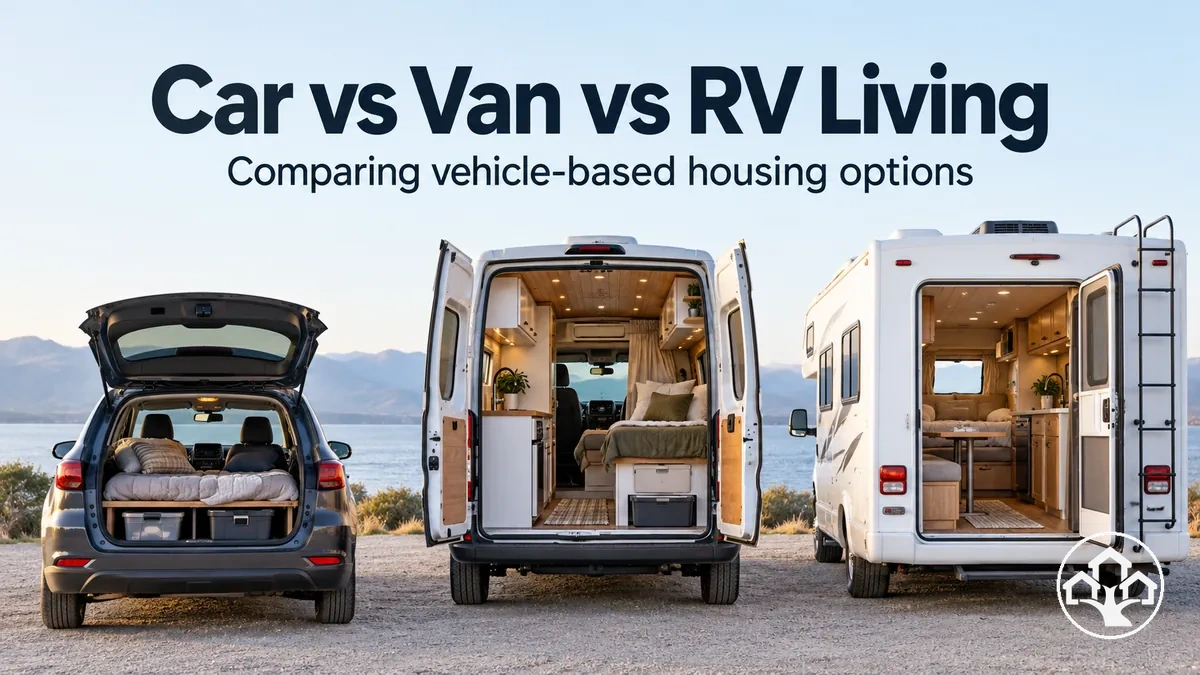
Car vs van vs RV: compare what matters
Review typical trade-offs using the same criteria for each option. Select your priority to focus a row; this does not produce a universal winner.
Space: Check the actual bed, storage and movement layout; exterior size alone does not determine usable space.
| Compare | Car | Van | Motorhome-style RV |
|---|---|---|---|
| Usable living space | CarSleeping, storage and daytime movement often share the same small area. | VanMay support a fixed or convertible bed plus more distinct storage. | RVSome layouts separate sleeping, storage and daytime living areas. |
| Privacy and occupants | CarLittle interior separation; sharing the space can be restrictive. | VanPartitions or screened zones are possible with a suitable conversion. | RVSome floor plans offer separate zones for multiple occupants. |
| Cooking, washing and toilets | CarUsually relies more heavily on portable or outside facilities. | VanCan use portable equipment or installed facilities, depending on fit-out. | RVMay include a kitchen, toilet and washing facilities; confirm the model. |
| Driving, parking and access | CarTypically fits more ordinary parking and narrow access situations. | VanLength and roof height can limit parking or clearance. | RVOften needs more turning, parking and clearance room. |
| Total financial commitment | CarAn existing car may need little setup, but operating and repair costs remain. | VanConversion and fit-out can add substantial upfront cost. | RVBuilt-in systems may reduce fit-out needs but add upkeep and repair exposure. |
| Frequent moves or longer stays | CarCompact mobility can help with frequent moves; the interior remains tight. | VanTrade-off depends on size and how often the layout must be reset. | RVExtra living functions may help on longer stays when access permits. |
Before deciding: Check the exact dimensions and fit-out, first-year and ongoing costs, vehicle registration and insurance conditions, sanitation access, and rules for sleeping or staying overnight at each intended location.
Here, RV refers to a self-propelled motorhome-style vehicle, not a towable caravan. Campervans and smaller motorhomes can overlap with the van category, so compare actual size and fit-out rather than labels.
Full-time use places more pressure on sleeping arrangements, accessible storage, privacy and reliable everyday facilities. An existing vehicle can change the upfront cost, while travel distance and vehicle condition affect ongoing expenses.
Table of Contents
Cost Differences Between Car, Van and RV Living
Total cost for car, van and RV living combines upfront cost or setup cost with ongoing operating cost, and the relative cost can change with usage, vehicle condition and configuration.
A vehicle that needs little modification may have a smaller initial burden than one requiring substantial conversion or fit-out, while frequent driving shifts more of the cost toward fuel, maintenance and repairs.

Car living can involve a relatively limited setup cost when an existing car already meets the intended sleeping and storage needs, but acquiring another vehicle or modifying it changes that starting cost.
Van living may add conversion or fit-out costs when the interior is adapted for living, while RV living may begin with more built-in residential equipment and therefore a different maintenance and repair profile.
Across all three options, fuel, insurance, servicing, maintenance and repairs remain recurring cost categories, but their amounts depend on the particular vehicle, insurance cover, mechanical condition and use rather than the vehicle label alone.
Configuration also matters because added weight, living equipment and mechanical systems can affect fuel demand, servicing requirements and repair complexity.
Upfront Vehicle and Setup Costs
Upfront cost for car, van and RV living depends on both the vehicle obtained and the work needed to make it usable for the intended living pattern.
Acquisition and vehicle condition determine the starting financial commitment, while setup, fit-out, conversion and essential equipment can add further cost when the vehicle is not already configured for living.
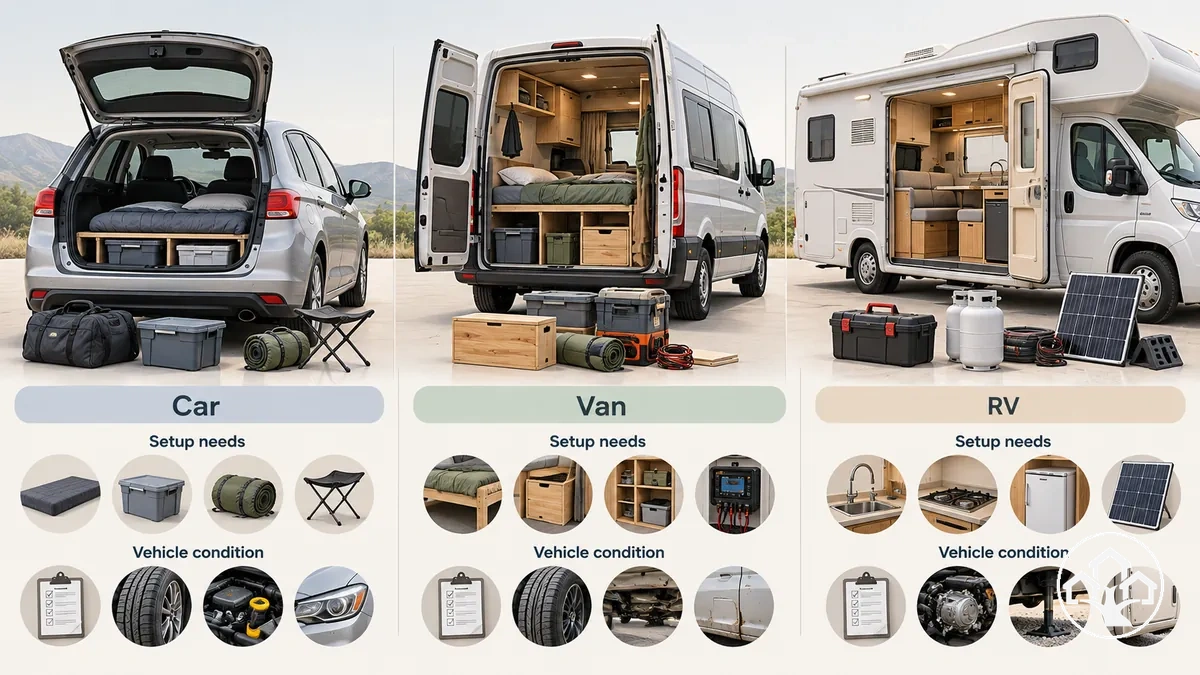
For car living, an existing vehicle with a workable sleeping setup and storage arrangement can reduce the amount of additional setup required, whereas acquiring another car or making substantial adaptations increases the starting burden.
Van living may require interior fit-out or conversion for sleeping, storage and other essential equipment when those features are absent.
An RV may already include more living equipment, but its upfront commitment still depends on acquisition, vehicle condition and what must be repaired, replaced or added before the intended use.
An already-owned or already-equipped vehicle can reduce acquisition or setup requirements without establishing a universal cost advantage for that vehicle type.
The starting burden therefore depends on the vehicle's existing condition, included equipment and the amount of additional work required to support the intended living pattern.
Fuel, Insurance, Maintenance and Repair Costs
Recurring operating cost for car, van and RV living depends on travel frequency, distance, vehicle size, vehicle condition and mechanical complexity rather than vehicle class alone.
Fuel use rises as more distance is driven under the same vehicle and driving conditions, while servicing, maintenance and repairs depend on the vehicle's condition and mechanical requirements.
Calculate the fuel component on the same basis
Annual fuel cost (AUD) = (planned km ÷ 100) × vehicle consumption (L/100 km) × fuel price (AUD/L)

Insurance suitability depends on the policy, declared vehicle use, modifications and coverage. Check whether the intended living arrangement and equipment are covered instead of assuming ordinary vehicle insurance includes them.
Maintenance covers planned servicing and wear-related work, while repairs address faults or failures; vehicle condition and mechanical complexity therefore change the potential exposure to these recurring costs.
A low-travel living pattern reduces distance-related fuel use and wear compared with driving the same vehicle frequently over longer distances.
A high-travel pattern places more emphasis on fuel consumption and servicing intervals, while an older or mechanically complex vehicle can create additional repair exposure regardless of whether it is a car, van or RV.
Space, Privacy and Everyday Living Capacity
Usable space, rather than exterior size alone, is the more useful basis for comparing the living capacity of a car, van and RV.
Interior layout determines how much room remains for a sleeping area, storage, movement, privacy and everyday facilities once the vehicle is configured for living.
A larger vehicle can provide more interior capacity, but that capacity is only useful when its layout matches the occupants and their daily routine.
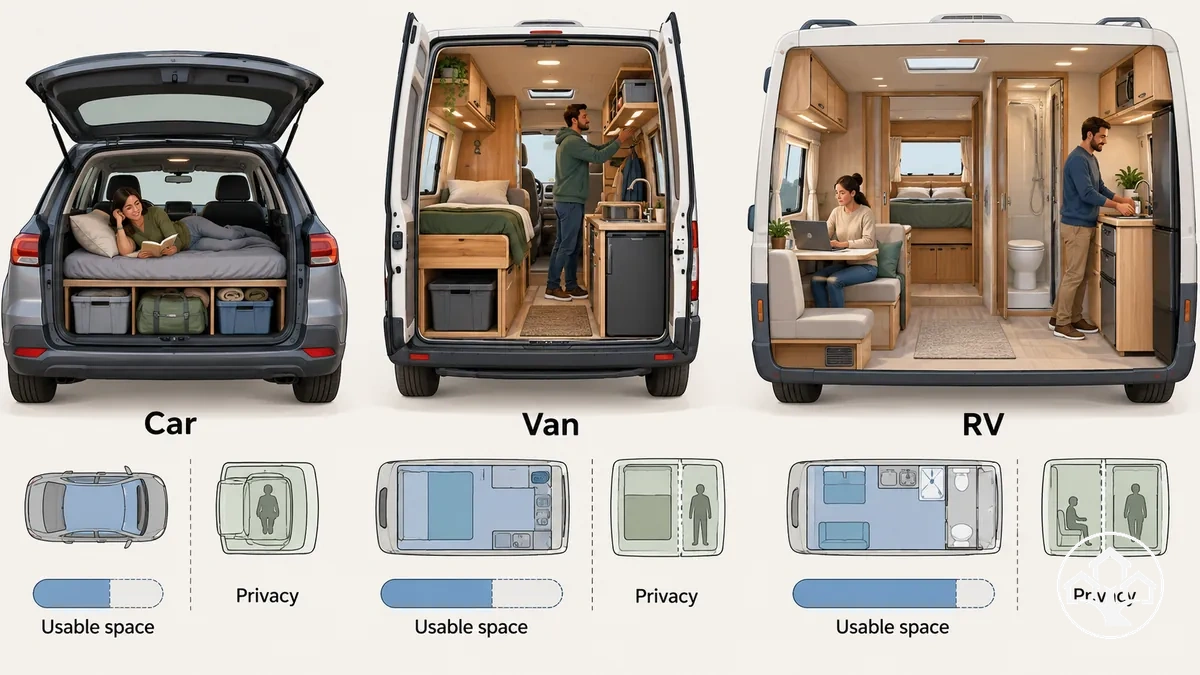
Car living typically concentrates the sleeping area, storage and movement space within the same compact interior, so one function can reduce the usable space available for another.
Van living can allow sleeping and storage to occupy more distinct areas when the conversion and interior layout support that separation.
RV living can provide greater separation between sleeping, storage and movement areas in configurations designed around residential use.
In every vehicle type, fixed furniture, stored belongings and the bed setup change how much of the interior remains usable during the day.
Privacy and occupancy also depend on how the interior is divided rather than on vehicle type alone.
A car generally provides little internal separation between occupants, while some van layouts can create partial separation and some RV layouts can provide distinct living or sleeping zones.
Access to cooking, washing or bathroom facilities likewise depends on configuration: a setup without those facilities requires greater reliance on outside facilities, while a vehicle equipped with them can support more daily functions inside the vehicle.
As occupancy increases, the same interior layout must accommodate more sleeping, storage and personal-space needs.
Individual conversions and RV classes can differ substantially, so vehicle size does not establish living capacity by itself.
The practical comparison is how each specific interior layout allocates usable space, privacy and facilities for the intended number of occupants and their routine.
Sleeping and Storage Space
Sleeping and storage capacity in a car, van or RV depends on the usable layout, occupant count and whether the sleeping setup must be reconfigured each day.
A layout that uses the same area for sleeping and daytime activity requires regular setup and pack-away, while a fixed bed space reduces that daily burden but occupies part of the usable living area.
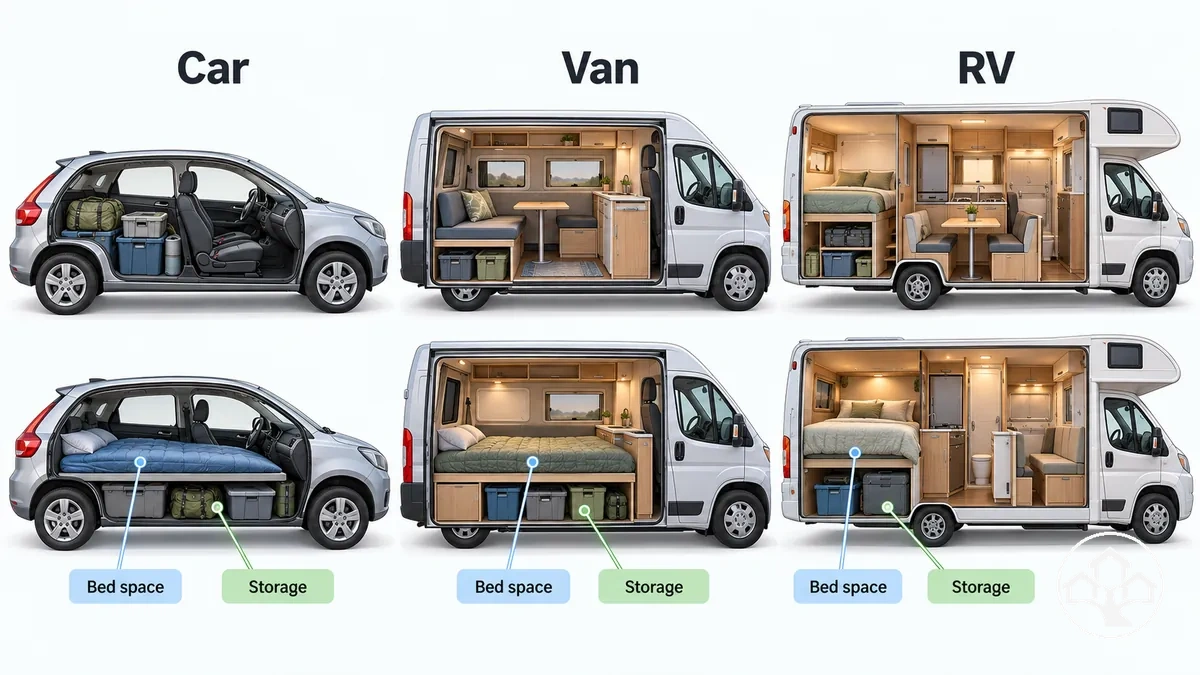
In a car, a sleeping setup may require seats or stored items to be moved before the bed space can be used, so access to belongings can change between daytime and sleeping modes.
A van layout may allow a bed to remain in place or use a convertible arrangement, with each choice affecting storage volume and daytime floor space.
An RV layout may provide more separation between bed space and storage when its configuration supports dedicated areas, but fixed furniture and equipment still reduce the interior space available for other uses.
Across all three vehicle types, storing more belongings inside the occupied area reduces the usable living area or makes frequently used items harder to access.
Longer stays and a higher occupant count increase pressure on the same layout because more sleeping positions, clothing and everyday belongings must share finite interior space.
Suitability therefore depends on whether the available sleeping setup and storage access can support the intended occupants and duration without creating an impractical daily reconfiguration burden.
Privacy and Personal Space
Privacy in car, van and RV living has three separate dimensions: visual privacy from outside, spatial privacy created by interior separation, and personal space between occupants.
- Visual privacy
- Window screening can reduce visibility from outside, but it does not separate people inside the vehicle.
- Interior separation
- Sleeping and changing privacy depend on the layout, window exposure and whether separate zones can be used.
- Personal space
- More occupants share the same usable area unless the layout provides additional capacity or separation.
Car layouts commonly place occupants within one open interior with multiple windows, so visual screening may improve outside privacy while personal space and interior separation remain limited.
Van layouts can provide more separation when the configuration divides sleeping or changing areas from the rest of the interior, but an open conversion can still leave occupants sharing the same space.
Some RV layouts provide distinct sleeping or living zones that allow greater separation between occupants, although this depends on the specific floor plan rather than the RV label alone.
These differences can affect daily comfort when a vehicle is shared, so visual screening, interior separation and co-occupant personal space should be assessed as separate privacy dimensions.
Cooking, Washing and Bathroom Facilities
Access to cooking facilities, washing, a toilet and a bathroom changes how much a car, van or RV living setup relies on external facilities for everyday routines.
A configuration with built-in facilities can reduce that external dependence, while portable arrangements or the absence of an onboard function require more frequent use of outside services.
The facility state depends on the specific layout and conversion rather than the vehicle label alone.
Car living commonly relies on portable or external arrangements for food preparation, washing and toilet access because the interior may not include dedicated built-in areas for those functions.
A van conversion can include built-in cooking facilities, washing access or a portable toilet, but other layouts may rely partly or entirely on external facilities to preserve interior space.
An RV configuration may include a built-in kitchen, washing facilities and a toilet or bathroom, yet the exact combination varies by model and layout.
For full-time living or situations where external facilities are difficult to access, a more self-contained configuration can support more daily functions inside the vehicle.
Where outside services are readily available, a setup with fewer built-in facilities may remain practical, so the relevant comparison is the balance between facility access, space use and external dependence.
Mobility, Parking and Access Trade-Offs
Mobility in car, van and RV living is not determined by vehicle size alone; it combines driving ease, parking fit and destination access under the conditions where the vehicle is actually used.
A smaller footprint can improve manoeuvrability and increase the range of parking spaces or access points that physically fit the vehicle, while a larger footprint can introduce more length, width or height constraints.
The practical trade-off depends on configuration, clearance, road environment and driver familiarity rather than on a simple smaller-is-always-easier rule.
Cars generally have the smallest footprint of the three and can fit a wider range of ordinary parking spaces and tighter manoeuvring areas, although access still depends on local dimensions and conditions.
Vans occupy more road and parking space than many cars, and taller or longer configurations can restrict parking fit or clearance at some destinations.
RVs can require more room for turning, parking and access because of their dimensions, but the degree of restriction varies substantially by RV class and configuration.
In each case, manoeuvrability and parking flexibility should be judged against the actual vehicle size and the spaces or routes it needs to use.
Travel frequency changes the importance of these differences.
Frequent movement through dense urban areas, confined parking areas or locations with limited clearance can make a smaller footprint more useful because manoeuvring, parking fit and access constraints recur more often, while less frequent travel or use in environments with generous space can reduce their practical effect.
Larger vehicles can still support frequent travel where routes, parking and destination access accommodate their dimensions, so the relevant comparison is how vehicle footprint matches the expected movement pattern and environment.
Driving and Manoeuvrability
Driving and manoeuvrability in a car, van or RV depend on vehicle length, width, height, overall configuration and driver familiarity rather than the vehicle label alone.
Longer or wider vehicles can require more space for turning and reversing, while greater height requires closer attention to clearance and route constraints.
These characteristics can overlap between large vans and small motorhomes, so driving burden should be assessed from the specific vehicle footprint and configuration.
The main driving-specific differences concern how the vehicle fits and moves through the road environment:
- Turning and reversing: Greater length and different turning behaviour can increase the space and planning required for turns or reversing manoeuvres, while shorter configurations may require less room under comparable conditions.
- Width and road fit: Greater width can reduce lateral space on narrow roads, confined approaches or tight traffic environments, increasing the attention needed to position the vehicle accurately.
- Height and clearance: A taller vehicle requires clearance awareness where routes include low structures, restricted entrances or other height constraints, regardless of whether the vehicle is classified as a van or RV.
- Driver familiarity: Familiarity with a vehicle's dimensions, mirrors, turning response and configuration can reduce perceived driving effort, while an unfamiliar vehicle may require more deliberate positioning and manoeuvring even when its dimensions are similar to another model.
Parking and Access Constraints
A car, van or RV can be suitable for living yet still be constrained by where its vehicle footprint physically fits and where an overnight stay is permitted.
Can the vehicle physically fit?
Compare its length, width, height, turning clearance and access route with the actual space or site.
Are you allowed to stay overnight?
Check the site's terms, signs and applicable local rules. Permission to park does not itself mean overnight occupancy is permitted.
Cars can fit parking spaces and access points that would exclude longer, wider or taller vehicle configurations, although the actual fit depends on the specific vehicle and location.
Longer vans or RVs can exceed the usable length of some parking areas or designated sites, while taller configurations can encounter a height restriction at covered parking, entrances or other access points.
Site access can also depend on available width, turning space, surface conditions and entrance dimensions, so the relevant constraint is whether the specific vehicle fits the physical conditions rather than its category alone.
Vehicle-living flexibility therefore depends on both physical fit and the applicable rules for the location being used.
How Full-Time Living Changes the Trade-Offs
Full-time living changes the weight of the same vehicle-living criteria rather than creating a separate rule for which vehicle must be used.
As duration and living intensity increase, storage, privacy, facilities, vehicle availability and comfort become more important because they affect the daily routine continuously rather than occasionally.
A car, van or RV can remain suitable for full-time living when its configuration and limitations match the occupants' needs, so duration changes suitability by increasing demand on existing attributes rather than by determining one required vehicle type.
- Accessible storage
- Clothes, food and daily essentials need to stay reachable without repeatedly dismantling the living area.
- Privacy and essential routines
- Sleeping, changing, cooking and washing must work as repeated daily activities, not just occasional travel arrangements.
- Vehicle availability
- Servicing or breakdowns can disrupt both transport and accommodation when the same vehicle performs both roles.
These pressures increase with full-time living even though the exact importance of each criterion depends on the occupants, layout and external services available.
A short-term trip can tolerate more frequent reconfiguration, greater reliance on external facilities or temporary compromises in comfort because those conditions apply for a limited duration.
With full-time living, the same compromises recur as part of the daily routine, so routine stability, comfort and reliable access to essential functions can carry more weight in judging suitability.
This does not make one vehicle class universally preferable; it changes which trade-offs remain acceptable when the vehicle is used continuously rather than occasionally.
Frequent Travel Versus Longer Stays
Frequent travel and longer stays change which vehicle attributes matter most because the movement pattern shifts the balance between mobility and living comfort.
When you relocate frequently
Each move adds another driving route and parking decision. More travel can increase fuel use and wear, while repeated bed setup, storage checks and pack-away add daily effort. Ease of manoeuvring and parking become more valuable.
When you stay longer in one place
Fewer departures reduce the frequency of driving and packing tasks. Usable floor space, storage and accessible onboard facilities may matter more because they support a longer continuous routine.
Neither pattern determines suitability by itself because travel distance, location and vehicle configuration still affect the trade-off.
Solo Living Versus Living With Others
Occupant count changes vehicle-living requirements because additional occupants increase demand on the same finite sleeping space, storage, privacy, facilities and personal space.
In solo living, one occupant can allocate the available interior and facilities around a single routine, while shared living requires the same resources to support multiple routines and belongings.
As occupant count rises, the amount of usable space and privacy available to each person can decrease unless the vehicle layout provides additional capacity or separation.
In a solo-occupancy scenario, sleeping space and storage only need to accommodate one person's belongings and daily activities, so conflicts over access to the same area or facilities are less likely.
In a shared-living scenario, multiple occupants may need the same sleeping area, storage zones, facilities or circulation space at overlapping times, increasing the potential for daily friction.
Privacy and personal space also become more dependent on interior separation and how shared routines are organised.
These pressures may change vehicle suitability, but the practical result depends on the specific layout, occupants' routines and tolerance for sharing space rather than on a fixed rule for any household type.
Suitability by Living Situation and Priority
Suitability among car, van and RV living depends on which constraint or priority carries the most weight for the intended living situation, not on a universal vehicle ranking.
A criterion matters more when it directly affects a person's budget, daily living needs or ability to use the vehicle in the required environment.
Different priorities can therefore make different vehicle characteristics more or less suitable without making one option preferable in every case.
The decision can be organised around three broad groups: financial commitment, residential capacity and mobility or access.
Budget covers upfront and ongoing cost exposure; residential capacity includes space, privacy, occupants and facilities; and mobility or access includes travel frequency, vehicle footprint and parking conditions.
Within those groups, the following criteria show how a user condition changes the practical trade-off:
- Budget: When limiting upfront or ongoing financial commitment is a high priority, acquisition condition, required setup and expected operating costs matter more, so suitability should be evaluated against the specific vehicle rather than its category alone.
- Space and privacy: When usable space, personal space or internal separation carries more weight, layouts with greater residential capacity become more relevant, although additional space can create a trade-off with vehicle footprint and mobility.
- Mobility and travel frequency: When frequent movement is central to the living pattern, manoeuvrability, driving burden and repeated fuel exposure matter more, increasing the value of a configuration that matches the expected travel conditions.
- Parking and access: When ordinary parking, constrained access points or clearance conditions are common, vehicle dimensions become a stronger criterion because a larger footprint can reduce the number of locations that physically accommodate the vehicle.
- Occupants: When multiple occupants share the vehicle, demand on sleeping space, storage, privacy and facilities increases, so layouts that provide more usable capacity or separation may become more suitable for that situation.
- Facilities: When reducing dependence on external facilities is a priority, built-in or otherwise self-contained cooking, washing, toilet or bathroom functions carry more weight, while configurations that rely on portable or external arrangements involve a different space and convenience trade-off.
Mixed priorities create trade-offs rather than a single score.
A person who gives more weight to mobility and parking may accept tighter interior space, while another who gives greater weight to privacy, facilities or multiple occupants may accept a larger vehicle footprint and the access constraints that accompany it.
Budget can alter either profile because the cost of obtaining, configuring and operating a particular vehicle may change whether its other advantages remain practical.
The vehicle-specific decision is therefore complete when each criterion has been evaluated against the intended duration, movement pattern, occupants, environment and acceptable trade-offs.
Car, van and RV living represent different combinations of financial commitment, residential capacity and mobility rather than fixed suitability categories.
If none of those combinations satisfies the user's core constraints, the decision boundary extends beyond choosing among a car, van and RV.
At that point, broader housing alternatives can be compared separately without changing the criteria already established for vehicle-based living.
When Car Living Suits the Situation
Car living can suit a situation where a small footprint, frequent mobility and a low space requirement carry more weight than interior living capacity.
Its compact vehicle footprint can support manoeuvrability and parking flexibility in places that physically accommodate the specific car, while the trade-off is limited living capacity for sleeping, storage, privacy and facilities.
Suitability therefore depends on whether those capacity constraints remain acceptable for the intended routine, body style and setup.
Car living may fit more readily when solo occupancy keeps demand on sleeping and storage space relatively limited and when frequent movement makes a smaller footprint valuable.
Parking can also be less restrictive for some cars than for larger vehicle configurations, although the result depends on the actual vehicle dimensions and location.
A user with limited tolerance for repeated setup or reconfiguration should weigh that condition carefully because a compact interior may require the same space to serve several daily functions.
Detailed car-living needs and constraints depend on the specific vehicle, setup and living pattern.
Those factors should be assessed separately when the limited living capacity becomes a material constraint rather than an acceptable trade-off.
When Van Living Suits the Situation
Van living can suit a situation where more residential capacity than a car is needed while a relatively compact driving and parking footprint still matters.
It may provide more interior space, storage and room for facilities without necessarily taking on the footprint of a larger RV, but the result varies with van size and configuration.
Suitability therefore depends on whether that balance between residential capacity and manoeuvrability matches the user's travel and living priorities.
Van size and conversion level can materially change the trade-off: a more compact or lightly converted van may preserve greater manoeuvrability while providing less storage, interior space or built-in facilities, whereas a larger or more extensively converted van may increase living capacity while placing more demand on parking and movement.
Travel frequency also changes the weight of those attributes because frequent movement can make manoeuvrability and parking more important, while longer stays can increase the value of storage, facilities and usable interior space.
Van living is therefore most suitable when the specific configuration matches the user's required balance of mobility and residential capacity rather than when a van is treated as a standardized middle option.
When RV Living Suits the Situation
RV living can suit a situation where interior space, privacy and self-contained facilities carry more weight than compact mobility.
Greater residential capacity can support more storage, separation between occupants and a wider range of onboard daily functions, while the trade-off is a larger vehicle footprint and potentially greater driving or parking constraints.
Suitability therefore depends on whether those residential priorities justify the reduced flexibility associated with the specific RV's size and layout.
Longer stays can increase the value of interior space and self-contained facilities because the vehicle is used as a living environment for extended periods rather than mainly as transport.
Multiple occupants can also place greater demand on storage, privacy and shared facilities, making layouts with more usable capacity relevant when those needs outweigh compact mobility.
At the same time, larger dimensions may increase parking constraints or driving demands in locations with limited space or access, so the practical trade-off depends on where and how often the vehicle moves.
RV living can therefore fit situations where residential capacity matters more than maintaining the smallest possible footprint.
RV classes and layouts vary substantially, so facility completeness, usable interior space and mobility constraints should be assessed from the specific configuration rather than assumed from the RV category alone.