
Full-Time Van and RV Living as a Housing Alternative
Full-time van and RV living uses a vehicle as the primary home, not only for recreation, and can reduce conventional rent in some circumstances. It is not automatically cheaper or easier: its suitability depends on combined fuel, overnight-stay, insurance, registration, utility and maintenance costs, plus workable space, water, power, sanitation and repair arrangements.

Housing suitability · four essential checks
Is van or RV living practical for your circumstances?
Assess all four conditions together; a potential rent saving does not remove daily living or vehicle-related demands.
-
Complete running cost
Allow for permitted places to stay, fuel, registration, insurance, utilities, services and maintenance. More driving or paid nights usually increases spending.
-
Daily resource cycle
Check usable water and power capacity, food access, hygiene and suitable waste disposal against realistic refill and service opportunities.
-
Space and legal stopping access
Match sleeping, storage, privacy and climate needs to the occupants and vehicle layout; confirm that intended overnight stays are permitted.
-
Reliability and fallback shelter
Plan routine servicing, access to repairs and what happens if a breakdown makes the vehicle immobile or temporarily uninhabitable.
Practical decision rule: Compare like-for-like monthly housing costs, then confirm that all four conditions are workable for your actual travel and stay pattern. No single vehicle type or parking pattern guarantees a lower cost.
The vehicle must support everyday sleeping, storing belongings, preparing meals and other residential needs while also serving as transport. A relatively stationary, low-mileage arrangement can have different costs and routines from frequent travel over long distances, even in the same vehicle.
Compare the complete cost and living conditions with the housing option the vehicle would replace. Climate, number of occupants, access to external facilities and the ability to arrange alternative shelter during repairs can change the outcome.
Table of Contents
Ongoing Costs of Full-Time Van and RV Living
The ongoing costs of full-time van and RV living are a bundle of relatively predictable recurring expenses and usage-dependent operating costs, not one universal monthly amount.
Insurance, registration and some connectivity charges can be comparatively predictable within a given policy, jurisdiction or service plan, while fuel, campground fees, parking fees, utilities and external services change with use.
There is no reliable universal monthly cost without the vehicle, kilometres travelled, paid-night pattern, local prices and service use. If the vehicle is financed, include repayments; also consider purchase or fit-out spending and long-term vehicle depreciation separately when comparing total ownership cost.
A parked-stay pattern and a frequent-travel pattern therefore create different recurring-cost conditions even before individual prices are considered.

Utilities, laundry and other external services depend on how much the vehicle can supply onboard and how often outside facilities are used, while a maintenance reserve accounts for repair uncertainty associated with vehicle condition, age and use.
The table organizes these recurring expense categories by their main cost driver and the conditions that change the amount.
| Expense category | Main cost driver | Why the amount varies |
|---|---|---|
| Campground or parking fees | Location and stay pattern | The total changes with the number of paid nights, the types of places used and how often the vehicle moves between locations. |
| Fuel | Travel frequency, mileage and vehicle efficiency | More driving increases fuel use, while consumption for the same distance differs with vehicle efficiency, load and operating conditions. |
| Insurance and registration | Vehicle, policy and jurisdiction | These expenses are relatively predictable once established, but their values remain specific to the vehicle, coverage and registration jurisdiction. |
| Vehicle finance, if applicable | Loan terms and purchase financing | Loan repayments add an ongoing commitment independently of mileage or overnight-stay fees; a cash purchase has no loan repayment but still involves purchase and future replacement costs. |
| Connectivity | Service requirements and access pattern | The expense depends on the chosen level of mobile or other connectivity and how much external connectivity is required. |
| Laundry and other external services | Frequency of outside-service use | Greater reliance on laundries, showers or other paid facilities increases this usage-dependent part of the monthly total. |
| Utilities and energy inputs | Energy demand and access to supplied services | Costs change with electricity, charging, gas or other energy use and with whether those inputs are included at a place of stay or obtained separately. |
| Maintenance reserve | Vehicle age, condition and use | The appropriate reserve is vehicle-specific because repair timing and cost are uncertain and depend on condition, age and use. |
The same van or RV can therefore produce materially different monthly expenses when travel frequency, paid-stay frequency or dependence on external services changes.
These categories identify what creates the ongoing cost rather than replacing a complete budgeting process.
A full monthly housing budget should apply the person's actual vehicle, travel pattern, stay pattern and service use rather than assume another full-time traveller's total will apply.
Daily Living Needs: Water, Power, Cooking, Hygiene and Waste
Daily living in a van or RV depends on recurring resource and sanitation systems that can support water, power, cooking, food storage, hygiene, toilet use and waste management.
Each system requires either sufficient onboard capacity or reliable access to an external facility, followed by regular use and eventual replenishment or disposal.
The practical requirement is therefore a repeatable cycle that remains workable under the vehicle's normal living and travel pattern.
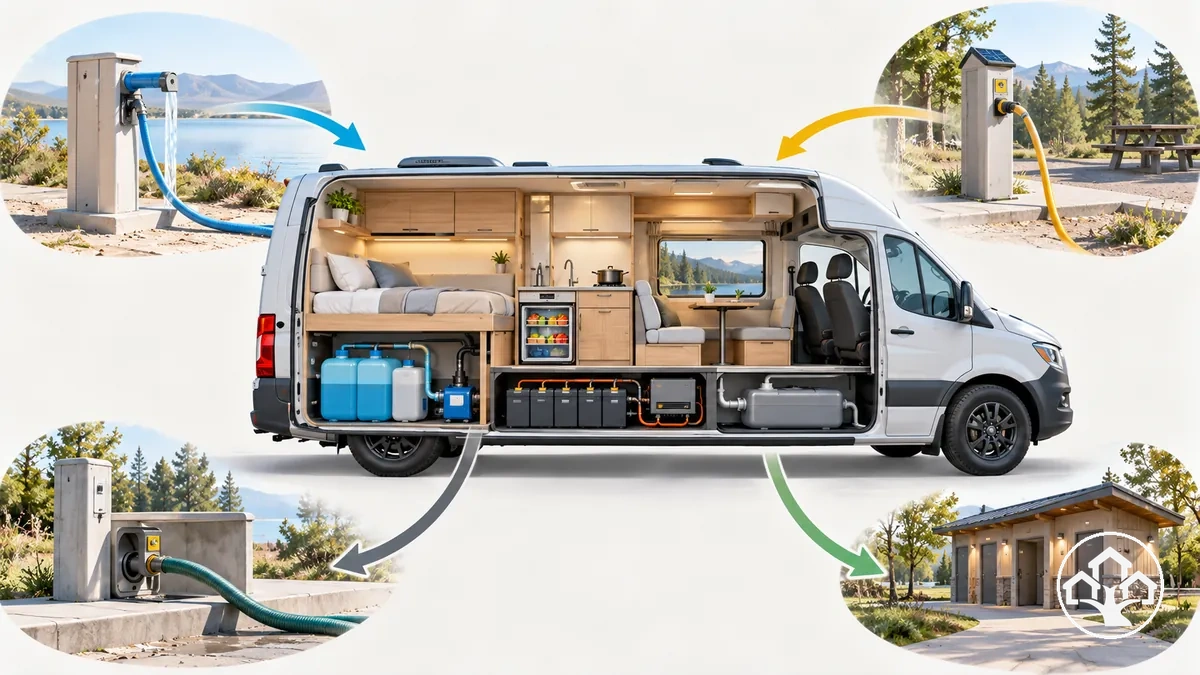
- Find access. Identify suitable water-refill points, charging sources, food shops, hygiene facilities and waste-disposal locations along the intended route or stay.
- Check usable capacity. Available water, stored energy and food limit what can be used; waste tanks and rubbish storage limit what can be held before disposal.
- Track daily use. Drinking, cooking, cleaning and electrical loads deplete supplies, while sanitation and rubbish use up holding capacity.
- Replenish or dispose. Match refill, charging, shopping and disposal opportunities to the rate of use. Longer gaps may require detours, more time or greater onboard capacity.
Greater onboard self-containment can reduce dependence on external facilities, but additional capacity and systems can occupy more space, add weight and create extra energy or maintenance demands.
Greater reliance on external facilities reduces some onboard demands but makes convenience more dependent on where and when those facilities are accessible.
For full-time living to remain practical, the water, power, food, hygiene and waste cycles need to remain workable together under the intended travel and stay pattern.
- Water: water access and storage capacity support drinking, cooking, cleaning and hygiene; consumption determines how quickly stored water is used and how often replenishment is required.
- Power: battery capacity or other power access supports lighting, charging and onboard electrical use; energy demand and charging opportunities determine recharge frequency and practical autonomy.
- Cooking and food storage: cooking access, food-storage capacity and refrigeration where used shape meal preparation and storage; consumption and shopping access determine how frequently food supplies need replenishment.
- Hygiene and toilet: onboard capacity or access to external facilities determines where washing and toilet needs can be met; frequency of use affects how often water, holding capacity or outside facilities must be accessed.
- Waste: rubbish and toilet-related waste require temporary holding capacity and appropriate disposal access; accumulation rate determines disposal frequency and affects convenience, space use and location flexibility.
Water Supply and Storage
Practical water autonomy in a van or RV depends on four linked conditions: water access, storage capacity, consumption and refill opportunity, rather than on one universally suitable tank size.
For a given storage capacity, higher daily consumption shortens the refill interval, while lower consumption or more frequent refill access extends how long the stored supply remains workable.
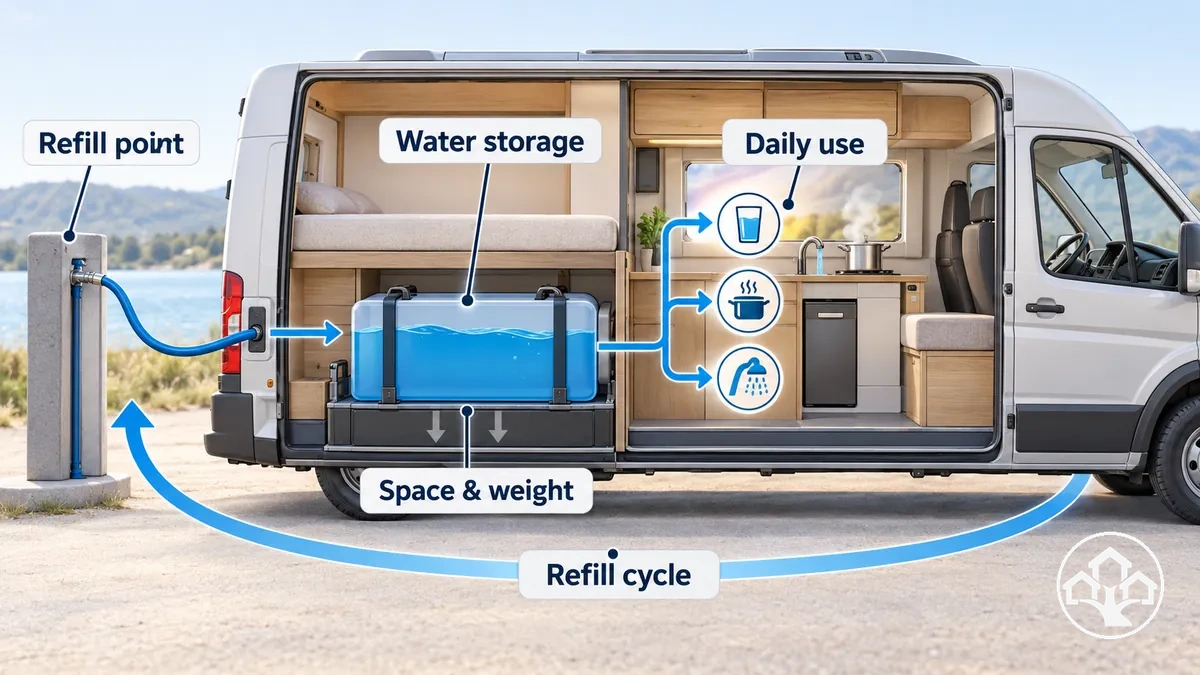 Drinking water, cooking, cleaning and hygiene all draw from the available supply when they rely on stored water.
Approximate refill interval (days) = usable stored water (L) ÷ combined daily water use (L/day). This planning estimate should be checked against actual consumption and the availability of the next suitable refill point; do not assume every planned refill will be accessible.
Greater usable storage can extend the interval between refills under the same consumption pattern, but water adds roughly 1 kg of weight per litre before the tank itself. Extra water therefore uses allowable vehicle payload and interior space that cannot serve another purpose.
Reliable water access along the intended route can make a smaller stored supply practical because replenishment is available before the supply becomes restrictive, whereas limited refill access increases dependence on onboard capacity and can reduce route flexibility.
For example, the same storage capacity may be adequate when reliable refill points are encountered frequently but restrictive when suitable refill access is infrequent or requires a substantial detour.
- Water access: reliable refill points increase replenishment opportunities, while limited availability makes the vehicle more dependent on the water already carried.
- Storage capacity: more usable stored water can support a longer interval between refills under the same consumption pattern, with the trade-off of greater weight and interior-space use.
- Consumption: drinking water, cooking, cleaning and hygiene determine the rate at which stored water is depleted; greater combined use shortens practical autonomy.
- Refill frequency: the interval between refills is determined by usable stored water relative to the occupants' rate of consumption and the availability of the next suitable refill point.
- Practical consequence: when storage and refill access match the actual use pattern, dependence on external facilities is more manageable; when either is insufficient, water needs can constrain location choice and route flexibility.
Power Supply and Charging
Reliable power supply in a van or RV depends on both electrical demand and realistic charging opportunities, not battery capacity alone.
Lighting, refrigeration, ventilation and other devices draw from stored power at rates that change with equipment use and conditions such as climate.
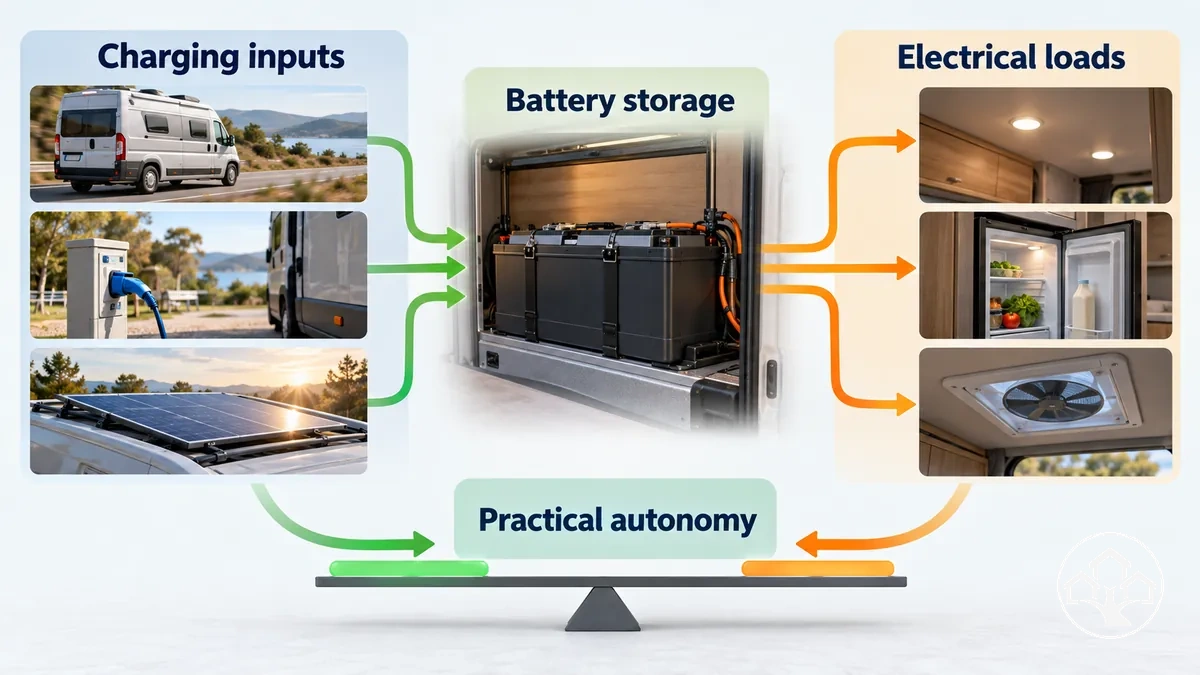 Higher combined demand depletes available stored energy sooner under otherwise similar conditions.
Practical autonomy therefore depends on balancing daily use with the opportunities available to replenish that energy.
Nominal battery capacity is not the same as usable energy delivered to appliances: system limits and conversion losses can reduce what is available. Even substantial storage requires a charging source that fits the actual parking, driving and site-access pattern.
Charging opportunities may include energy obtained while driving, an external electrical connection where available, or solar input where conditions and the vehicle's system support it; none is universally available.
Approximate battery-only autonomy (days) = usable stored energy (Wh) ÷ average daily use (Wh/day), assuming no recharge and a reasonably consistent load. In practice, recharging must keep pace with energy use and the opportunities to restore it.
A system can have substantial nominal capacity yet still provide limited practical autonomy if electrical demand repeatedly exceeds realistic replenishment.
- Electrical demand: the combined use of lighting, refrigeration, ventilation and other devices determines how quickly stored energy is consumed; greater or longer use shortens the interval before charging is needed.
- Battery capacity: greater usable stored energy can support a longer interval between charges under the same demand, but capacity alone does not establish reliable power supply.
- Charging source: practical replenishment depends on which charging opportunities are actually available during driving, parking or site stays, so the usable source can change with the travel pattern and location.
- Recharge frequency: charging must occur often enough to replace energy used between opportunities; when replenishment is less frequent than the demand pattern requires, autonomy decreases and daily device use becomes more constrained.
Cooking and Food Storage
Cooking and food storage in a van or RV are daily housing functions shaped by available kitchen space, the usable energy source, ventilation and food-storage capacity.
The cooking method determines which meals can be prepared within those constraints, while dependable refrigeration or shelf-stable food determines how much food can be kept between shopping trips. Perishable foods that require chilling should not be treated as shelf-stable when power or refrigeration is unreliable.
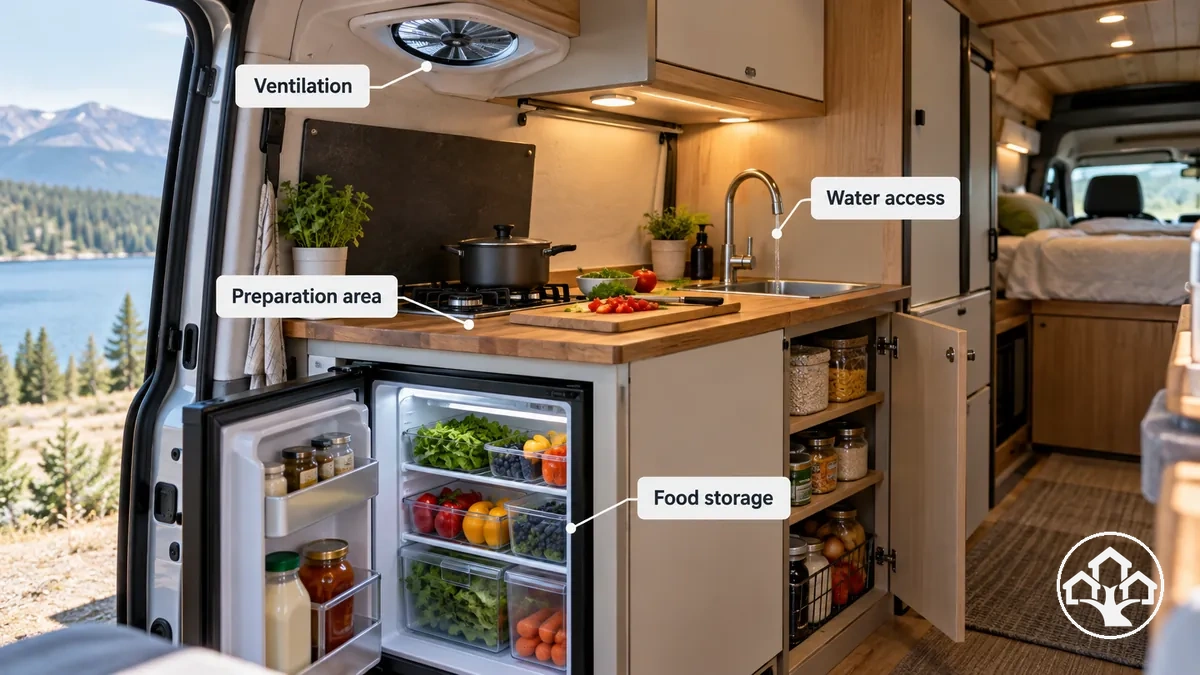 Limited preparation and storage space can narrow meal options or require more frequent restocking.
Water use for preparation and cleaning also forms part of the operating demand created by regular meal preparation.
These constraints affect shopping frequency, dependence on outside food services, food waste, day-to-day food costs and the amount of routine devoted to obtaining, preparing and storing food.
Greater food-storage capacity and dependable refrigeration can reduce the need for frequent shopping under suitable energy conditions, while limited storage increases reliance on shorter restocking cycles or shelf-stable food.
A minimal cooking arrangement uses less kitchen space and places fewer demands on onboard systems but may increase dependence on outside food or frequent shopping, whereas a more self-contained arrangement can support greater independence at the cost of more space, energy and system demands. Use fuel-burning cookers only in the locations and ventilation conditions specified for that equipment; an outdoor-only stove is not safe to use inside a vehicle because of fire and carbon monoxide risks.
- Cooking method: available preparation space and the energy source determine which forms of meal preparation are practical and how much routine depends on outside food services.
- Refrigeration and food storage: refrigeration capacity and space for shelf-stable food determine how much food can be kept onboard and influence shopping frequency.
- Ventilation: the cooking method and amount of indoor meal preparation determine how much ventilation is needed within the limited interior space.
- Water use: cooking, food preparation and cleaning draw on the available water supply, so more intensive meal preparation increases the water that must be replenished and the related waste that must be managed.
- Kitchen space: preparation surfaces, food-storage capacity and access to cooking functions compete for limited interior space, so greater self-containment requires more of that space to be allocated to daily food functions.
Hygiene, Toilet and Waste Management
Hygiene, toilet and waste management are recurring sanitation functions in full-time van or RV living, with practical limits set by hygiene access, the toilet arrangement, available holding capacity and access to appropriate disposal facilities.
Bathing and toilet use create repeated needs for cleaning, waste storage and disposal rather than one-time setup requirements.
Grey water, black water where the toilet arrangement produces it, and rubbish must remain manageable within the available storage or holding limits.
As use increases or holding capacity decreases, disposal frequency increases and can affect convenience, odour control, interior space and location choice.
Facility access determines whether these sanitation needs can be handled mainly onboard or through external facilities, while actual use determines how quickly storage or holding limits are reached.
Limited disposal access can make travel or stopping patterns depend on where each waste type can be handled. Use an appropriate, authorised disposal point for grey water, black water where produced, and rubbish; check the site's rules rather than assuming ordinary drains or bins accept every waste stream.
Onboard facilities can reduce dependence on public or paid facilities but require space and recurring waste management, whereas greater reliance on external facilities reduces onboard capacity demands but can increase schedule dependence and reduce location flexibility.
- Hygiene access: bathing and washing can rely on onboard capacity, external facilities or a combination of both; greater reliance on external facilities makes the hygiene routine more dependent on their availability and access conditions.
- Toilet arrangement: the available toilet arrangement determines whether waste must be held onboard or managed through external facilities; more frequent use reaches a fixed holding limit sooner and increases the required disposal frequency.
- Liquid waste: grey water and, where applicable, black water require sufficient holding capacity until an appropriate disposal opportunity is available; longer intervals between suitable disposal points increase the amount that must be accommodated onboard.
- Rubbish: everyday rubbish requires temporary storage until suitable disposal is available; greater accumulation or longer storage intervals increase space use and make cleanliness and odour control more important.
- Sanitation: cleaning, containment and timely disposal must remain workable together under the actual use pattern; when facility access or holding capacity is restrictive, sanitation needs can influence schedules, stopping locations and overall convenience.
Space, Storage, Privacy and Comfort Constraints
Space constraints in van and RV living come from how the same interior space must support storage, movement, privacy, sleep and everyday comfort.
Usable living volume depends not only on vehicle size but also on layout, because beds, seating, possessions and access routes compete for the same enclosed area.
When one function occupies more space, less remains available for another unless the layout allows the area to serve multiple purposes.
The practical effect is therefore determined by how the available interior volume matches the occupants' actual daily needs.
Occupant count changes these constraints because additional people require more sleeping space, storage capacity, movement room and opportunities for privacy within the same layout.
Climate and time spent inside also change how important the available space becomes: prolonged indoor living increases competition for movement and private space, while temperature comfort depends more heavily on ventilation and the ability to use the interior without blocking airflow or access.
Storage that is sufficient for a limited set of possessions can become restrictive when more belongings must remain accessible, increasing clutter or requiring frequent rearrangement.
The table maps each limited-space attribute to its practical consequence and the conditions that make that constraint more significant.
| Constraint | Conditions that intensify it | Practical consequence |
|---|---|---|
| Storage | More possessions, multiple occupants or limited dedicated storage capacity | Frequently used items compete for accessible space, increasing clutter and the need to move belongings during daily routines. |
| Movement | Narrow circulation areas, fixed furniture, occupied sleeping areas or more people inside at the same time | Routine activities can interfere with one another because access between sleeping, seating, cooking or storage areas becomes more restricted. |
| Privacy | Multiple occupants, shared sleeping and living zones or prolonged periods inside | Opportunities for visual or personal separation decrease, making simultaneous private activities harder to accommodate. |
| Sleep | Shared space, competing evening or morning routines, limited separation from active areas or repeated conversion of living space to sleeping space | Sleep arrangements can become more dependent on coordinated routines and on keeping the sleeping area clear and usable. |
| Comfort and ventilation | Hot or cold climate, prolonged indoor time, multiple occupants or a layout that limits airflow | Temperature comfort and ventilation become more important to daily usability, while restricted airflow or crowded interior space can make extended indoor periods less comfortable. |
The same layout may be workable for one occupant with limited possessions and substantial time spent outdoors but feel more restrictive when multiple occupants need storage, privacy and movement at the same time.
Likewise, fair-weather use can reduce pressure on the compact interior, whereas prolonged indoor living during less favourable climate conditions makes ventilation, usable space and shared routines more consequential.
Maintenance, Repairs and Vehicle Reliability
Maintenance, repairs and vehicle reliability affect both mobility and housing continuity when a van or RV is used as a full-time home.
A mechanical or habitation-system problem can prevent travel, reduce the usability of the living space, or create both consequences at once.
Repair-related downtime can therefore disrupt ordinary routines as well as transport, and a vehicle that cannot remain safely or practically occupied may create a temporary accommodation need.
Reliability is consequently a housing practicality issue rather than only a vehicle-performance issue.
Maintenance demand and exposure to failure are influenced by the vehicle's age, condition, mileage, system complexity and access to suitable service.
These factors do not determine that a failure will occur, but they can affect upkeep requirements and how difficult a repair is to resolve within the normal living routine.
Service access also changes the practical consequence of a fault: a problem that can be assessed and repaired locally may cause limited disruption, while a problem that requires the vehicle to be moved or held out of use can affect both transport and everyday housing functions. Before relying on a particular vehicle as housing, a mechanical and habitation-system inspection can help identify existing faults, but cannot guarantee future reliability.
The main reliability domains differ in function, but each can affect the vehicle's ability to continue serving as both transport and living space.
- Mechanical systems: faults affecting propulsion, steering, braking or other essential vehicle functions can restrict mobility and may require the vehicle to remain out of normal use while repairs are completed.
- Tyres: tyre wear or damage can interrupt travel and create downtime until the affected tyre can be inspected, repaired or replaced, which can also alter where the vehicle can remain during the interruption.
- Seals and weather protection: deterioration or failure around exterior openings can affect protection from weather and the usability of the interior, creating a housing consequence even when the vehicle can still move.
- Plumbing: faults in onboard water or waste-related systems can reduce access to normal living functions and increase dependence on external facilities until the problem is resolved.
- Electrical systems: electrical faults can affect lighting, charging, refrigeration or other habitation functions, with the practical consequence depending on which circuits or systems are unavailable and how quickly service can be obtained.
- Habitation systems: failures involving systems used specifically for living can leave the vehicle mechanically mobile while still reducing comfort or basic residential functionality, so mobility alone does not establish housing reliability.
Routine wear refers to deterioration and upkeep that can often be anticipated within normal maintenance planning, whereas an unexpected failure creates an unplanned repair need with less control over timing or downtime.
Both can create costs and service interruptions, but unexpected failures can produce immediate mobility or housing disruption because the need for repairs is not scheduled around the occupant's routine.
Routine Maintenance and Wear Costs
Routine maintenance and wear costs arise from mileage, elapsed time, weather exposure and continuous residential use, so full-time van or RV living needs a recurring maintenance allowance rather than money only for fuel and parking.
Mileage contributes to wear on mechanical components, tyres and brakes, while time and exposure can affect items such as seals and weatherproofing even when the vehicle is driven less.
Residential use also adds repeated demand to onboard systems that may operate more frequently than they would during occasional recreational trips.
The amount of the maintenance allowance cannot be universal because the relevant service interval, vehicle condition, use pattern and required work differ by vehicle and operating conditions.
Routine maintenance should therefore be planned around the service triggers that apply to the particular vehicle and habitation systems rather than a manufacturer-independent fixed interval.
Delaying an inspection, scheduled service or replacement of a wear item can allow deterioration to continue, which may increase later maintenance needs or reduce reliability, although the consequence depends on the component and its condition.
Planned upkeep covers wear or servicing that can reasonably be anticipated from mileage, time, exposure or use; an unexpected fault that creates an unplanned repair belongs to breakdown risk rather than routine maintenance.
- Mileage-based mechanical service: accumulated mileage and the vehicle's applicable service schedule trigger planned mechanical upkeep; postponing required service can leave wear or deterioration unaddressed, so the expected servicing burden should form part of the maintenance allowance.
- Tyres and brakes: mileage, driving conditions and component wear determine when tyres or braking components require inspection or replacement; greater wear can bring that expense forward and affect reliability if necessary work is delayed.
- Time-based checks: some maintenance needs arise with elapsed time as well as distance travelled, so a low-mileage vehicle can still require scheduled checks or replacement of age-sensitive items according to its applicable service requirements.
- Seals and weatherproofing: time, movement and weather exposure can contribute to deterioration of seals and weather-protection points; delayed attention can allow problems affecting the living space to develop and add to planned upkeep requirements.
- Onboard systems: repeated residential use creates wear on habitation systems such as plumbing and electrical equipment; the maintenance burden depends on system complexity, frequency of use and condition, so these systems also need to be considered within the recurring maintenance allowance.
Unexpected Repairs and Breakdown Risk
An unexpected repair or breakdown can disrupt both transport and housing when a van or RV is the person's full-time home.
A mechanical failure can prevent the vehicle from moving, while a habitation-system failure such as a leak or electrical fault can reduce the usability of the living space even if the vehicle remains mobile.
The immediate consequence can include unplanned repair cost, downtime and interruption of normal living arrangements.
What Changes the Cost and Practicality of Van and RV Living
The cost and practicality of van and RV living change mainly with travel frequency, parking access, campground access, vehicle characteristics, fuel efficiency, climate, occupant count, access to external facilities and the degree of self-containment required.
No single vehicle characteristic determines whether the arrangement is inexpensive or manageable because these operating conditions interact.
The same vehicle can create a relatively low-demand living pattern when movement, paid-site use and facility dependence are limited, but a higher-demand pattern when frequent travel, constrained parking, greater energy needs or repairs are added.
Travel frequency interacts with fuel efficiency because more mileage increases fuel use, while frequent paid campground stays can add site costs even when driving is limited. Check overnight-stay permission and any stay-length limits at the actual locations you intend to use; access and rules vary by site and jurisdiction.
Vehicle age and condition influence maintenance exposure, but age alone does not determine reliability; service history, current condition and service access also affect the practical burden.
Climate, occupant count and available interior space influence ventilation, energy demand, privacy and storage needs, while external facilities determine how much water, sanitation, charging or other capability must be provided onboard.
Self-containment can reduce dependence on outside facilities, but greater onboard capability can also require more space, energy and system complexity, so the practical effect depends on the use pattern.
The table organizes these criteria by conditions that tend to reduce or increase operational burden rather than predicting a fixed outcome.
| Criterion | Lower-demand condition | Higher-demand condition | Practical implication |
|---|---|---|---|
| Travel frequency | Lower mileage and longer stays between moves | Frequent or long-distance travel | More travel generally increases fuel consumption and mileage-related maintenance exposure, while a more stationary pattern reduces those demands. |
| Parking and campground access | Reliable access to suitable low-cost or no-fee places where overnight stays are permitted | Frequent dependence on paid sites or locations with limited suitable parking | Site availability affects both overnight cost and how much planning or relocation is required. |
| Vehicle size, age and condition | Size suited to intended locations and occupants, with known condition and manageable service needs | Size that restricts intended parking or access, or condition that creates greater maintenance and repair exposure | Vehicle characteristics can change manoeuvrability, usable space, service needs and the range of practical stopping locations. |
| Fuel efficiency | Lower fuel use for the required travel distance under comparable conditions | Higher fuel use for the same travel requirement | Fuel efficiency matters most when combined with travel frequency; the same efficiency difference has a larger cost effect as mileage increases. |
| Climate | Conditions that require relatively little heating, cooling or prolonged indoor living | Conditions that increase heating, cooling, ventilation or indoor-time demands | Climate can change energy use, comfort requirements and how heavily the enclosed living space must support daily routines. |
| Occupant count | Occupant needs that fit available sleeping, storage and living space | More occupants competing for the same storage, privacy and movement space | Higher occupant count can increase resource use and make limited interior space more restrictive. |
| External facilities and self-containment | Reliable external facilities combined with onboard capacity that matches actual needs | Scarce external facilities, or self-containment demands that exceed practical space, energy or storage capacity | Greater self-containment can increase independence from external facilities, while greater facility reliance can reduce onboard demands; either approach becomes restrictive when access and capacity do not match the use pattern. |
| Maintenance tolerance and limited-space tolerance | Time, contingency funds and routines that can absorb expected upkeep, occasional downtime and compact living conditions | Limited ability to absorb maintenance disruption, unexpected repair needs or persistent space constraints | Lower maintenance tolerance or limited tolerance for compact living can make the same vehicle and use pattern less practical even when its direct operating costs remain manageable. |
A relatively stationary arrangement with suitable parking access, moderate resource demands and reliable external facilities can produce a different cost and convenience profile from frequent travel that combines paid campground use, greater fuel consumption and more limited service access.
Likewise, greater self-containment may improve independence in one use pattern but create extra space, energy and maintenance demands in another.
These conditions show practical fit within van and RV living rather than establishing whether vehicle-based housing is universally suitable or preferable to other housing alternatives.
Benefits and Trade-Offs of Full-Time Van and RV Living
The main benefits of full-time van and RV living are also tied to corresponding trade-offs, so their value depends on operating conditions rather than the feature alone.
Mobility can create flexibility over where the vehicle is used, but frequent movement can increase fuel use and maintenance exposure.
Greater self-containment can reduce dependence on external facilities, but it also requires space, energy, storage and additional onboard systems.
Practical fit therefore depends on whether each capability remains useful after its limiting conditions are considered.
The shared comparison dimensions include mobility, housing flexibility, potential cost reduction, self-containment, space, maintenance exposure, comfort and service dependence.
Potential cost reduction is most relevant when reduced conventional housing expenses are not offset by frequent paid sites, high fuel use, significant maintenance or other operating demands.
Space and comfort become more restrictive as occupant needs, storage requirements or time spent indoors increase, while reliability becomes more consequential when downtime also removes access to the living space.
Each row therefore pairs a potential benefit with the condition that limits it and the situation in which that trade-off affects practical use.
| Dimension | Potential benefit | Limiting condition | Practical implication |
|---|---|---|---|
| Mobility | The home can move between locations, supporting travel and changes in where the occupant stays. | Frequent or long-distance movement increases fuel use, mileage and exposure to travel-related maintenance. | Mobility has greater value when changing location is important and the added operating demands remain manageable. |
| Housing flexibility | A vehicle-based home can support changes in location without changing the primary living space. | Parking restrictions, limited campground access or dependence on suitable overnight locations can constrain that flexibility. | Flexibility is more practical where suitable stopping locations are consistently available for the intended use pattern. |
| Potential cost reduction | Reducing or avoiding some conventional fixed housing expenses can lower the housing burden under certain conditions. | Paid sites, fuel, maintenance, repairs and other operating costs can offset part or all of that reduction. | The financial benefit depends on the complete operating pattern rather than the absence of conventional rent alone. |
| Self-containment | Onboard water, power, cooking or sanitation capability can reduce service dependence and increase independence from external facilities. | Greater self-containment uses interior space and can increase energy demand, storage requirements and system complexity. | It provides more practical benefit where external facilities are limited and the additional onboard burden remains manageable. |
| Space | A compact living area can reduce the amount of space and possessions that must be managed. | Limited space can restrict storage, movement, privacy and the feasibility of sharing the vehicle with more occupants. | Compact living is easier to accommodate when occupant count, possessions and indoor-space needs fit the available layout. |
| Maintenance exposure | Transport and housing are combined into one mobile asset rather than separate systems. | Mechanical or habitation-system problems can create repair cost and downtime while also disrupting the living arrangement. | The trade-off matters most when service access, contingency funds or alternative shelter are limited. |
| Comfort | The living environment travels with the occupant and can provide familiar sleeping, storage and daily-use functions between locations. | Climate, ventilation demands, limited interior volume and prolonged indoor time can reduce comfort. | The same interior may remain workable in favourable conditions but become restrictive when heating, cooling, ventilation or additional indoor space is needed. |
| Service dependence | Access to campgrounds or other external facilities can reduce the amount of water, power, sanitation and storage capability required onboard. | Reliance on those services creates dependence on their availability, location and access conditions. | External facilities can reduce onboard system burden where access is reliable but can reduce flexibility where suitable services are scarce. |
These trade-offs explain why mobility or lower fixed housing costs can be valuable in one use pattern without producing the same result in another.
A relatively stationary arrangement with suitable low-cost stopping places and reliable external facilities places different demands on the occupant than frequent travel combined with paid sites, greater fuel use and higher maintenance exposure.
Differences between vans and RVs can change how these dimensions are expressed, but the relevant comparison remains conditional on vehicle characteristics and the intended living pattern.
Within the wider range of low-cost housing alternatives, full-time van and RV living is distinctive because housing flexibility is combined with vehicle operation, compact space and recurring resource management.
Its practical fit therefore depends on whether mobility and flexibility are valuable enough under the intended conditions to justify constraints involving space, comfort, maintenance and service dependence.