
How to Start Van or RV Living
To start van or RV living, define the daily routines your vehicle must support, confirm permitted overnight stays and backup locations, and match water, power, wastewater, internet access and interior space to the people using it and the time between services. Test the complete setup in realistic conditions and correct problems before relying on it full time.

Start-up planner
Five decisions before moving into a van or RV
Follow the sequence, then check how your expected access to services and internet needs change the setup priorities.
- Define your daily needs Count occupants and identify sleeping, cooking, washing, storage, work and accessibility needs.
- Verify overnight options Check local permission, physical access, stay limits, services and a viable backup site.
- Match utility capacity Plan water, wastewater, usable energy and required connectivity around actual demand and service gaps.
- Make the space workable Keep sleeping, cooking and work areas usable while protecting exits, ventilation, payload and access.
- Trial, record and adjust Repeat normal routines, record resource use and friction, then change and retest the constraint.
See what changes your setup priorities
Utilities: Choose a service-access pattern to see which capacity and refill constraints deserve attention.
Connectivity: Choose your connectivity need to see when a tested backup matters.
These are planning directions, not universal tank, battery or data-size recommendations. Confirm site permission and use a representative trial to establish actual requirements.
The right configuration depends on occupants, service intervals, climate, travel pattern, work and accessibility. Regular access to facilities may reduce the self-contained capacity needed; longer gaps generally increase it. Start with the routine you will actually use, not a universal vehicle layout.
Table of Contents
Define the Daily Requirements Your Van or RV Setup Must Meet
Define the daily requirements your van or RV setup must meet before committing to equipment or layout decisions.
Separate fixed daily-function needs, such as sleeping and sanitation, from context-dependent needs shaped by climate, service access, work, and travel patterns; the annotated setup shows how those requirements affect sleeping and cooking areas, storage access, utilities, connectivity, and circulation space.
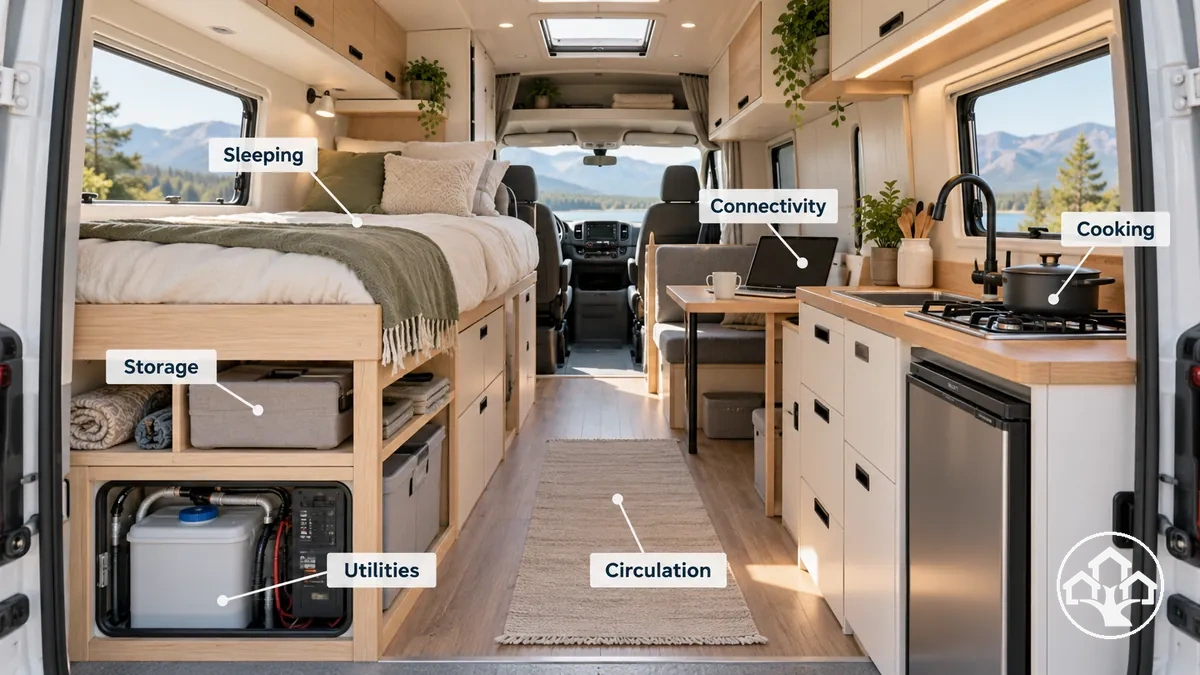
- Occupants: Check how many people will regularly use the space; more occupants increase demand on sleeping space, storage, water, power, sanitation, and shared circulation areas.
- Sleeping: Define who needs a regular sleeping place and whether beds must remain available during the day; frequent bed conversion changes how easily the same area can support other routines.
- Cooking: Consider how often meals will be prepared inside and how much preparation space normal cooking requires; more frequent indoor cooking increases the importance of usable food storage, work surfaces, and access to utilities.
- Sanitation: Identify the washing, toilet, and hygiene routines the occupants expect to maintain; greater dependence on onboard sanitation increases the importance of water, waste-handling capacity, and access to service points.
- Storage: Estimate the belongings, food, work materials, and daily-use items that need accessible storage; carrying more items increases storage demand and makes clear access paths more important.
- Hookups and service intervals: Check how long the setup is expected to operate between water, power, and waste services; longer self-contained periods can increase the capacity or backup needed compared with frequent hookup access.
- Work and connectivity: Identify whether work depends on regular internet access, powered devices, or a dedicated work position; heavier work requirements can increase power, connectivity, and usable-space demands.
- Climate: Consider the temperatures and weather conditions in which the vehicle will normally be used; greater heat, cold, or weather exposure can change ventilation, temperature-control, power, and storage requirements.
- Mobility and accessibility: Check whether occupants need wider circulation space, easier entry, fewer conversions, or more reachable storage and controls; those needs can change the workable layout and reduce the space available for competing functions.
Fixed daily-function needs come from the occupants and their normal sleeping, cooking, sanitation, and storage routines, while context-dependent requirements change with service intervals, climate, work connectivity, mobility, and accessibility.
Longer periods between hookups place more demand on onboard water, power, waste handling, and backup capacity, whereas frequent service access can reduce that level of self-containment.
Mobility or accessibility constraints can also shift layout priorities toward clear circulation, easier reach, and fewer required conversions.
For example, a solo occupant using hookups frequently may place less demand on onboard capacity than two occupants spending longer periods between service points, while remote work can increase the importance of connectivity, device power, and a usable work position.
As daily demand rises or the time between services increases, the required capacity, redundancy, or usable space can increase with it.
Detailed budgeting and vehicle-category trade-offs remain outside these setup criteria.
Plan Where You Will Park and Stay Overnight
Plan each overnight stay before relying on it because parking conditions determine how often the van or RV must move, which services are available, and how self-contained the setup needs to be.
Check permission, stay limits, site access, hookups, mobile coverage, and a backup option for the places you are realistically likely to use.

Private sites, campgrounds, and public areas can operate under different rules and access conditions. Permission to park does not automatically mean permission to stay overnight, so verify the specific location and intended use rather than assuming one rule applies everywhere.
Stay duration may depend on the property, campground conditions, or local jurisdiction, while vehicle dimensions and access hours can determine whether the site is physically usable.
Confirm those constraints before treating a location as part of the routine.
- Identify likely stay types: List the kinds of places you expect to use, such as private sites, campgrounds, or permitted public areas, and estimate how long each overnight stay needs to support your routine.
- Verify permission and stay limits: Check the current rules or property conditions for the specific location, including whether overnight parking is permitted and whether arrival, departure, or stay-duration restrictions apply.
- Confirm physical site access: Check vehicle dimensions against entrances, parking space, turning room, surface conditions, access hours, and weather exposure so the van or RV can realistically enter, remain, and leave the site.
- Confirm services and connectivity: Determine whether the location provides hookups, water, waste facilities, power, and usable mobile coverage; fewer available services increase reliance on onboard capacity and self-contained operation.
- Identify a backup option: Plan another overnight location whose current permission and access can be verified in case weather, booking availability, site restrictions, or service conditions make the intended stop unusable.
- Verify the required self-containment: Compare the expected stay duration with the services available at the location; longer periods without hookups, water, waste facilities, or power require the setup to support more of those needs between service points.
Service availability, communications coverage, weather exposure, and distance from daily services determine how dependent an overnight routine is on the surrounding site.
A mostly serviced routine can rely more often on hookups and nearby facilities, while frequent stays away from services place greater importance on onboard water, power, waste capacity, and reliable mobile coverage where work or communication depends on it.
Backup locations also reduce reliance on a single site whose conditions or availability may change.
Before relying on any place to stay, verify its current permission, physical access, available services, communications coverage, and the conditions that apply to the intended stay.
That final check shows whether the planned overnight location supports the routine or whether the van or RV needs greater self-containment or a different backup option.
Set Up Water, Power and Essential Utilities
Set up water, power, waste handling, and connectivity around normal demand and realistic opportunities to refill, recharge, connect, or dispose.
Each utility needs enough capacity to cover the expected service interval, because running out of water or power, losing required connectivity, or reaching waste capacity can interrupt normal daily routines until the system can be replenished or serviced.
The illustration shows these essential van or RV utility systems as connected parts of the same daily-use setup.

What changes utility capacity and backup needs?
- Number of occupants
- More people commonly increase daily water use, wastewater volume and electrical demand.
- Time between service points
- Longer gaps increase reliance on stored water, usable energy and waste capacity; regular hookups can shorten the self-contained interval.
- Climate and critical tasks
- Heat or cold can change consumption and electrical loads, while device charging and work-critical connectivity can raise the consequences of an interruption.
Size and backup decisions should reflect the actual routine and available recovery options, not one assumed capacity for every vehicle.
Essential utilities are the systems needed to support the intended daily routine; convenience upgrades are optional features that do not determine whether basic water, power, waste handling, or required connectivity needs can be met.
The practical objective is not to install the largest systems that can physically fit, but to match demand, capacity, and replenishment or recovery opportunities so the setup remains workable between expected service points.
The detailed configuration of each utility can then be based on its own use pattern, service access, and operating conditions.
Set Up Fresh Water and Wastewater Handling
A workable fresh-water and wastewater routine must protect potable-water quality from filling through daily use and provide a lawful disposal path for wastewater.
Treat the process as a repeating sequence of safe sourcing, filling, storage, use, monitoring, refill, and disposal, with black-water handling included only when the van or RV configuration produces or stores black water.
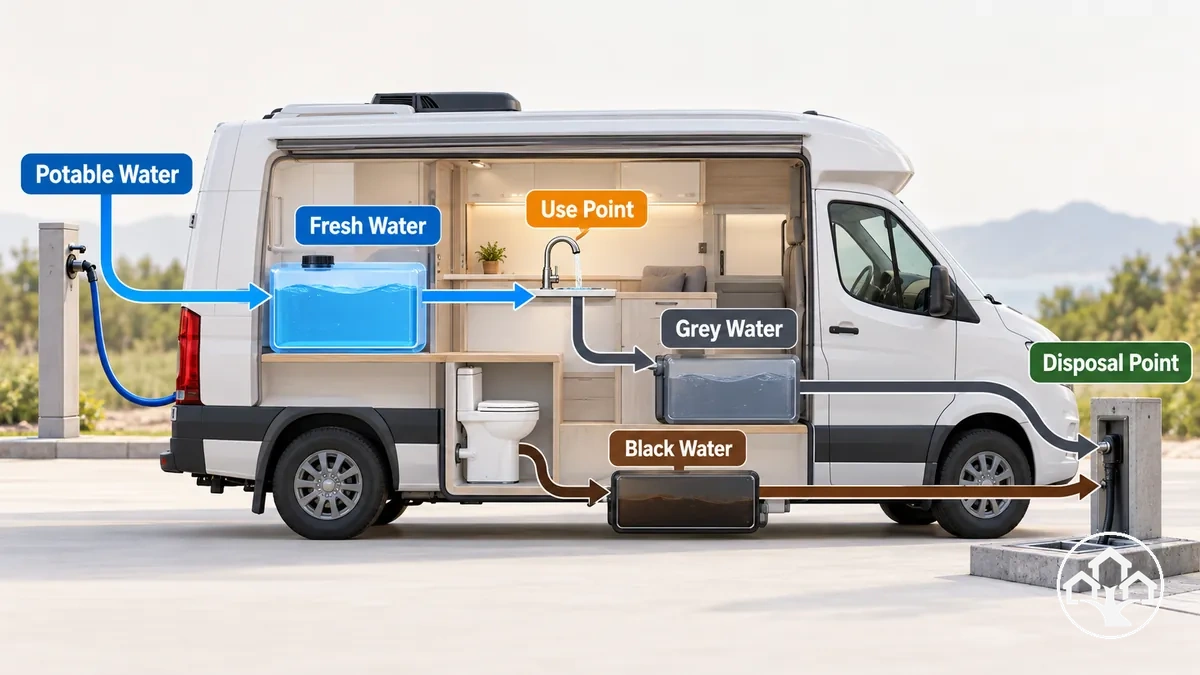
- Verify the water source: Use a source identified as potable water for drinking and food preparation; if the quality of an untreated source is not established, do not assume it is suitable for those uses and verify the appropriate treatment or use before filling.
- Fill without contaminating the supply: Keep the filling method and fresh-water connection suitable for potable-water use, and check that the tank or container receiving the water is intended for fresh water before filling.
- Store and dispense fresh water: Match the tank, container, or delivery configuration to the vehicle and routine, including any filtration appropriate to the source and intended use. Temperature conditions can also affect how water storage and delivery need to be managed.
- Monitor daily consumption: Track the remaining fresh water and accumulating wastewater against normal daily consumption; higher use by occupants shortens the interval before a refill or disposal point is needed for the same available capacity.
- Plan the next refill: Compare remaining fresh-water capacity with the expected time until the next suitable water source. Longer periods between service points require enough stored water for the intended routine rather than reliance on an assumed universal tank size.
- Handle grey water: Direct grey water into the setup's intended collection or handling path and use a disposal method permitted for that waste stream at the current location rather than assuming discharge is acceptable everywhere.
- Handle black water where applicable: If the setup has a toilet system that stores black water, monitor that waste separately and use an appropriate authorised disposal or service point. A setup without a black-water tank does not follow the same storage routine, but any toilet waste still needs handling according to the system used and the applicable disposal conditions.
As an initial planning check, estimated days until fresh-water refill = usable stored litres ÷ observed litres used per day. Measure normal use rather than assuming one allowance for every occupant; tank configuration, the delivery method and access to the next safe refill point also matter.
Fresh-water endurance is not the same as the complete service interval: wastewater capacity or lawful disposal access may become the earlier constraint. Higher daily consumption or fewer service opportunities shorten the margin even when tank capacity stays the same.
Filtration, temperature exposure, and the way water is stored or delivered are configuration-dependent, so they should be matched to the actual source and operating conditions rather than treated as universal requirements.
A van or RV using serviced sites frequently can refill fresh water and dispose of wastewater more often, so its routine may depend less on extended onboard capacity.
Spending several days between service points increases the importance of matching fresh-water storage, wastewater capacity, refill timing, and lawful disposal access to normal use.
The practical goal is a repeatable sanitation routine whose service intervals fit the occupants, configuration, environment, and expected access to water and disposal points.
Set Up Power Storage, Charging and Daily Energy Use
Size a van or RV electrical system from actual daily energy demand and realistic opportunities to recharge it, not from a generic battery or solar recommendation.
Start with the loads that will run, how often they operate, and whether they are direct 12-volt loads or inverter-dependent loads, then relate that demand to usable battery capacity and available charging sources.
The diagram shows the flow between solar, alternator charging, shore power, battery storage, and daily loads rather than a universal wiring plan.
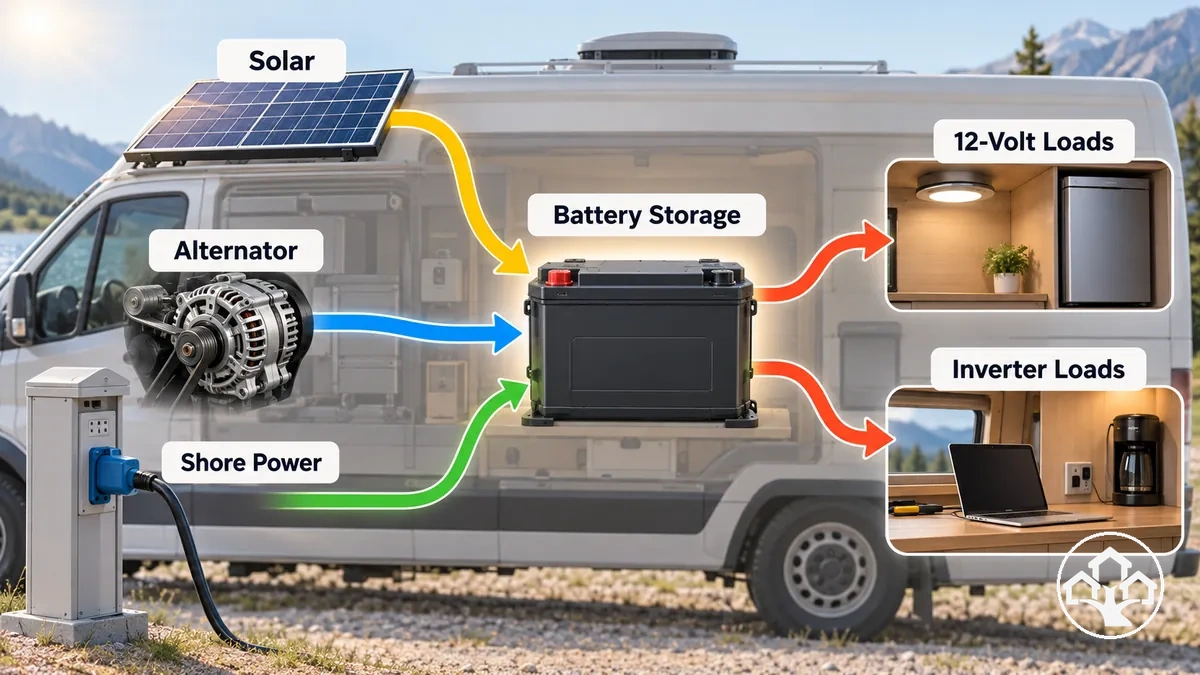
| Load Category | Typical Use Pattern | Demand Implication | Charging or Recovery Source |
|---|---|---|---|
| 12-volt loads | Regular or recurring use throughout the day | Energy demand accumulates with operating time and reduces available battery storage between charging opportunities. | Solar when available, alternator charging while driving where the system supports it, or shore power when connected. |
| Inverter-dependent loads | Intermittent use of equipment that requires inverter-supplied power | The inverter adds conversion losses, so these loads draw more stored energy than the useful energy delivered to the appliance. | Battery storage is replenished through the charging sources available to the particular setup. |
| High-draw loads | Shorter periods of comparatively heavy electrical use | Even brief operation can materially increase daily energy demand and shorten runtime when compared with a routine dominated by lower-draw loads. | Recovery depends on sufficient solar input, alternator charging, shore power, or a combination available before the next high-demand period. |
| Work and communications loads | Repeated charging or extended operation when connectivity and powered devices are part of the routine | Longer operating periods increase total daily demand and can increase the usable battery capacity or recharge frequency needed. | Solar, alternator charging, or shore power according to availability and the vehicle's charging configuration. |
For an initial daily energy budget, multiply each appliance’s power in watts (W) by hours used per day to estimate watt-hours (Wh), then add the individual demands. Use measured consumption where loads vary; include inverter and charging losses when comparing the total with usable battery energy and realistic recharge opportunities. Leave a reserve for changes in use or charging performance.
Solar recovery depends on available solar input, alternator charging depends on driving and the installed charging arrangement, and shore power is available only when a suitable connection is accessible.
Charging losses reduce the amount of input energy that becomes stored energy, so the power plan should account for those losses rather than treating charging input and recovered battery energy as identical.
Reserve margin and recharge frequency therefore depend on the actual load pattern, charging availability, and operating conditions rather than one universal battery size.
A routine built mainly around lower-draw 12-volt loads can require a different storage and recovery plan from one that adds an inverter-dependent, high-draw appliance even for relatively short periods, because the latter can materially increase daily energy demand.
Protective devices and installation details should match the specific electrical system and the requirements that apply to the vehicle and location; work requiring electrical expertise should be handled by appropriately qualified people rather than treated as a generic DIY procedure.
Verify the plan against measured daily use and realistic recharge opportunities before relying on the expected runtime.
Set Up Internet and Connectivity for Daily Use
Choose a van or RV connectivity setup by matching the connection strategy to expected coverage, data demand, required uptime, and available power.
No single connection method should be assumed to provide the same reliability everywhere because availability and performance vary by location and operating conditions.
The more important continuous access is to work or essential communication, the more important a practical backup becomes.
Mobile data depends on usable network coverage at the location, while campground or public Wi-Fi depends on an accessible network and its operating conditions.
Signal-improvement options may help where they are lawful, appropriate, and able to work with an existing usable signal, while satellite connectivity depends on service availability, suitable operating conditions, and additional equipment and power draw.
These connection methods should therefore be evaluated by the tasks they must support rather than treated as interchangeable sources of internet access.
- Coverage: Check which connection methods are usable in the locations you expect to visit; limited local coverage or network access can make an otherwise convenient method unsuitable for the intended routine.
- Data demand: Match the connection to the activities it must support; basic browsing, messaging, and navigation generally place different demands on the connection than frequent streaming or video calls.
- Power draw and setup: Consider the power required by the chosen equipment and whether installation, positioning, and normal use are practical for the vehicle.
- Reliability: If the connection supports remote work, scheduled calls, or essential communication, assess how consistently each method remains usable under the expected location and coverage conditions rather than focusing only on peak speed.
- Uptime: Frequent video calls or other time-sensitive work can require a connection strategy that remains available when one access method becomes weak or unavailable; lighter personal use may tolerate interruptions more easily.
- Backup: Use a second connection method when the consequence of losing connectivity justifies redundancy. A backup might combine mobile data with available Wi-Fi or satellite connectivity, depending on coverage, service access, power draw, and the locations in which the vehicle is used.
A remote worker who depends on frequent video calls has a higher uptime requirement than someone using the internet mainly for occasional messaging, navigation, and basic browsing, so redundancy can matter more than maximum connection speed.
The appropriate setup therefore depends on where the vehicle will be used, how much data the routine requires, how serious an interruption would be, and which backup connection can realistically operate under those conditions. A backup is useful only if it remains usable when the primary connection fails; test the actual coverage, access and power requirements rather than assuming a second device guarantees continuity.
Organise the Interior for Daily Living
Organise the van or RV interior layout around the daily routine, clear movement paths, ventilation, emergency access, and access to essential systems rather than appearance alone.
The layout should allow occupants to move between sleeping, cooking, washing, working, and entry areas without repeatedly blocking doors, hatches, vents, or service access.
Frequently used items and fixed equipment should support those repeated actions while keeping required exits and access points unobstructed.
Four constraints to check in the layout
- Movement and opening clearance
- Usable floor area, standing or seated room, and fully opened doors or hatches determine where furniture can go without blocking passage.
- Ventilation and emergency access
- Keep required ventilation paths usable for activities such as cooking and sleeping, and ensure emergency exits remain unobstructed in normal living mode.
- Load placement
- Place heavier belongings and fixed equipment within the vehicle’s permitted load and distribution limits; available space alone does not establish safe placement.
- Maintenance and conversion effort
- Keep cleaning and service access practical, and limit repeated rearrangement when changing between sleeping, cooking and work.
Test the interior organisation by walking through one ordinary day: wake and clear the sleeping area, prepare food, move into a working position, wash, pack away daily items, and return the space to a sleeping configuration.
During that routine, note whether any movement path becomes blocked, ventilation or emergency access is obstructed, service panels become unreachable, or one activity requires unnecessary unloading before another can begin.
Repeated rearrangement, awkward clearance, inaccessible equipment, or excessive conversion time indicates a layout conflict that should be adjusted before decorative choices are prioritised.
Create Functional Areas for Sleeping, Cooking and Work
Create the sleeping area, cooking area, and work area so each has enough usable space, access, ventilation, and setup time for normal daily use without creating unsafe or excessive conflicts with the other activities.
A fixed zone is not required in every van or RV, but each activity needs a workable surface or position, clear access when in use, and a level of conversion effort that fits the daily routine.
- Sleeping area: Choose a bed size that provides usable sleeping space and clearance for the occupants to enter or leave the bed without blocking essential access. If the bed shares space with seating or another activity zone, frequent conversion can increase daily setup effort and limit when that space is available for other uses.
- Cooking area: Provide a stable cooking surface, suitable ventilation, and practical access to food and utensils while the area is in use. The main conflict is with a shared surface or movement space, because cooking can temporarily restrict another activity and requires ventilation and access to remain usable during preparation.
- Work area: Provide seating and a work surface that support a workable posture, with appropriate lighting and access to device charging where required. If the work area uses the same surface as eating, cooking preparation, or another activity, repeated clearing and resetting can make the arrangement impractical for frequent or longer work sessions.
A shared surface can reduce the amount of dedicated space needed, but its usefulness depends on conversion effort and how often competing activities occur.
A table that changes from a work surface to a dining or preparation surface may support several functions efficiently when items can be cleared quickly, while a surface that requires repeated unloading, bed conversion, or disconnection of charging equipment can become a daily burden.
The better arrangement is the one that keeps ventilation, posture, lighting, charging, and access workable while limiting unnecessary setup between repeated activities.
Organise Storage Around Access and Daily Use
Organise van or RV storage by access frequency, weight, safety, contamination risk, and the order in which items are needed.
Frequently used belongings should be easy to reach, while heavy items, wet items, emergency equipment, and condition-sensitive gear need placement that accounts for restraint, payload, separation, and unobstructed service access.
Exact storage placement depends on the vehicle layout and its actual load limits rather than a universal arrangement.
- Daily-access items: Place frequently used food, clothing, and routine-use items where they can be reached directly without unloading unrelated belongings. Poor access increases repeated handling and makes ordinary daily tasks slower or more disruptive.
- Occasional-use items: Store tools, seasonal clothing, and outdoor gear in less immediate locations when they are not needed during normal daily routines. Giving these items prime access can displace belongings that are used more often and increase retrieval friction.
- Heavy items: Keep heavy objects low where the vehicle configuration permits, restrain them securely, and account for the vehicle's payload and load distribution. Poor restraint or unsuitable placement can allow loads to shift and can concentrate weight where the vehicle is not intended to carry it.
- Wet or dirty items: Separate wet items, muddy footwear, and dirty outdoor gear from food, clean clothing, and other contamination-sensitive belongings, with ventilation where the storage condition requires it. Mixing these categories can transfer moisture or dirt and make cleaning and drying more difficult.
- Emergency equipment: Keep emergency equipment reachable without moving unrelated storage, and do not allow stored items to obstruct exits, vents, utilities, inspection points, or service access. Safety-critical equipment loses practical value if it cannot be reached quickly when the surrounding storage is packed.
Storage should also remain restrained and usable within the vehicle's payload limits, with vents, exits, utilities, inspection points, and service panels left accessible.
Placement that works while parked may still need adjustment if items cannot be secured for travel or if routine loading blocks essential access.
On arrival, items such as frequently used food, clothing, wet-weather gear, or emergency equipment should be reachable without first unloading tools or occasional-use belongings; the same principle applies before departure when travel-critical items need to be accessed and restrained efficiently.
Test the Setup Before Living in It Full Time
Use a realistic trial period to verify that the complete van or RV setup works under normal use before depending on it full time.
The trial should reproduce the routines, locations, service intervals, and living conditions that matter to the intended lifestyle rather than merely confirm that individual equipment switches on.
There is no universal trial length; it should be long and representative enough to repeat the important routines and reveal problems that may not appear during a brief equipment check.
A functioning setup allows normal routines to be completed without unsafe workarounds, excessive rearrangement, unexpected resource depletion, or repeated dependence on facilities that will not normally be available.
A revise condition appears when overnight comfort, sanitation, site setup, utility endurance, temperature control, connectivity, packing, or departure repeatedly creates friction under representative conditions.
The checklist therefore verifies observable behaviour and consequences rather than assigning a score or requiring a perfect pass.
- Daily routines: Complete a representative day of waking, preparing food, working or carrying out normal daytime activities, washing, packing away items, and preparing for sleep; repeated workarounds or unnecessary rearrangement indicate that the setup needs adjustment.
- Overnight comfort: Sleep in the vehicle under conditions similar to those expected during normal use and check whether the sleeping arrangement, ventilation, noise, temperature, and access remain workable through the night.
- Cooking: Prepare normal meals using the intended cooking area and routine; revise the setup if food preparation repeatedly obstructs access, ventilation, another essential activity, or practical cleanup.
- Sanitation: Follow the intended washing, toilet, and hygiene routine and verify that it remains usable between the service opportunities expected during normal travel or parking patterns.
- Parking or site setup: Arrive at a representative overnight location and complete the normal parking, levelling where relevant, access, and setup routine; repeated dependence on unavailable space, services, or difficult workarounds indicates a mismatch with the intended use.
- Utility endurance: Observe whether water, power, and waste capacity support the expected interval between refill, recharge, and disposal opportunities; earlier-than-expected depletion indicates that demand, capacity, or the service routine requires revision.
- Temperature control: Use the setup during representative weather conditions and check whether ventilation and available temperature-control measures keep the living routine workable without creating conflicts with power use, sleeping, or other essential functions.
- Connectivity: Test the internet and communication tasks that matter to normal use, such as work calls, navigation, messaging, or browsing; repeated loss of required uptime indicates that the primary connection or backup strategy needs adjustment.
- Packing and access: Store and retrieve the belongings used during the trial and verify that frequently needed items, emergency equipment, and service points remain accessible without unloading unrelated belongings.
- Departure: Return the vehicle to its travel-ready configuration and leave the site using the normal routine; excessive conversion time, unsecured items, forgotten setup tasks, or repeated repacking reveal friction that should be corrected before full-time use.
Record friction points and resource use during the trial instead of relying on memory after it ends.
Note which routines required extra rearrangement, which resources depleted sooner than expected, which facilities were unexpectedly necessary, and which parts of the setup repeatedly interrupted normal use.
Adjust the setup in response to those observations and retest the affected routines so readiness decisions are based on observed behaviour rather than assumptions.
Test Water, Power and Connectivity Under Normal Use
Test water, power, and connectivity under representative daily demand and recovery conditions rather than checking each system only at idle.
Record the starting state, normal consumption, remaining capacity, recovery interval, any failure point, and available backup so the trial measures utility endurance and recovery under the conditions the van or RV is expected to face.
- Fresh water: Record the starting water level, normal water use, the remaining supply after representative routines, and the refill interval that results. Water depletion before the next realistic refill opportunity indicates either a capacity shortfall or a routine that uses more water than the intended service interval can support.
- Wastewater: Track the starting wastewater state, accumulation during normal use, remaining capacity, and the time until the next suitable disposal opportunity. Reaching capacity earlier than expected may reflect insufficient wastewater capacity, heavier-than-expected use, or disposal timing that does not match the normal routine.
- Battery state: Record the battery state before normal electrical use, observe the change after representative loads, and note the remaining usable capacity before recharging. A larger-than-expected decline suggests that actual demand, operating time, or available storage differs from the assumptions used for the routine.
- High-draw loads: Use high-draw loads in the way they would normally be used and observe their effect on battery state and available runtime. A sharp change during these loads may reflect their contribution to demand rather than prove that total battery capacity is inadequate.
- Recharge recovery: Record the battery state before charging, the available charging source, and how far the system recovers during a realistic charging opportunity. Incomplete recharge recovery before the next normal use period may indicate limited charging opportunity, higher demand, charging losses, or insufficient recovery capacity.
- Mobile or Wi-Fi coverage: Test mobile coverage and available Wi-Fi in representative parking and travel locations, recording where each connection supports the required tasks and where coverage or access becomes weak or unavailable. Connection loss may reflect location, network availability, or operating conditions rather than a fault in the connectivity setup.
- Data use: Observe data use during representative activities such as work calls, streaming, navigation, messaging, or browsing and compare it with the access available during the trial. Higher-than-expected data use can reveal a mismatch between the normal routine and the available connection or plan conditions without establishing a universal data requirement.
- Backup connectivity: When continuous access is important, test whether the intended backup connectivity can be activated and used when the primary connection is unavailable or unsuitable. A backup that cannot operate under the same location, power, or coverage conditions may not provide the redundancy required by that routine.
Interpret the results by separating a true capacity shortfall from an operational or timing problem.
Repeated water depletion despite realistic refill timing, inadequate battery recharge recovery despite suitable charging opportunities, or persistent loss of required connectivity across representative locations may indicate that available capacity or connection options do not match normal demand; the same symptoms may instead reflect unnecessary power use, delayed refilling, unsuitable charging timing, excessive data use, or reliance on weak coverage.
Record the observed resource use, recovery intervals, failure points, and backup performance, then adjust the routine or capacity only where those observations support the change.
Adjust the Layout and Routines After the Trial
Adjust the layout and routine by responding to an observed problem from the trial with one targeted change, then retest before keeping it.
Start with recurring friction that affects normal use, such as poor storage access, repeated furniture conversion, sleep comfort, ventilation, water or battery capacity, connectivity reliability, or excessive setup and pack-down effort.
Changing one variable at a time makes it easier to relate the adjustment to the later result.
- Observe the baseline: Record the recurring problem under normal use, including the routine in which it occurs and its practical effect. Proceed when the issue can be described from repeated or clearly observed trial behaviour rather than an assumption or rare edge case.
- Isolate the likely constraint: Identify the most plausible limiting factor, such as placement, conversion effort, ventilation, available space, capacity, or routine timing. Use the trial observations to separate that constraint from unrelated variables before changing the setup.
- Make one adjustment: Change one relevant variable, such as item placement, activity order, conversion sequence, or use pattern, only when it directly addresses the isolated constraint. Record the change and its implication for space, weight, capacity, or access so the later result can be compared with the baseline.
- Retest the affected routine: Repeat the same normal-use condition that revealed the problem and compare the new behaviour with the baseline. The retest should show whether friction, effort, comfort, depletion, connectivity reliability, or access meaningfully changed under comparable conditions.
- Retain or revert: Keep the adjustment when the observed result improves the targeted routine without creating a more important conflict elsewhere. Revert or revise it when the result does not improve the original problem, introduces new friction, or shifts the constraint rather than resolving it.
The result of a retest should be interpreted in relation to the original constraint rather than treated as proof that the whole setup is improved.
A storage change that shortens access time may still be unsuitable if it reduces usable space or affects weight placement, while a routine change that reduces battery depletion may indicate that behaviour rather than additional capacity was the limiting factor.
Continue the iteration only when the evidence identifies another recurring constraint worth testing.
- Observed constraint
- Preparing the bed requires unloading belongings from a shared surface every evening, creating repeated conversion effort.
- One targeted adjustment
- Move those regularly displaced belongings into accessible storage without compromising weight placement or other essential access.
- Repeat the same routine
- If bedtime now works without the unloading step and no important access is lost, keep the change. If friction remains or a new conflict appears, refine or revert it instead of automatically adding equipment.
Common Beginner Mistakes When Starting Van or RV Living
A common beginner mistake in van or RV living is building around untested assumptions about daily routines, overnight locations, utility capacity, storage access, connectivity or recurring costs. These mismatches often emerge when the same routines are repeated under realistic conditions.
Use each recognition cue to identify whether the problem is an assumption, capacity, access or verification gap. Then correct the specific constraint behind it rather than changing unrelated parts of the setup.
Common warning signs and the matching correction
-
Assumption error — starting without defined daily requirements
- Mistake
- Building the setup before identifying the sleeping, cooking, sanitation, work, storage, and service needs that normal use must support.
- Consequence
- The layout or utility capacity can conflict with repeated routines.
- Recognition cue
- Normal activities regularly require improvised workarounds, unavailable space, or repeated rearrangement.
- Corrective direction
- Recheck the actual daily requirements revealed by use and adjust the mismatched part of the setup rather than adding features without a defined need.
-
Assumption error — assuming overnight locations will be available
- Mistake
- Treating intended overnight locations as dependable without accounting for permission, availability, access conditions, services, or a backup.
- Consequence
- The routine can become dependent on a site that is unavailable or unsuitable when needed.
- Recognition cue
- Repeated last-minute location changes, unexpected service gaps, or difficulty finding a usable overnight option reveal the assumption.
- Corrective direction
- Verify realistic overnight options and maintain an appropriate backup rather than relying on one expected location.
-
Capacity error — underestimating water demand
- Mistake
- Planning fresh-water and wastewater capacity around assumed consumption instead of observed normal use and realistic service intervals.
- Consequence
- Fresh water can deplete or wastewater capacity can be reached before the next expected refill or disposal opportunity.
- Recognition cue
- The trial repeatedly requires earlier refilling or disposal than the intended routine allows.
- Corrective direction
- Compare observed water use with the refill interval and adjust consumption, service timing, or capacity according to the measured constraint.
-
Capacity error — underestimating power demand
- Mistake
- Assuming battery capacity and charging opportunities will support the routine without testing representative electrical loads.
- Consequence
- Battery state can fall faster than expected or recharge recovery can be insufficient before the next use period.
- Recognition cue
- High-draw loads, longer device use, or limited charging opportunities repeatedly leave less remaining capacity than the routine requires.
- Corrective direction
- Use observed demand and recharge recovery to determine whether the issue is unnecessary power use, charging timing, or a genuine capacity mismatch.
-
Access and weight error — overpacking or placing heavy items poorly
- Mistake
- Adding belongings without considering payload, restraint, weight placement, and retrieval order.
- Consequence
- Heavy items can be difficult to restrain appropriately, usable space can shrink, and routine access can become inefficient.
- Recognition cue
- Repacking becomes frequent, heavy objects occupy unsuitable positions, or the intended storage arrangement conflicts with the vehicle's actual payload and load distribution.
- Corrective direction
- Reduce unnecessary load where needed and place heavy items according to the vehicle configuration, payload limits, and restraint requirements.
-
Access error — allowing storage to block essential access
- Mistake
- Using available space for storage without preserving access to exits, vents, utilities, inspection points, emergency equipment, or frequently used belongings.
- Consequence
- Normal use or servicing requires unloading unrelated items, and safety-critical access can be obstructed.
- Recognition cue
- Opening a service point, reaching emergency equipment, or completing a routine repeatedly requires moving stored belongings first.
- Corrective direction
- Reposition storage so essential and frequently used access remains unobstructed during normal use.
-
Verification error — relying on one connectivity method when uptime matters
- Mistake
- Assuming one mobile, Wi-Fi, or other connection will remain usable across all intended locations.
- Consequence
- Work or essential communication can be interrupted when coverage or access conditions change.
- Recognition cue
- Representative locations repeatedly produce periods when the primary connection cannot support the required task.
- Corrective direction
- Where uptime is important, test backup connectivity under the same location and power conditions instead of assuming the primary method will remain available.
-
Verification and cost oversight — skipping a realistic trial or ignoring recurring costs
- Mistake
- Depending on the setup before testing normal routines and before recording repeated site, utility, maintenance, communication, or operating expenses.
- Consequence
- Practical friction and recurring costs can remain hidden until they become part of full-time use.
- Recognition cue
- Problems first appear only after dependence begins, or repeated expenses were absent from the original assumptions.
- Corrective direction
- Run a representative trial, record recurring friction and resource use, and plan the ongoing housing budget from observed costs rather than one-time setup assumptions.
Corrections should reconnect each recognition cue to the earlier setup criteria that govern daily requirements, overnight access, utility endurance, storage, connectivity, and trial evidence.
A recurring problem is useful evidence only when it can be traced to a specific assumption, capacity limit, access conflict, or verification gap.
Address that identified condition without reopening the entire setup process unless normal-use evidence shows that the broader configuration is mismatched.